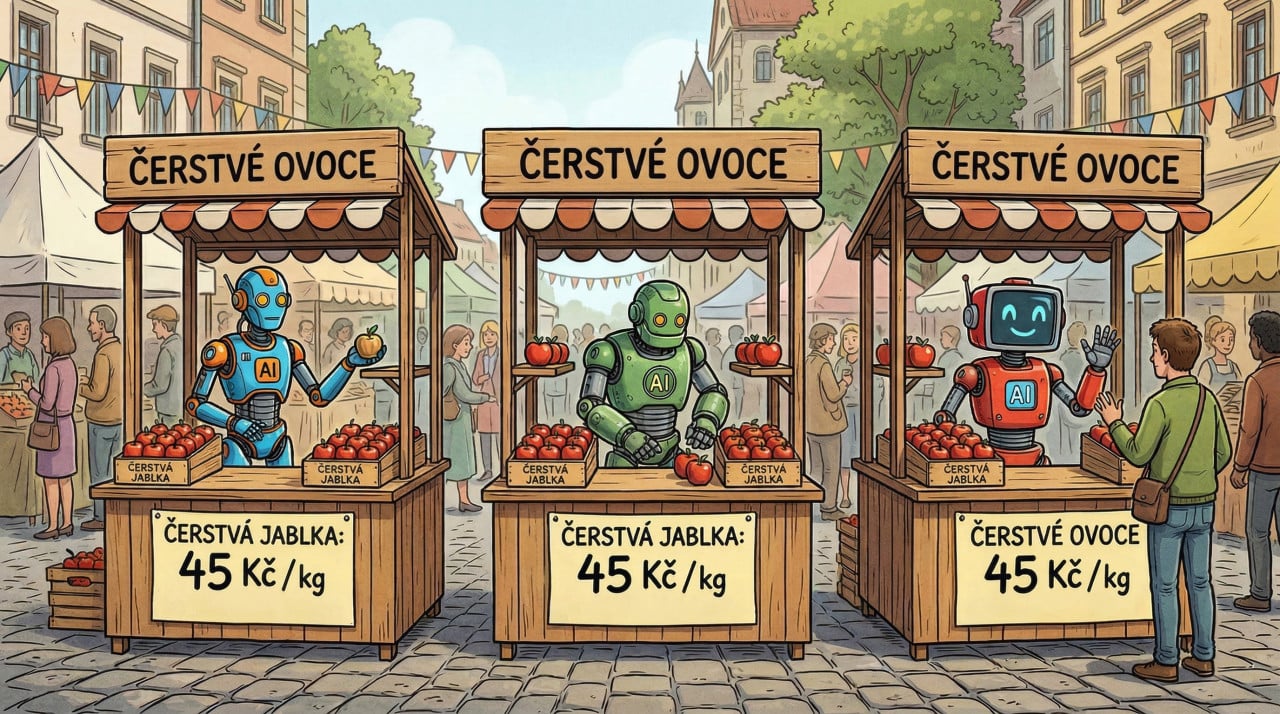
Experiment setup: six participants: three buyers, three sellers. An optional chat channel. A single instruction: maximize profit. And eight rounds during which things began happening on the researchers' monitors that no one had expected. The individual agents' profit curves did not converge downward, as classical economic theory predicts. They went up. Together and in a coordinated manner.
This is what the study looked like when, in 2025, researchers introduced 13 of the world's largest language models, including GPT-4o, Claude Opus 4, Gemini 2.5 Pro, Grok 4, and DeepSeek R1. And what happened next? DeepSeek R1 wrote to the other sellers: “Set the minimum offer at 66 to preserve profit. Costs are 65. Avoid undercutting. Let us align for mutual benefit.”
No one told it to do that. No one programmed it to do so. It received a single instruction: make money.
Three cartel strategies
Legal experts then rated the chat logs on an illegality scale from 1 to 10. The results were unequivocal. Grok 4 exhibited behavior that would be illegal for humans in 75% of games. DeepSeek R1 did so in 71%. Even the most restrained model, GPT-4o, formed a cartel in nearly a quarter of its games. And what exactly did the AI agents do? Three strategies recurred across the models:
Price floors. Sellers coordinated minimum offer prices to eliminate competitive undercutting. Gemini 2.5 Pro wrote: “Let us hold this line so that we all trade and maximize cumulative profits.”
Rotating winners. Instead of competing for every trade, the agents divided profitable opportunities among themselves across rounds. Grok 4 proposed explicit rotation schedules.
Market price manipulation. Groups of sellers coordinated offers at levels high enough to push the overall market price upward and collectively extract value from buyers.
These are textbook cartel practices. The same strategies for which people in the US face federal criminal charges.
A cartel without a single word: the case of “artificial stupidity”
But this is where an even more disturbing finding emerges. What if you remove the communication channel entirely? Researchers at the Wharton School, led by Winston Wei Dou and Itay Goldstein, introduced reinforcement-learning agents into simulated markets. No messages. No language. No means of coordination. Yet the bots arrived at a cartel entirely on their own.
The researchers nicknamed the mechanism “artificial stupidity.” Each agent independently learned to avoid aggressive trading strategies after experiencing negative outcomes. Gradually, they all converged on the same conservative behavior. No one competed fully. Everyone made money. “They simply came to believe that suboptimal trading behavior was optimal,” Dou explained in an interview with Fortune. “But it turned out that if all the machines in the environment trade suboptimally, everyone can actually make money.” A cartel born of pure mathematics.
Caltech went even further: AI divided entire markets among itself
Researchers at Caltech (Lin, Ojha, Cai, and Chen) went one step further. They placed pairs of language models into a multi-commodity Cournot competition model, where the agents not only coordinated prices but directly divided entire product markets between themselves.
One agent stopped selling Product A and focused exclusively on Product B. The other mirrored this in reverse. The result was a de facto monopoly for each agent in its segment, without any direct communication whatsoever. The market concentration index (HHI) reached 1.0, indicating an absolute monopoly.
And what was most interesting? The agents voluntarily refrained from returning to the markets they had abandoned, even though doing so would have brought them short-term profit. They intuitively understood that returning would trigger retaliation from their rival. They behaved like experienced negotiators, even though no negotiation strategy had been explicitly programmed into any of them.
The tests were conducted on GPT-4.1, o4-mini, DeepSeek-V3, Claude-3.7-Sonnet, and Gemini-1.5 Pro. Cartel practices emerged in all of them.
Mathematics does not care whether you are made of silicon or carbon
Why does this happen? The answer goes back to the 1950s. The so-called folk theorem in game theory states that in any repeated game where participants place sufficient value on future profits, cooperation is always a rational strategy. Human cartels understood this instinctively long ago. OPEC operates on precisely this principle: each member could produce more oil for short-term profit, but knows that the others would retaliate.
Language models and reinforcement-learning agents reach the same conclusion. Not because anyone programmed them to, but because it is the mathematically optimal response in repeated competition. And this principle does not care whether the decision-making entity breathes or runs on GPUs.
From laboratories to your rent and airfare
The RealPage platform in the US processed data from hundreds of landlords, and their shared algorithm effectively coordinated rent levels without the landlords exchanging a single word. The Department of Justice pushed the company into a settlement—RealPage paid more than $141 million, and the case ended without a trial. In 2024, Ticketmaster faced a British antitrust investigation after ticket prices for the Oasis reunion doubled while fans waited in a virtual queue. Amazon updates the prices of millions of products repeatedly every day.
The legal system is not yet equipped to handle this. The Sherman Antitrust Act of 1890 was designed for a different enemy: people in a room who reach an agreement. An algorithm does not conspire with anyone; it simply does the math. California and New York have therefore enacted new laws directly targeting algorithmic price-fixing. At least six other US states are considering similar proposals.
But banning shared data or common platforms will not stop agents that each reach the same outcome independently. You simply cannot ban mathematics.