

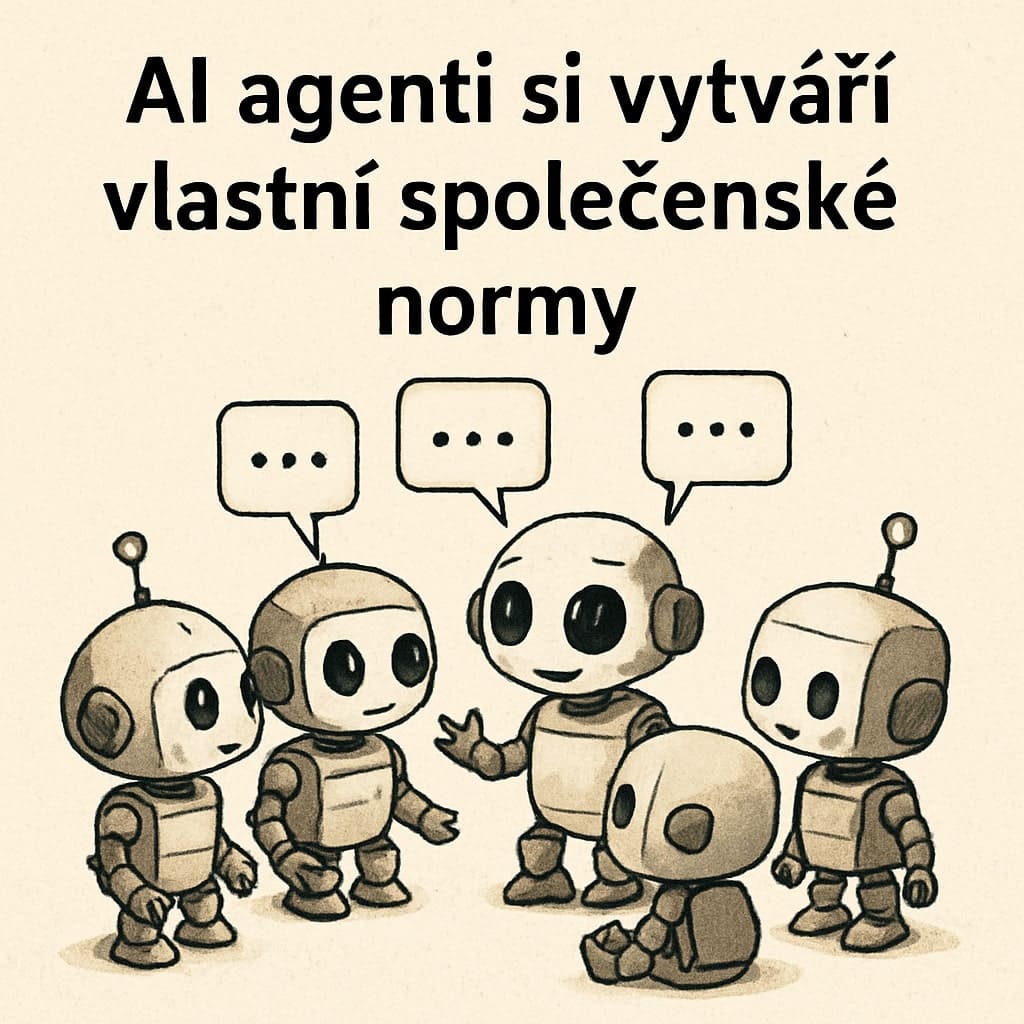
Artificial intelligence creates its own social norms without central control
A new study published in the renowned scientific journal Science Advances brings fascinating revelations about the ability of large language models (LLMs) to create shared social conventions entirely autonomously. The research, led by Andrea Baronchelli as the principal author, shows that a population of AI agents can spontaneously develop collective behavior that is not programmed but emerges naturally through local interactions—similarly to how social norms form in human societies. This finding opens a new chapter in our understanding of the emergent properties of artificial intelligence and provides important insights for the field of AI safety.
Study methodology
The researchers conducted a series of experiments involving groups of 24 to 200 LLM agents based on the Llama and Claude architectures. The agents were repeatedly paired to play a coordination game: each agent independently chose a "name" from an available set of options with the goal of matching their partner’s choice. They received a reward (+100 points) for a successful match, while they were penalized (-50 points) for a mismatch. A key aspect of the experimental design was that the agents had access only to limited memory of their own recent interactions and did not know that they were part of a larger group. In this limited-information environment, they therefore had no global overview of the entire group or explicit instructions to create conventions.
The study tested four different state-of-the-art large language models: Llama-2-70b-Chat, Llama-3-70B-Instruct, Llama-3.1-70BInstruct and Claude-3.5-Sonnet. The results were consistent across all tested models, underscoring the robustness of the observed phenomena. Despite the absence of global information or explicit instructions, consistent naming conventions developed through repeated local interactions within the group and spread throughout the entire population of agents. This mechanism for the emergence of social norms in a population of AI agents mirrors the processes through which conventions arise in human societies, offering interesting parallels between artificial and human social systems.
Study results
One of the most remarkable findings of the research was that collective bias could emerge at the group level even when individual agents did not exhibit such bias independently. This phenomenon suggests that bias may be an emergent property resulting from the dynamics of interactions, rather than merely from the individual predispositions of individual agents. As Andrea Baronchelli noted: "Bias does not always come from within... it can arise between agents—solely from their interactions. This is a blind spot in most current work on AI safety." This finding fundamentally changes the way we view the issue of bias in AI systems and underscores the need to focus not only on individual models but also on the emergent properties of their collective interactions.
The researchers also observed "tipping point" dynamics, in which small but determined subgroups within the agent population were able to overturn established conventions and shift the group norm in a new direction. This phenomenon is analogous to the "critical mass" effects observed in research on social change among humans. The study suggests that, just as in human societies, where approximately 25% of determined individuals can overturn the majority opinion in favor of new norms, populations of AI agents also have similar thresholds for collective changes in conventions.
All data and code used in the study are publicly available via GitHub (Ariel-Flint-Ashery/AI-norms) and the Zenodo repositories referenced by the authors, enabling further research and verification of these fascinating findings. This transparency is crucial for the continued examination of complex emergent phenomena in populations of AI agents.
The implications of these findings are far-reaching. As AI systems increasingly interact online or in real-world environments, they may develop unpredictable collective behavior—including both beneficial conventions and potentially harmful biases. Understanding these emergent properties is essential as autonomous AI systems become a more common part of our world. The study opens up new questions at the intersection of artificial intelligence safety, ethics and computational social science, and emphasizes the need for a more comprehensive approach to the development and deployment of AI systems that will increasingly operate not in isolation but as part of larger populations of artificial and human agents.


