

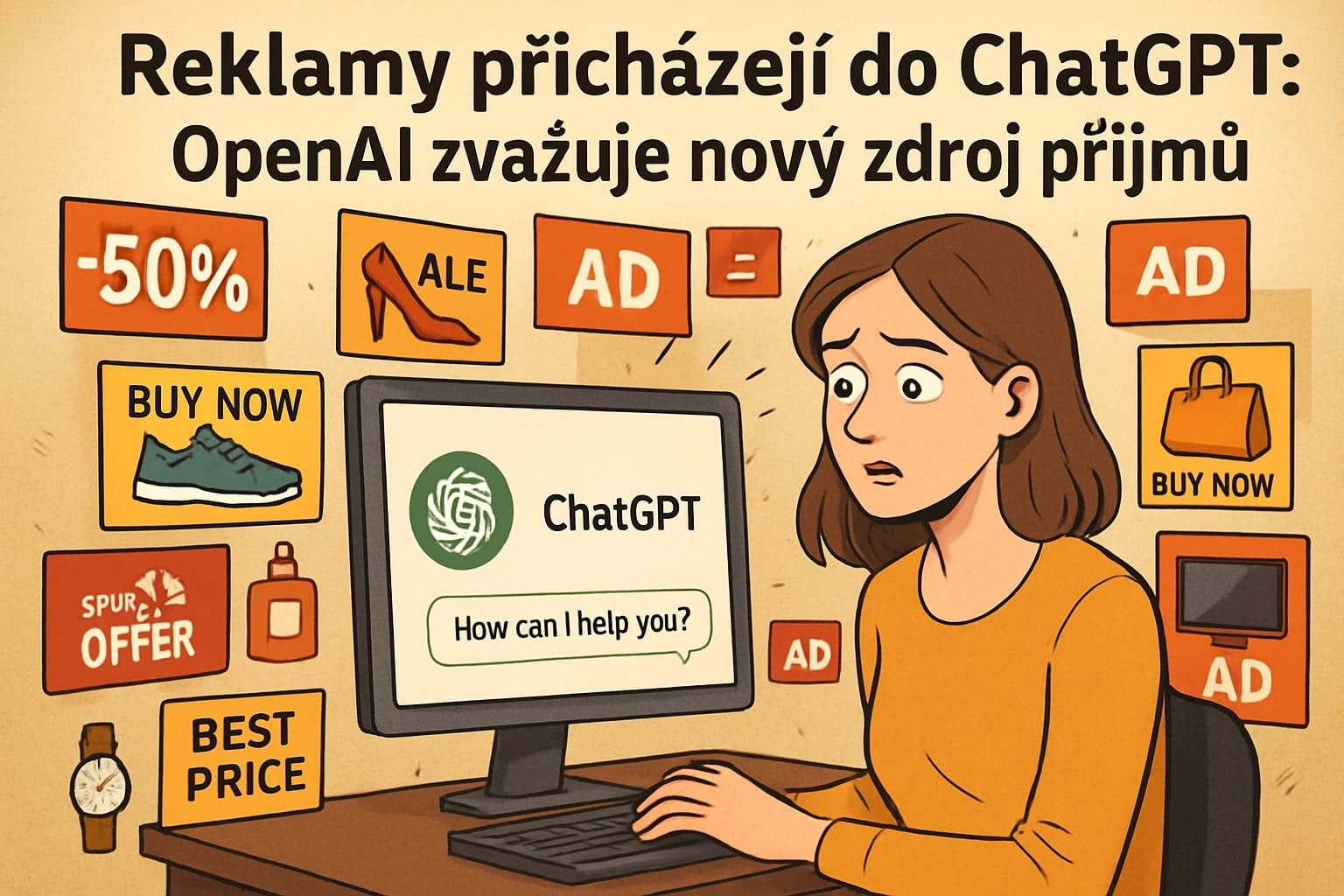
Ads Are Coming to ChatGPT: OpenAI Considers a New Source of Revenue
The end of June 2025 confirms that the discussion about ads in ChatGPT is no longer merely theoretical. Sam Altman and his team are gradually changing their approach to monetizing their best-known product.
Altman’s Changing Stance on Advertising
Sam Altman’s position on ads in ChatGPT has undergone a significant shift. While at Harvard Business School in 2024 he described advertising as a "last resort" for OpenAI—a path he wanted to avoid—his stance has gradually softened.
As early as March 2025, he acknowledged in an interview: "Maybe there is a tasteful way we can do ads, but I don’t know how."
Most recently, on OpenAI’s official podcast, Altman spoke even more openly: "We haven’t done any advertising product yet. I kind of... think I’m not totally against it. I can point to areas where I like ads. I think Instagram ads are kind of cool. I’ve bought a bunch of stuff from them. But I’m aware that it would be very difficult... I think it would take a lot of care to get it right."
Financial Pressures and Operating Costs
Operating ChatGPT reportedly costs more than $3 billion to $4 billion annually. Although OpenAI raised a record $40 billion in March 2024—the largest private funding round in tech history—followed by $6.6 billion from Microsoft and Nvidia in October 2024, the need for sustainable revenue remains crucial. According to available data, ChatGPT has 20 million subscribers, and OpenAI projects revenue of $12.7 billion for 2025. The company also recently secured a $200 million contract with the U.S. Department of Defense.
Risks of Integrating Ads
Introducing ads into ChatGPT presents several fundamental challenges that OpenAI must address. Ads could disrupt the natural flow of conversation and make interactions less seamless and more intrusive for users. Another important concern is privacy—ads could be personalized based on conversation content, raising questions about the use of user data without explicit consent. This could lead to a loss of user trust. There is also a risk of bias, as funding from advertisers could influence which products or services are promoted, potentially undermining the objectivity and credibility of the answers provided.
OpenAI is not the only company considering ads in AI chatbots. Google is already experimenting with native ads in Gemini, showing that the concept has gained traction within the industry. ChatGPT is already being used to generate marketing plans and advertising campaigns, assisting with creating offers, analyzing sales, and optimizing advertising activities across various platforms.
Outlook for the Second Half of 2025
As of June 2025, OpenAI has not yet provided any specific details about implementing ads, but the idea is clearly on the table. Altman’s gradually evolving stance suggests that ads in ChatGPT are no longer a question of "if," but rather "when" and "how."
Users should be prepared for changes in how AI assistants are funded and operated, with the key question being whether OpenAI can find the "tasteful way" Altman has spoken about.


