AB-MCTS: A New Method That Enables Different AI Models to Collaborate
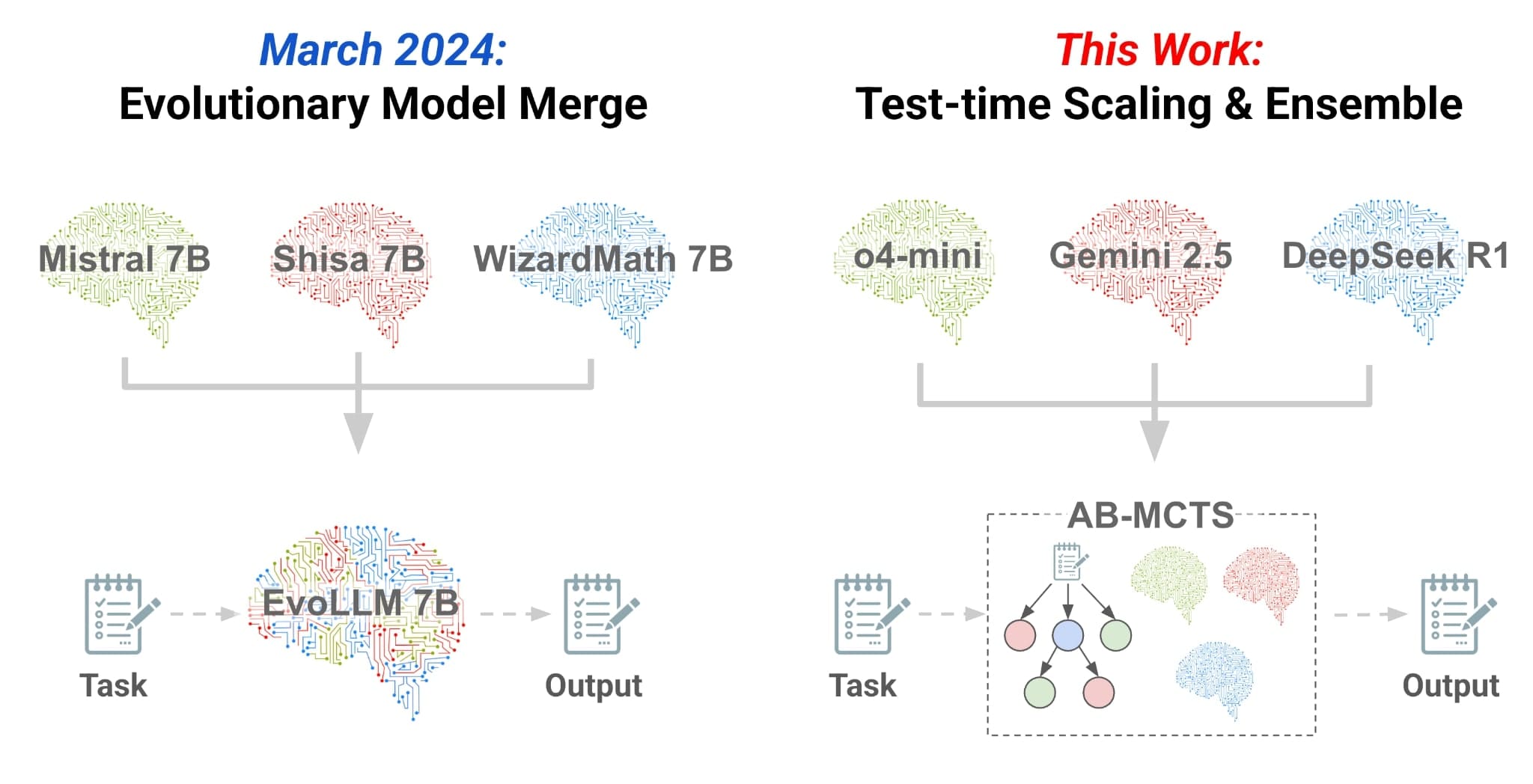
Sakana AI has introduced a groundbreaking algorithm called AB-MCTS (Adaptive Branching Monte Carlo Tree Search), which enables leading AI models to collaborate on solving complex problems. Using AB-MCTS, a combination of the o4-mini, Gemini-2.5-Pro, and DeepSeek-R1-0528 models achieves significantly better results on the challenging ARC-AGI-2 benchmark than any of these models individually.
This technology represents a new direction in inference scaling, where performance is improved through additional computational resources during the model's actual use.
Inspired by Human Collaboration
Sakana AI builds on the observation that humanity's greatest achievements, such as the Apollo program, the creation of the internet, and the Human Genome Project, were accomplished through collective intelligence. The same principle is proving useful for artificial intelligence.
Leading AI models such as ChatGPT, Gemini, Grok, and DeepSeek retain their individuality, which stems from their unique training data and methods. Rather than viewing these differences as limitations, Sakana AI sees them as valuable resources for creating collective intelligence.
Principles of Inference Scaling
Inference scaling is a paradigm in which performance on a complex problem can be improved by allocating more computational resources at inference time. One approach is to use reinforcement learning to generate longer chains of thought, which has dramatically increased the capabilities of "reasoning models" such as OpenAI o1/o3 and DeepSeek R1.
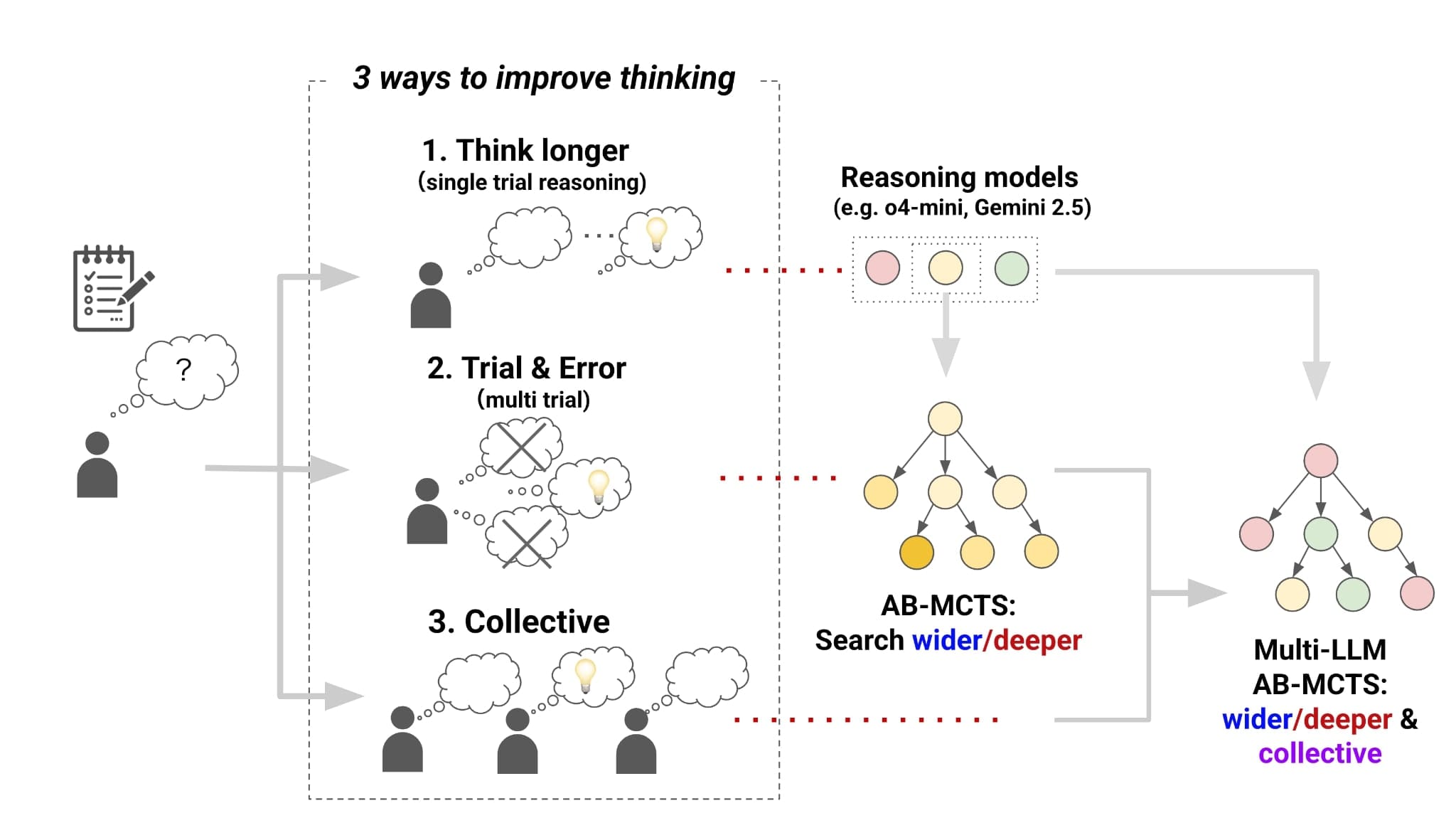
In addition to simply providing more "time to think," we can let the model repeatedly approach the problem, revise its answers, and, if necessary, start over from scratch—much like a programmer working through complex code.
Navigating Two Search Dimensions
AB-MCTS combines two approaches: Sequential Refinement (depth-first search) for improving existing solutions and Repeated Sampling (breadth-first search) for generating new solutions. Although both approaches are effective, there was previously no way to combine them efficiently.
AB-MCTS solves this problem by flexibly searching in both directions while adapting to the problem and context. When a promising solution is found, the system can repeatedly improve it while simultaneously balancing the generation of entirely new solutions.
The algorithm extends Monte Carlo Tree Search (MCTS) and uses Thompson Sampling to decide the direction of exploration. At each node, AB-MCTS uses probabilistic models to estimate the potential quality of two possible actions: generating a new solution or improving an existing one.
Multi-LLM AB-MCTS
To maximize the potential of multiple models as collective intelligence, Sakana AI developed Multi-LLM AB-MCTS, which adaptively explores not only the search direction but also which model to select for a given problem. In addition to the options to "generate a new solution" and "improve an existing solution," it adds a new step: selecting which model to use.
The system uses balanced mixtures of models in the initial stages and then focuses on those that prove more promising. This can be understood as a multi-armed bandit problem, in which the system must adapt to changing inputs based on the generated responses.
Experimental Results on ARC-AGI-2
Experiments were conducted on the ARC-AGI-2 benchmark, which aims to evaluate human-like, flexible intelligence capable of reasoning effectively and solving novel problems. In the experiment, the maximum number of search iterations was set to 250, and the models were instructed to generate a transformation rule as Python code.
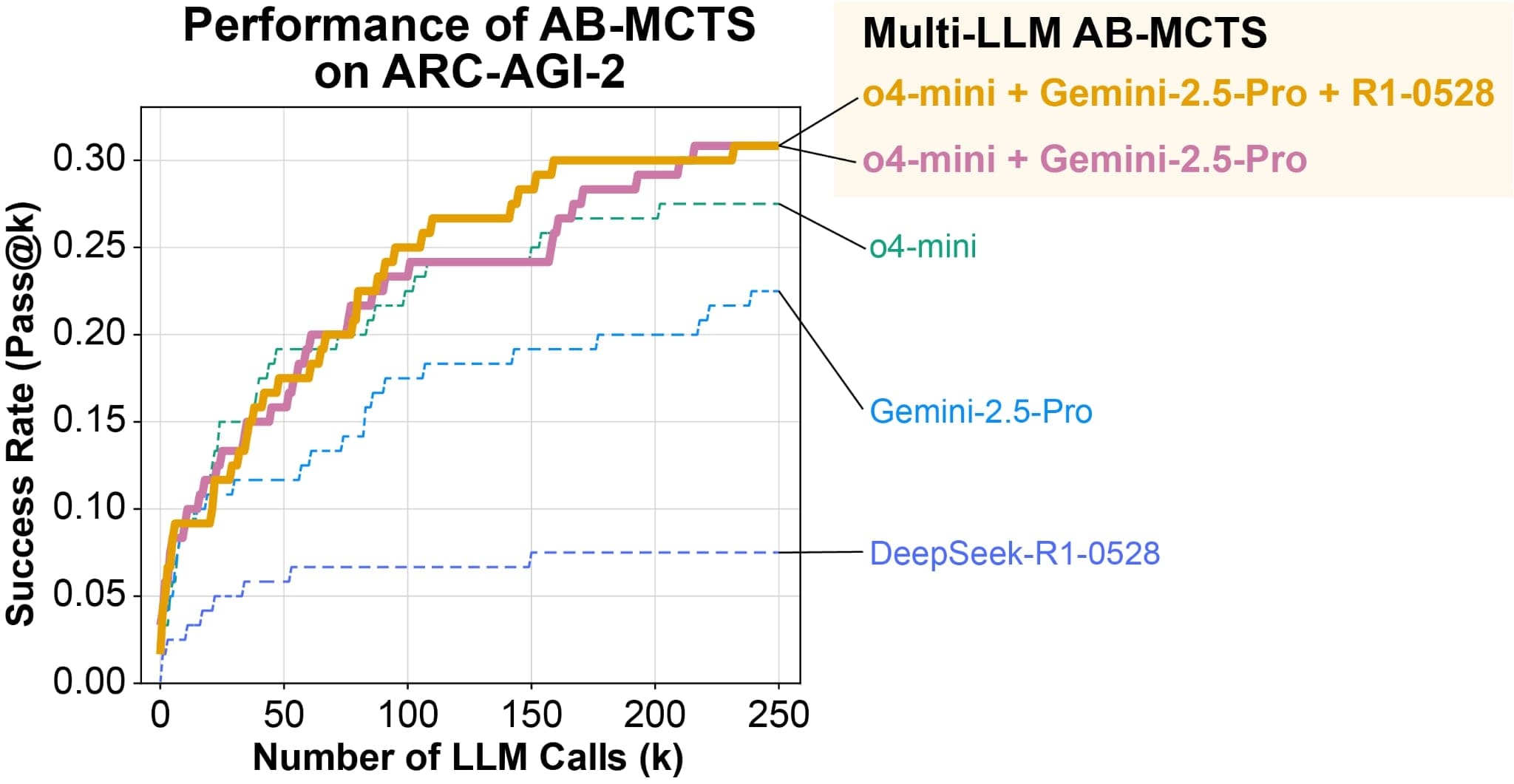
Repeated sampling with o4-mini succeeded on 23% of the problems. However, AB-MCTS improved the score to 27.5%. Using Multi-LLM AB-MCTS, the system found correct solutions for more than 30% of the problems. Interestingly, although DeepSeek-R1-0528 does not perform particularly well on its own, including it in Multi-LLM AB-MCTS effectively increased the number of solvable problems.
Dynamic Allocation and Collaboration
A key characteristic of Multi-LLM AB-MCTS is its ability to dynamically allocate models based on their proficiency with a specific problem. During the search process, the algorithm identifies which model is most effective for the given problem and subsequently increases the frequency with which that model is used.
There were examples in which problems that could not be solved by any individual model were solved by combining multiple models. In one case, even though the solution originally generated by o4-mini was incorrect, DeepSeek-R1-0528 and Gemini-2.5-Pro were able to use it as a clue to reach the correct solution.
Potential for Future Applications
The ability to combine the strengths of different leading models opens up new possibilities for solving complex tasks that are beyond the capabilities of individual models. Sakana AI released the core algorithm as TreeQuest under the Apache 2.0 license, allowing users to apply AB-MCTS and Multi-LLM AB-MCTS to various tasks with minimal code. This technology not only demonstrates the power of collective intelligence in AI but also points the way toward more efficient use of existing AI resources and represents a concrete step toward realizing the vision of collaborative AI systems.