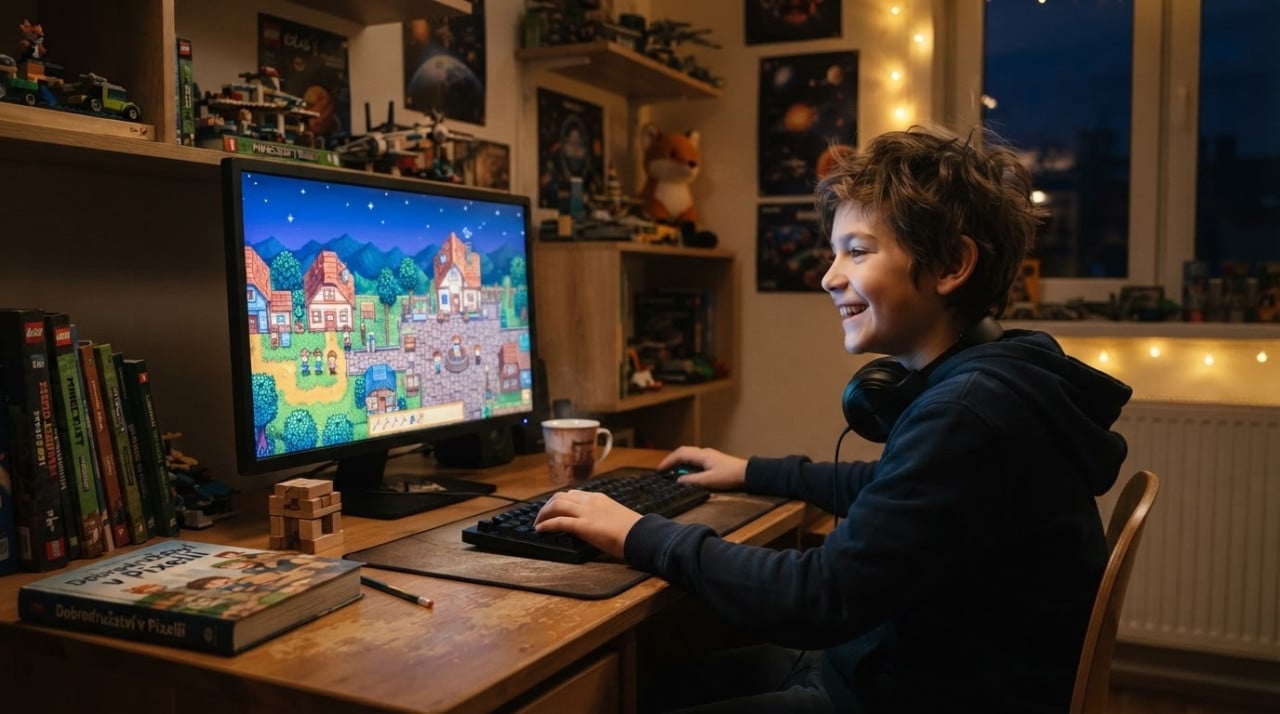
Eleven-year-old Jacob from California initially used artificial intelligence just like all his peers. It helped him with homework and research for essays. But everything changed when he read a book assigned at school. He immediately thought it would make a great game. And it did not remain just an idea! The story, which Jacob's mother, Michele Ragon, shared with Business Insider, beautifully illustrates how AI is expanding the range of people who can create today.
From a report on hurricanes to his own game
It all began innocently enough. Jacob received a computer for Christmas, and because he was preparing a report on hurricanes, he decided to try the AI assistant Copilot while doing his research. A few weeks later, however, his mother discovered that instead of having an ordinary conversation with a chatbot, Jacob was programming his first video game.
His inspiration was the book Mrs. Frisby and the Rats of NIMH, which he was reading at school. It tells the story of a widowed mouse who must move her entire family before the spring plowing begins. The story and theme of the book reminded him of a strategy game he had seen on the Steam platform.
8 hours of work and plenty of patience
Jacob began with a simple prompt: “Help me create this game; here is my idea.” Copilot then guided him through the entire process step by step. He completed a working version of the game in less than eight hours. It took him just four days, during which he programmed for one to two hours a day.
Another important factor is why Jacob found working with AI so engaging. The boy had recently been diagnosed with ADHD, dyslexia, and dysgraphia. The fact that AI does not get frustrated and can explain the same thing over and over again allowed him to understand things and persevere. Whenever he did not know how to handle something or an error message appeared, he copied it into Copilot and had it explained to him in different words until he fully understood it. And when something still did not work, he improvised. For example, he replaced the rats in the game with smiley faces, which stopped the game from crashing.
AI does not destroy creativity—it enhances it
And how does Jacob's mother view the whole situation? Her only concern is whether her son can recognize when AI is giving him inaccurate information. Otherwise, she views the experience positively and believes that children should learn more about working with artificial intelligence at school. According to her, her son is proof that AI does not destroy creativity—it enhances it. It was only thanks to AI that he was able to bring his idea to life.
Jacob is not an exception
Similar stories are becoming increasingly common. Back in 2024, a video by developer Ricky Robinett went viral, showing how his eight-year-old daughter used the Cursor AI editor to create her own chatbot in just 45 minutes. These cases therefore suggest that the barrier to entering the world of software development is falling significantly. The question remains whether and how the education system will respond to this development.
Source: Business Insider, AOL, Medium