
A model that no one knew anything about appeared on the OpenRouter platform. No official announcement, no blog post, just a quiet listing called Pony Alpha. The model was free to use and offered a 200,000-token context window with a maximum output window of 131,000 tokens, an absurd figure even by 2026 standards.
Within four days, users had burned through 25 billion prompt tokens. Throughput hovered around 17 to 19 tokens per second. The three most-used applications were Kilo Code (10 billion tokens), OpenClaw (8.59 billion), and SillyTavern (2.83 billion). People used the model for everything from programming to role-playing.
No one knew who had created it. The community began investigating and eventually uncovered the truth: Pony Alpha was actually GLM-5 from the Chinese company Zhipu AI.
Zhipu AI and the GLM-5 model
Zhipu AI (also known as Knowledge Atlas Technology JSC Ltd.) officially introduced its GLM-5 model ahead of the 2026 Lunar New Year. It is the fifth generation of its GLM model series, building on the successful GLM-3 and GLM-4 models.
GLM-5 uses a Mixture-of-Experts (MoE) architecture with a total of 745 billion parameters, but only approximately 44 billion parameters are activated for each token. This structure provides two main benefits: first-token latency is comparable to models with 30–70 billion parameters, while the model also maintains stability during long outputs.
GLM-5 brings significant improvements in several areas:
Logical reasoning: The model uses a chain-of-thought structure more frequently, even when the user does not explicitly request it. When asked to critique its own plan, it can adapt without repeating itself or getting stuck in a loop.
Programming: The model handles incremental code modifications better than complete rewrites. When asked to make a diff-style change, it preserves the context instead of reprinting the entire code.
Agentic behavior: Tool-calling tasks (describing steps, identifying missing inputs, proposing retries) are produced more clearly and in a more structured manner.
Creative writing: Voice control has improved. If the user sets the tone of the text, the model can maintain it for several pages.
Performance and speed
The GLM-5 model delivers stable performance across a variety of tasks. First-token latency is under one second for short prompts and 1–2 seconds for more complex requests with multi-part instructions. Sustained throughput during long responses reaches 30–60 tokens per second. The model does not stop in the middle of a paragraph, as some MoE models do under load. With a context of around 8,000–16,000 tokens, outputs remain coherent. The MoE architecture represents a compromise between the simplicity of dense models and a routing layer that ideally pays off in speed and cost at the same quality level.
API access
The GLM-5 model is available through the Zhipu AI platform and some aggregators such as WaveSpeed, which provides an OpenAI-compatible interface. Integration is simple—all that is required is changing the base URL and model string.
The model ID is listed as "glm-5" in the model catalog. Authentication uses a single API key in the standard Authorization header. Rate limits are displayed in the headers, which is useful when tuning concurrency.
For better stability with complex prompts, it is recommended to reduce the temperature to 0.5–0.7. This reduces meandering without flattening the tone. The default output token limit is conservative, so if responses are being cut short, it needs to be increased.
Comparison with competitors
Compared with the GPT series, GLM-5 keeps pace in writing and step-by-step reasoning. It makes fewer formatting errors in long outlines and handles incremental code modifications with less spillover.
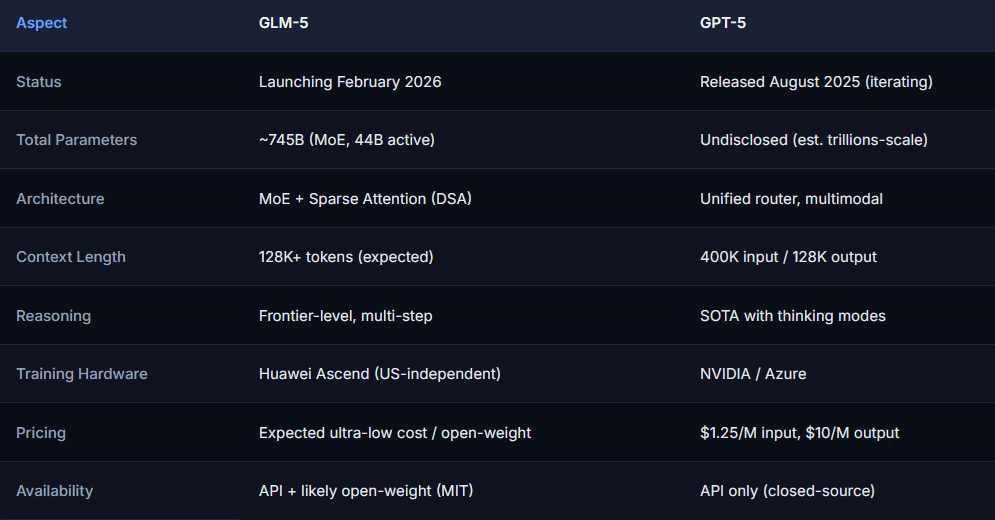
Compared with Claude models, GLM-5 is similarly cautious with factual rewrites and slightly more willing to suggest next steps without prompting. Users who prefer Claude for its tone and safety structure may still favor it for sensitive content.
Compared with DeepSeek, GLM-5 feels heavier per call but more stable during multi-layered analysis. DeepSeek may have an advantage in cost efficiency for a high volume of small queries, while GLM-5 makes sense for fewer but deeper calls.
Domestic chips and independence
Zhipu AI announced that its open-source image generation model, GLM-Image, is the first cutting-edge multimodal model to complete training using Ascend chips from Huawei Technologies. The model was built on the Huawei Ascend Atlas 800T A2 server and the MindSpore framework. This announcement represents a significant milestone for Huawei, as no other major AI company in China has publicly announced success in training its models on domestic chips. After being added to the U.S. blacklist in 2025, Zhipu AI intensified its efforts to collaborate with domestic chip manufacturers, including Cambricon Technologies.
Zhipu AI's move aligns with Beijing's policy of reducing reliance on foreign expertise in light of a multi-year campaign by the U.S. and its allies to restrict China's access to advanced Western technologies.
Using the GLM-5 model
The GLM-5 model is suitable for users who need fewer models and more stable outputs for planning, analysis, and revision-intensive writing. If someone is optimizing for ultra-cheap, ultra-fast microtasks, a smaller dense model or a DeepSeek-style option may be more suitable.
Availability: GLM-5 is being rolled out gradually and is accessible through the Zhipu platform and some aggregators. Outside China, latency and access may vary by provider.
Context window: Working ranges of around 8,000–16,000 tokens have been stable. For workflows that depend on very long contexts, hard limits should be confirmed in the documentation.
What stood out was not raw power, but the fact that the model does not require constant supervision. That is not sensational news, but the kind of quiet improvement that adds up over the course of a week.
Sources: wavespeed.ai and finance.yahoo.com