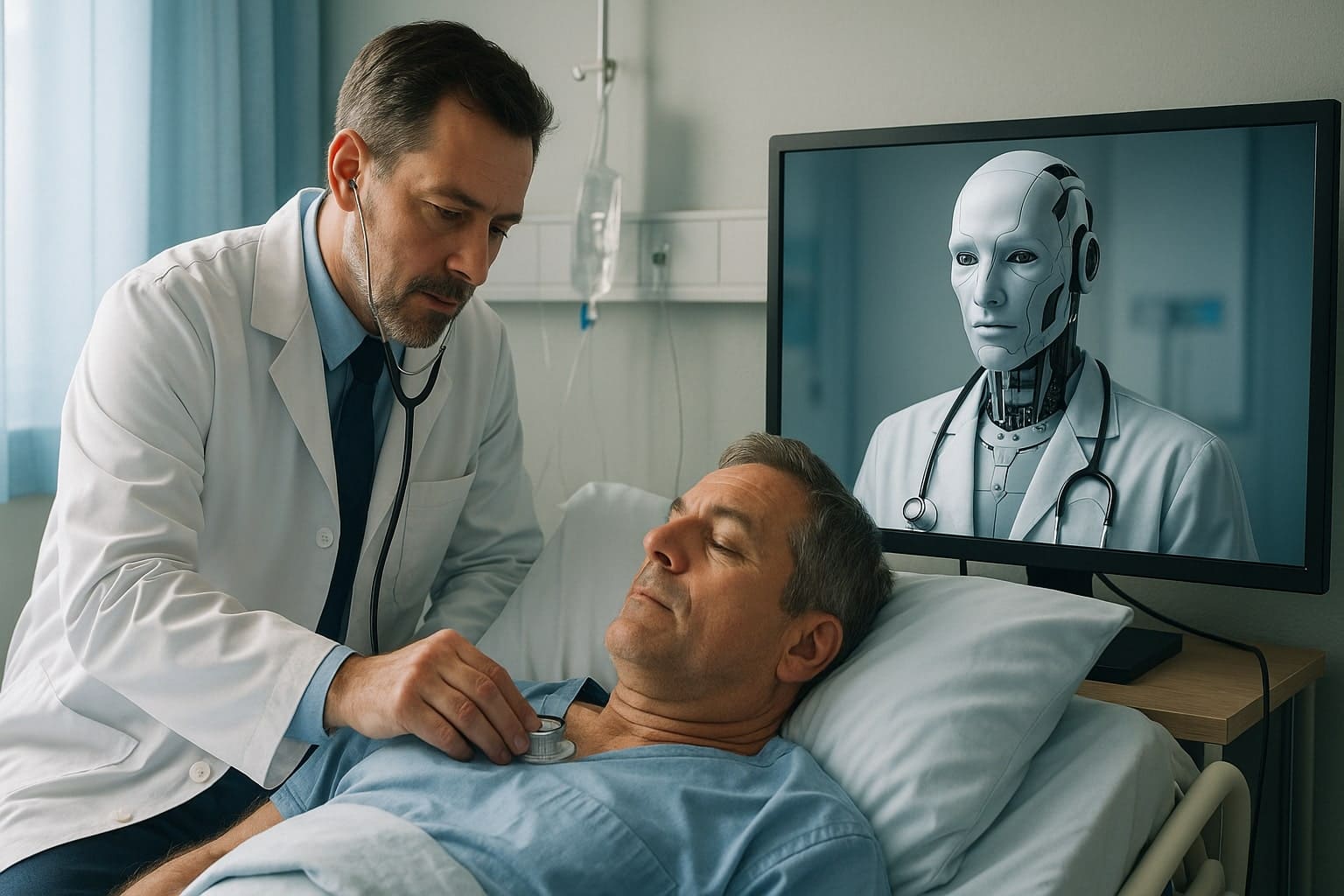
Why We Shouldn't Fear AI Doctors: Facts from Practice
People expect perfection from their doctors – to be infallible, tireless, and always make the right decision. But doctors are only human. They often work long hours under enormous pressure and with limited resources. Better conditions, more staff, and improved systems would of course help. Yet even in the best-funded clinics with the most conscientious professionals, standards sometimes fall short. Doctors, like all of us, work with Stone Age brains. Despite years of training, human brains are not ideally adapted to the pace, pressure, and complexity of modern healthcare.
Because patient care is at the heart of medicine, the question is: who or what is best suited to provide it? Artificial intelligence (AI) continues to arouse suspicion, but research shows how it could address some of the most persistent problems and overlooked failures – from misdiagnoses and errors to unequal access to care. Each of us, as a patient, will experience at least one diagnostic error in our lifetime. In England, conservative estimates suggest that about 5% of GP visits result in an incorrect diagnosis, putting millions of patients at risk. In the US, diagnostic errors cause death or permanent harm to nearly 800,000 people each year. The risk of misdiagnosis is higher if you are among the one in ten people worldwide with a rare disease.
Human Limitations in Medicine vs AI
Modern medicine prides itself on being scientific, yet doctors do not always apply what the evidence recommends. Studies show that evidence-based treatments are offered to only about half of adults in the US. Doctors may also disagree on diagnoses. In one study involving more than 12,000 radiological images, second-opinion reviewers disagreed with the original assessment in about one-third of cases – leading to a change in treatment in nearly 20% of cases. As the working day progresses, quality declines: inappropriate antibiotic prescribing rises, while cancer screening rates fall.
These failures are alarming, but they have understandable causes – and from another perspective, it is remarkable that doctors get it right as often as they do. The realities of human life – distractions, multitasking, even our biological clocks – take their toll. Burnout, depression, and cognitive aging not only exhaust doctors but also increase the risk of clinical errors. Medical knowledge is also evolving faster than doctors can keep up with it. By the time they graduate, half of what medical students learn is already outdated. It takes an average of 17 years for research to reach clinical practice, and with a new biomedical article published every 39 seconds, merely reviewing the abstracts would take about 22 hours a day. There are more than 7,000 rare diseases, with 250 new ones identified each year.
By contrast, AI absorbs medical data at lightning speed, 24 hours a day, 7 days a week, without sleep or breaks. While doctors vary in unintended ways, AI is consistent. And although these tools also make mistakes, it would be unfair to deny how impressive the latest models are. Some studies show that they significantly outperform human doctors in clinical reasoning, including for complex health conditions. AI has a superpower for recognizing patterns that people overlook, and these tools are surprisingly good at identifying rare diseases – often better than doctors. For example, in one 2023 study, researchers entered 50 clinical cases – including 10 rare conditions – into ChatGPT-4. It was asked to provide diagnoses in the form of ranked suggestions. It solved all common cases by the second suggestion and 90% of rare conditions by the eighth – outperforming the human doctors used for comparison.
Patients and their families increasingly recognize these benefits. One child, Alex, saw 17 doctors over three years because of chronic pain – none could explain his symptoms. His desperate mother turned to ChatGPT, which suggested a rare condition called tethered cord syndrome. Doctors confirmed the diagnosis, and Alex is now receiving the correct treatment. Other research shows that AI improves diagnostic accuracy by analyzing vast amounts of medical data and images, enabling earlier disease detection. For example, machine learning and deep learning identify patterns that even experienced doctors might overlook.
Care and the Role of AI
Then there is the problem of access. Healthcare is upside down. Those who need it most – the sickest, poorest, and most marginalized people in society – are the ones most often overlooked. Busy schedules and poor public transportation mean that millions of people miss appointments. Parents and part-time workers, including those in the gig economy, often struggle to attend checkups. Data from the American Time Use Survey shows that patients sacrifice two hours for a 20-minute doctor's appointment. The problems are often worse for people with disabilities, who in Britain are about four times more likely to go without care because of transportation problems, costs, and long waiting lists. Compared with men without disabilities, women with disabilities are more than seven times as likely to have unmet needs because of the cost of care or medication.
Yet we rarely question the idea of waiting in line to see a doctor in town, because that is how it has always been. AI could change that. Imagine a doctor in your pocket, providing information whenever and wherever you need it. As part of the Labour Party's ten-year plan in the UK, Wes Streeting, the Health Secretary, announced that patients will soon be able to discuss their health concerns with AI through the NHS app. It is a bold move – and one that could deliver faster, actionable clinical advice to millions.
Of course, this only works for those who can use it. Internet access is improving globally, but serious gaps remain: 2.5 billion people are still offline. In Britain, 8.5 million people lack basic digital skills, and 3.7 million families fall below the “minimum digital living standard,” meaning poor connectivity, outdated devices, and limited support. Trust is also a barrier: 21% of people in Britain say they feel left behind by technology.
Currently, research into AI in healthcare focuses almost exclusively on its shortcomings. Examining the potential for bias and error is crucial. But this focus fails to take into account the creaking and sometimes dangerous systems on which we already rely. Any fair assessment of AI must be weighed against the reality of what we have now – a system that is too often frustrating, inaccessible, or simply wrong. Other studies highlight that AI can automate administrative tasks such as documentation and appointment reminders, freeing doctors to spend more time with patients and reducing burnout. It also supports personalized care by integrating patient data, increasing treatment effectiveness, for example in oncology.
Difficult Obstacles
Although AI offers benefits such as predictive analytics for forecasting disease risks and identifying patients in need of preventive care, it is important to integrate it thoughtfully. AI should serve as an assistant, not a replacement for doctors, and education must prepare professionals to work with these tools. Preserving empathy, trust, and shared decision-making remains crucial. Charlotte Blease, a health researcher and author of the book Dr Bot: Why Doctors Can Fail Us – and How AI Could Save Lives, published by Yale on September 9, emphasizes these points based on real-world data and examples.
Ultimately, adopting AI in medicine is not about replacing people, but about strengthening a system that is full of human limitations. With growing evidence of its benefits – from faster drug research to better resource allocation – it is time to view it as an ally that can make healthcare safer and more accessible for everyone.
Source: www.theguardian.com