
Why Does Context Engineering Outperform Traditional Prompts in AI?
The development of artificial intelligence has brought a significant shift in the approach to optimizing large language models (LLMs) in recent years. While until recently most attention was focused on prompt engineering, it is becoming increasingly clear today that context engineering represents a key discipline for the future of AI applications.
What Is Prompt Engineering?
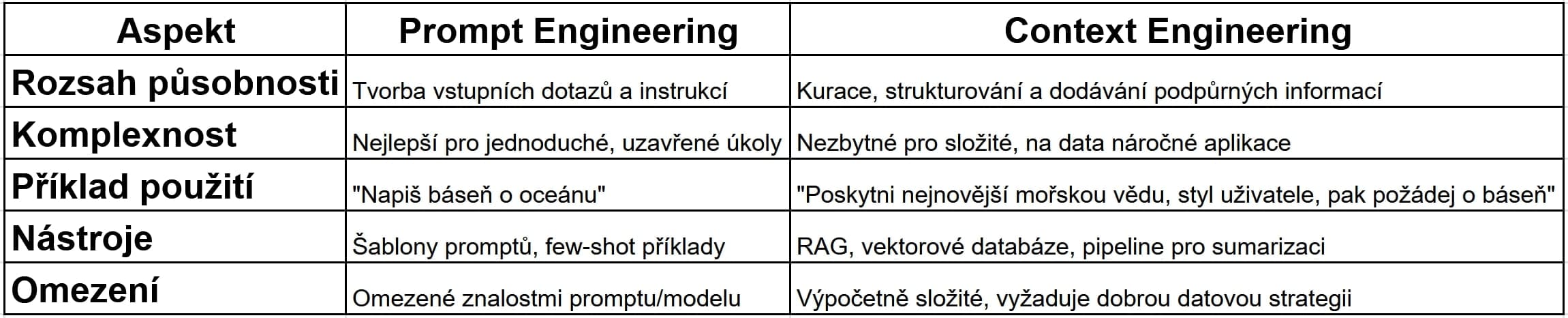
Prompt engineering is the art of formulating the right questions or instructions to present to language models. It is the process of optimizing input queries so that the model provides the best possible output. This approach focuses on how we ask questions or give instructions.
Prompt engineering works very well for simple and clearly defined tasks. Examples include instructions such as "Write a poem about the ocean" or "Summarize this text in three sentences." The main tools of prompt engineering are prompt templates and few-shot examples.
However, the limitations of this approach become apparent when the required knowledge or data cannot be included directly in the prompt, or when the model's internal knowledge is insufficient to solve more complex tasks.
Context Engineering: The Next Generation of AI Optimization
Context engineering is a much more comprehensive approach that goes beyond merely formulating prompts. Rather than focusing solely on how we ask, context engineering concentrates on curating, structuring, and providing the supporting information, data, and tools that the model needs to solve complex tasks.
This approach involves dynamically assembling context—such as relevant documents, user history, APIs, or knowledge bases—before or alongside the prompt. Context engineering is essential for multi-step, data-intensive, or dynamic applications such as enterprise AI systems, research assistants, or customer support chatbots.
Key context engineering tools include retrieval-augmented generation (RAG), vector databases, summarization pipelines, and automated context builders.
Key Differences Between the Two Approaches
Why Context Engineering Is Becoming More Important
Context engineering tasks include processing relevant data, structuring it for optimal model processing, compressing data to fit within context window limits, and evaluating the accuracy and relevance of information.
As one expert puts it: "Prompt engineering tells the model how to think, but context engineering provides the model with the training and tools to actually get the job done."
Context engineering requires skills in information architecture, data strategy, and user experience, which go far beyond the linguistic focus of traditional prompting.
The Future Lies in Context Engineering
While prompt engineering was crucial when LLMs became mainstream, today's applications demand ever greater complexity. Context engineering has therefore become critically important and is now considered the dominant practice for serious enterprise AI deployments.
The summary is simple: Prompt engineering is about how we ask; context engineering is about the information and tools we provide and how we structure them to enable LLMs to operate effectively in the real world and in complex scenarios. Both approaches are important, but context engineering is becoming increasingly essential as LLM-powered systems grow in complexity and ambition.