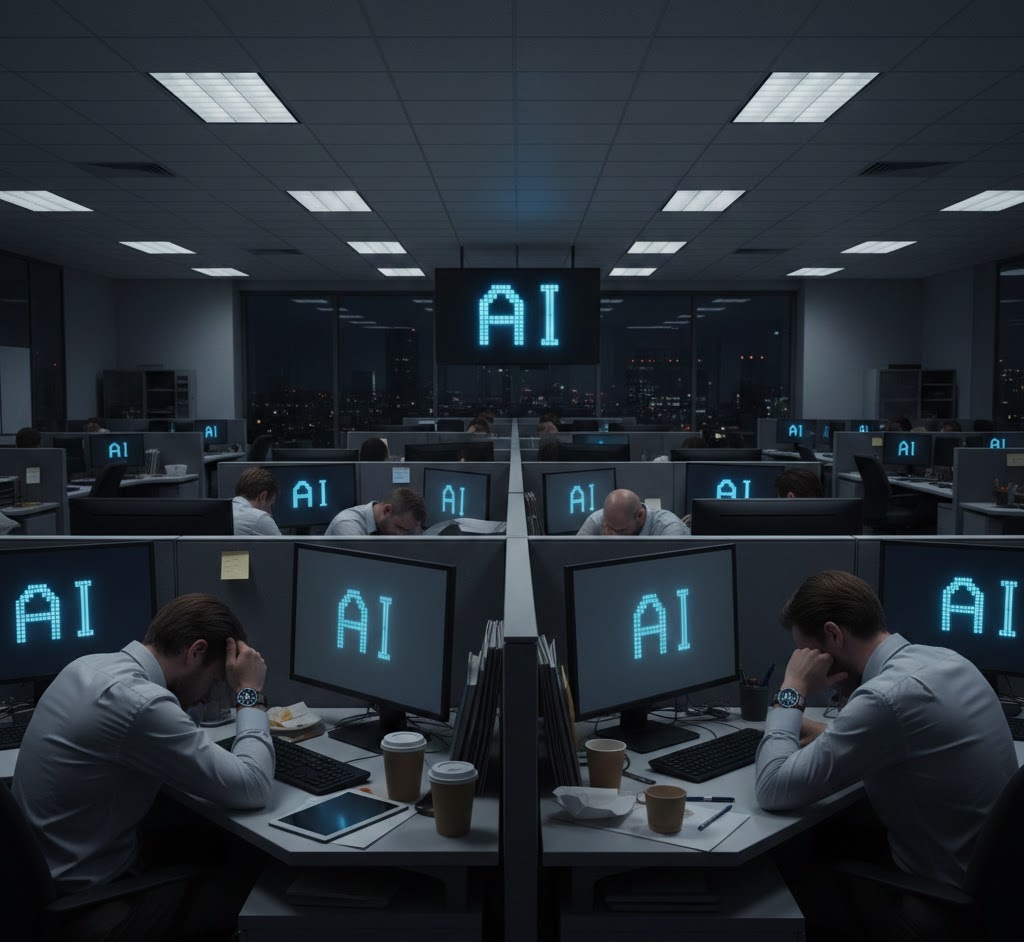
Many companies today are focused on getting more employees to use artificial intelligence. After all, AI promises to relieve people of routine tasks such as writing documents, summarizing information, or debugging code, allowing workers to devote themselves to more valuable activities. But are companies prepared for what will happen if they succeed?
Research by Aruna Ranganathan and Xingqi Maggie Ye from the Harvard Business Review revealed a surprising finding: AI tools do not reduce work but consistently intensify it. In an eight-month study of a U.S. technology company with approximately 200 employees, they found that workers worked at a faster pace, took on a broader range of tasks, and extended work into more hours of the day, often without being asked to do so.
Ways AI Intensifies Work
Task Expansion
Because AI can fill gaps in knowledge, employees increasingly took on responsibilities that previously belonged to others. Product managers and designers began writing code, researchers took on technical tasks, and people across the organization attempted work they would previously have outsourced, postponed, or avoided altogether.
Generative AI made these tasks newly accessible. The tools provided what many perceived as an enhancement of cognitive abilities: they reduced dependence on others and offered immediate feedback. Workers described it as "just trying things out" with AI, but these experiments accumulated into a significant expansion of job responsibilities. Employees increasingly absorbed work that would previously have justified additional support or new positions.
This also had side effects. Engineers, for example, spent more time reviewing, correcting, and guiding AI-generated work created by their colleagues. This oversight often occurred informally – in Slack messages or quick consultations at someone’s desk – adding to engineers’ workloads.
Blurred Boundaries Between Work and Leisure
Because AI made it easier to begin a task – lowering the barrier of a blank page or an unfamiliar starting point – workers inserted small amounts of work into moments that had previously been breaks. Many entered prompts into AI during lunch, in meetings, or while waiting for a file to load. Some described sending a "quick final prompt" just before leaving their desk so that AI could work while they were away.
These actions rarely felt like more work, but over time they created a workday with fewer natural breaks and more continuous engagement with work. The conversational style of prompting softened this further – typing a line into an AI system felt more like chatting than performing a formal task, making it easier for work to spill into evenings or early mornings unintentionally.
Some workers described realizing only in hindsight that, once prompting during breaks became a habit, leisure time no longer provided the same sense of recovery. Work felt less bounded and more all-encompassing – something that could always be moved forward a little. The boundary between work and leisure did not disappear, but it became easier to cross.
More Multitasking
AI introduced a new rhythm in which workers managed several active threads at once: they wrote code manually while AI generated an alternative version, ran multiple agents in parallel, or revived long-postponed tasks because AI could "handle" them in the background. They did this partly because they felt they had a "partner" who could help them work through their workload.
While this sense of having a "partner" created a feeling of progress, the reality was constant switching of attention, frequent checking of AI outputs, and a growing number of open tasks. This created cognitive strain and a sense of constant juggling, even though the work felt productive.
Over time, this rhythm raised expectations of speed – not necessarily through explicit demands, but through what became visible and normalized in everyday work. Many workers noted that they were doing more at once and felt greater pressure than before they began using AI, even though the time savings from automation were supposedly meant to reduce such pressure.
Implications for Companies
All of this created a self-reinforcing cycle. AI accelerated certain tasks, which raised expectations of speed; greater speed made workers more dependent on AI. Increased dependence expanded the scope of what workers attempted to do, and the broader scope further increased the volume and density of work. Several participants noted that although they felt more productive, they did not feel less busy and, in some cases, felt busier than before. As one engineer summarized: "You thought that maybe, because you can be more productive with AI, you would save time and could work less. But in reality, you do not work less. You work the same amount or even more."
Companies might view this voluntary expansion of work as a clear win. But the research reveals the risks of informally expanding and accelerating work: what looks like higher productivity in the short term may mask a quiet accumulation of workload and growing cognitive strain as employees juggle more AI-supported workflows.
Because the additional effort is voluntary and often framed as enjoyable experimentation, it is easy for executives to overlook how much additional strain workers are carrying. Over time, overwork can impair judgment, increase the likelihood of errors, and make it harder for companies to distinguish genuine productivity gains from unsustainable intensity. For workers, the cumulative effect is fatigue, burnout, and a growing sense that it is harder to disconnect from work.
How to Create an "AI Practice"
Instead of passively reacting to how AI tools are reshaping the workplace, individuals and companies should adopt an "AI practice": a set of intentional norms and routines that structure how AI is used, when it is appropriate to stop, and how work should and should not expand in response to newly discovered capabilities. Companies should consider adopting:
Intentional pauses – As tasks accelerate and boundaries blur, workers could benefit from brief, structured moments that regulate the pace: protected intervals for assessing alignment, reconsidering assumptions, or absorbing information before continuing. For example, a pause before making a decision could require one counterargument and one explicit connection to organizational goals.
Sequencing – Because AI enables constant background activity, companies may benefit from norms that intentionally shape when work moves forward, not just how quickly. This includes batching non-urgent notifications, holding updates until natural breakpoints, and protecting focus windows.
Human anchoring – Because AI enables more independent, self-sufficient work, organizations may benefit from protecting time and space for listening and human connection. Brief opportunities to connect with others – whether through short check-ins, shared moments of reflection, or structured dialogue – interrupt continuous solitary engagement with AI tools and help restore perspective.
The question companies face is not whether AI will change work, but whether they will actively shape that change – or allow it to quietly shape them.