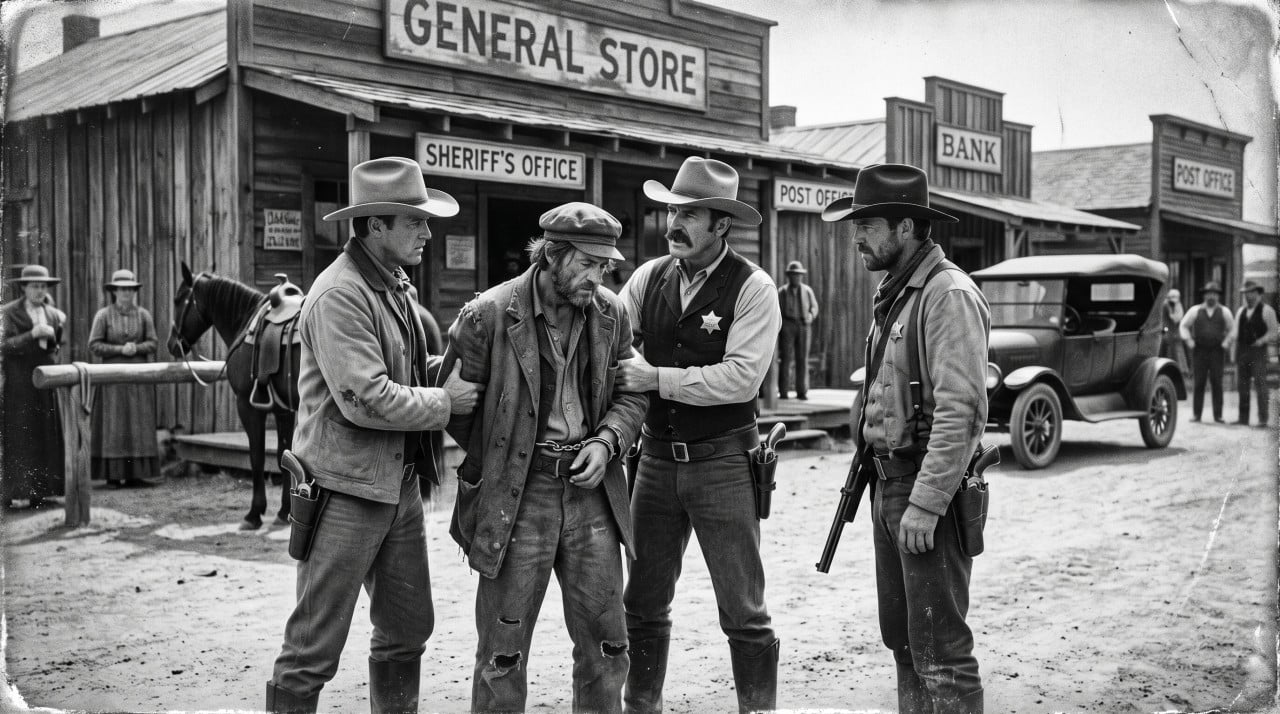
Fort Worth proudly calls itself “Cowtown” or “The City Where the West Begins.” Newspaper publisher Amon Carter began printing this slogan in the masthead of the Fort Worth Star-Telegram in 1923, and the entire city enthusiastically embraced it. The “cowboy culture” extended even to local police officers. Many of them carried revolvers long after automatic pistols became widespread, and the police department maintained a mounted unit until 1927. The cowboy spirit was primarily a matter of outlook and attitude, and it did not end with the disappearance of the frontier but survived in full force well into the 20th century. Local officers preferred to “pacify” unruly prisoners with the butt of a pistol rather than a nightstick. As late as 1904, night patrol captain Joe Witcher made his rounds on a faithful horse named Old Baldy, which he tied to a telephone pole behind City Hall whenever he dismounted. For all these reasons, it is surprising that the issue of defendants’ rights arose in criminal cases in this “cowboy town” long before the Miranda rule was established by the famous 1966 Supreme Court decision.
In three documented cases from the early 20th century, murder suspects were “Mirandized,” or at least informed of their constitutional rights by police officers. This was not a legal requirement, and it certainly did not happen every time. To understand how someone could be Mirandized before Miranda even existed, it is necessary to understand the contemporary concept of defendants’ rights. A so-called “spontaneous confession,” as opposed to a confession coerced through interrogation, was admissible in court. If a murderer cried out, “I did it,” such a statement was admitted as evidence. This is the principle of res gestae (Latin for “the thing itself”), under which a statement is admissible if it “forms part of the crime itself.” Res gestae does not apply if enough time passes between the arrest and confession that the confession can no longer be considered “spontaneous.” Another requirement of this principle is that every confession must be “free and voluntary,” meaning it must not have been beaten out of the suspect through the good old “third degree,” which encompassed various forms of physical and psychological coercion. At least that was what the law said. In reality, Fort Worth police officers regarded the third degree as standard practice, particularly with hardened Black and Mexican prisoners. Former police chief James Maddox defended it at the 1910 convention of the International Association of Chiefs of Police, and local newspapers praised the department more than once for this “effective work.”
The Fort Worth Police Department was typical of law enforcement at the time. Officers learned their trade on the job, without training academies or manuals. The way local police officers and prosecutors dealt with the issue of defendants’ rights is part of the story of the demise of the Wild West. Although the frontier had closed in 1890 according to historian Frederick Jackson Turner, the men charged with enforcing the law were still shaped by the frontier era.
Three specific cases from Fort Worth demonstrate that local police officers and courts were more receptive than most to recognizing defendants’ rights. In 1902, Jeff Vann was a Fort Worth cab driver who earned his living picking up passengers at the Texas and Pacific station at the southern end of Main Street. Vann was supposed to wait behind a marked line across the driveway in front of the station entrance and queue with the other cab drivers until it was his turn to pick up passengers. Officer Andy Grimes was on duty at the station on May 12, and among other things, he made sure that cab drivers did not block traffic and waited their turn. Vann refused to wait in line and parked his carriage directly in front of the entrance. Grimes approached him, looked up at Vann sitting on the driver’s box, and ordered him to move along. Because Vann had already been fined for the same offense and also had a history with Grimes, he began cursing at the officer. “You damned crooked son of a bitch, if you want something from me, come and get it!” he fumed.
Grimes pulled out his “appearance-bond book” and filled out a bond slip, which functioned much like a modern traffic ticket. He tried to place it in Vann’s hand, but Vann angrily pulled his hand away and reached beneath the seat for the .45-caliber revolver he kept hidden there. From a distance of several paces, he opened fire on the officer. Grimes crouched beside the carriage, and Vann jumped down on the other side. Meanwhile, Grimes drew his .38-caliber revolver and began firing back. Passersby and nearby cab drivers threw themselves to the ground as a good old-fashioned Wild West shootout unfolded: both men used the carriage for cover, firing over the roof and through the windows. They worked their way to the rear of the carriage, where they came face to face. They fired simultaneously, but only Vann’s shot found its mark, striking Grimes in the abdomen. The officer died at the scene. A total of eight or nine shots were exchanged, which dispels the Wild West myth that all men were armed and knew how to handle a gun. Eight or nine shots and only one hit is hardly an impressive result.
Officers John Fulford and Joe Witcher came running from the station, disarmed Vann, and arrested him. Before being taken away, Vann blurted out, “I did it.” After he was indicted for murder, the other cab drivers pooled their money for his defense and hired William P. McLean, one of the finest attorneys at one of Fort Worth’s most prestigious firms. Vann also changed his statement to better support his claim of innocence. Nevertheless, the jury found him guilty and sentenced him to hang. The appeals then began. One of the key arguments was that Vann’s confession was inadmissible because the officers had not first “warned” him that anything he said could be used against him. The Texas Court of Criminal Appeals agreed and overturned the verdict, though not solely for this reason. The court also pointed to other errors by the prosecution. Even if Miranda had existed, Vann’s confession would have been admissible as a “spontaneous statement,” so the defense’s objection was more a tactical maneuver than the core of the appeal. The fact that the appeal invoked it, however, proves that it was considered a constitutional issue worthy of judicial review. Jeff Vann was tried twice more before he was finally acquitted in 1904, on technical grounds, of course. The best lawyer always wins!
The second case came several years later, in 1908, and involved Ike Knight. At the time, he lived in North Fort Worth, then a separate city just across the Trinity River, with his bride Flo and her daughter Nellie from a previous marriage. Nellie had never much cared for her mother’s new husband, even before she married the “strikingly handsome” Ed Larmon and the newlyweds moved into the house shared by Ike and Flo. With her mother’s consent, they took over the master bedroom, while Flo moved into the second room and Ike was left with a “cellar-like den” at the rear of the house. Ike developed an immediate dislike for Ed that had nothing to do with fatherly concern for Nellie. The situation became so tense that Flo ordered Ike to move out. On Saturday morning, April 11, Ike went to work as usual, but soon left and headed to the county attorney’s office. He intended to file a complaint over being thrown out of his own home. When a clerk explained that the county attorney could do nothing until the matter had been decided by a court, Ike flew into a rage and left. Soon afterward, he returned through the back door of his house carrying a double-barreled shotgun and broke in. Ed and Nellie were at home. While Nellie ran to call the police, Ike chased Ed from room to room. He finally caught up with him, and Nellie heard two shotgun blasts, a brief pause, and then a third shot. Convinced she would be next, she ran outside screaming at the top of her lungs. As a crowd gathered in front of the house, Ike set off down Lake Street, with the crowd following at a safe distance. When North Fort Worth police officers Dick Howell and Oscar Montgomery came to stop him, Ike shot them both. The crowd eventually cornered him at the Panther City Creamery, where he surrendered to local sheriff’s deputies.
Both Howell and Montgomery survived the murderous attack, and Knight was charged with murder and “attempted murder.” Two days later, county attorney R.E.L. Roy visited him in his cell. Ike still had no lawyer, and Roy said menacingly, “It will be better for you if you make a statement.” Ike meekly confessed everything in the presence of a court reporter. He signed his statement, which was witnessed by an assistant county attorney and a deputy sheriff. Roy believed the signed confession had secured his victory. He obtained a first-degree murder indictment from the grand jury. By the time Ike went on trial on April 29, court-appointed counsel had been assigned to him and argued that Ike’s confession had not been made “freely and voluntarily.” It had allegedly been coerced from a man without legal representation who feared for his life and did not understand the legal system. In court, Ike testified under oath that no one had ever told him his confession could be used against him. This was either the statement of an incredibly naive man or the result of thorough preparation with his new lawyer. Nevertheless, the jury found him guilty and sentenced him to hang. Among the twenty-seven “bills of exception” filed by the defense, the decisive issue was the one challenging the admissibility of the jailhouse confession. The appellate court agreed with the defense and overturned the verdict, citing a “chain of errors” beginning with the disputed confession. The court ruled that the confession had been made too late to be considered “spontaneous” and had also been given without access to legal counsel. It was the first time in Fort Worth’s history that a defendant had succeeded in having a verdict overturned at least partly because he had not been properly advised of his rights. It was an application of the Miranda principle before it officially existed. The farmers and cattlemen who typically made up local juries at the time were generally unmoved by appeals to defendants’ rights. It was not customary to find a man innocent merely because his rights had been violated; either he had committed the crime or he had not. Over the next five years, Ike Knight went through four more trials before the prosecution settled in the sixth trial for a manslaughter conviction carrying a five-year prison sentence. Two years later, Texas governor James Ferguson granted him one of his annual Christmas paroles.
The third case involving a Miranda-style warning occurred in 1920 and concerned Jeff Couch and Tom Vickery. Fort Worth police officer Couch was the victim, and Tom Vickery was the man accused of murdering him. Couch came from an extended family of police officers. He grew up near the police station but did not take up the badge until the age of twenty-six. A quiet and peaceable officer, Couch was the complete opposite of old-school lawmen such as Timothy Isaiah “Longhair Jim” Courtright, who had ruled the city with his fists and revolvers in the 1870s. Couch joined the Fort Worth police force in April 1920.
Tom Vickery was a typical scoundrel: aggressive, a notorious drunk, quarrelsome, and always armed. In 1920, he worked as a driver for the Dollar Dodge car service. On December 20, he returned to the garage with drunken Fort Worth councilman Robert Dawson in the back seat. Vickery had also been drinking, perhaps the same bootleg beer as his passenger. At the garage, they argued over the fare, and Vickery emphasized his demand for payment by firing a couple of shots into the air. Jeff Couch, still a rookie patrolling the local trouble spot, was nearby and came running at the sound of gunfire. Instead of arresting anyone, he tried to settle the matter amicably, but then made a rookie mistake: he turned his back, and Vickery disappeared. Couch focused on escorting Councilman Dawson to a hotel where he could sleep it off. He was preparing to put him back in the car and take the wheel when Vickery reappeared, this time with a revolver in each hand. He forced them back into the garage along with the owner, lined them up against the wall, and opened fire in the style of the Saint Valentine’s Day Massacre, except that he used revolvers instead of submachine guns. The other two escaped uninjured, but Couch was hit seven times. He fell to the ground without ever managing to draw his weapon. Someone across the street called the police, who arrived shortly afterward. A citywide manhunt was launched for Vickery, and police chief R.R. Porter ordered his men to shoot to kill. Less than an hour later, accompanied by his attorney, Vickery walked into the sheriff’s office and surrendered.
That same day, Tarrant County attorney Jesse Brown came to the jail to question the accused. He had barely begun the interrogation when Vickery burst out, “I shot him, I know I shot him.” Vickery continued talking, implicating Dawson and accusing Couch of trying to “frame” him. Brown let him talk and must have privately congratulated himself on having such a forthcoming culprit. Unfortunately, no court reporter was present during the questioning, and Vickery had not yet spoken with an attorney. No problem. Brown returned to his office and wrote down a “detailed statement” from memory, considering it admissible evidence under the principle of res gestae because he had not actually been questioning the prisoner when he confessed. In his view, it was a “spontaneous confession made freely and voluntarily.”
Yet no one ever saw this crucial confession, and its admissibility was never challenged in court because it was never introduced into evidence. The reason was simple: Tom Vickery never made it to trial. On the night of December 22, while both guards at the Tarrant County jail were mysteriously occupied elsewhere, Vickery was dragged from his cell by unknown vigilantes, thrown into a car, and driven to Samuels Avenue, where he was hanged from a large tree. Those responsible were never brought to trial, although certain names were whispered in the streets. A grand jury indicted no one for taking Vickery from jail and hanging him. It was said that the decent people of Fort Worth had grown tired of delays in justice and of criminals escaping punishment on technicalities. Most people believed Tom Vickery had gotten what he deserved. The Texas Court of Criminal Appeals therefore never had to rule on the admissibility of the confession or on prosecutor Brown’s unorthodox methods.
There is a myth about law enforcement in the Wild West that justice was more straightforward in the old days, less obsessed with legal technicalities, and therefore more effective. These three cases show what happened when the old concept of justice collided with legal maneuvering. The appellate court usually set matters right, if an appeal ever reached it. Critics claimed that the Texas Court of Criminal Appeals enjoyed overturning verdicts merely to prove it was smarter than local judges and jurors. Whether true or not, the respectable citizens of Fort Worth had little patience for appeals and legal technicalities. They knew nothing about res gestae, but they knew very well when a man was guilty and what punishment he deserved.