Reining is one of the most dynamic Western disciplines you can see at competitions. It combines precision, speed, and perfect harmony between rider and horse into an exciting spectacle that fascinates spectators and experienced riders alike.
What is reining and why is it so attractive?
Reining is a Western riding discipline focused on maximum responsiveness and the horse's willingness to cooperate with the rider. It arose from the practical needs of American ranchers, who required horses capable of reacting quickly to unpredictable situations when working cattle. Today, it is one of the most prestigious Western competitions and often forms the highlight of events in the Czech Republic and around the world.
The word “reining” comes from the English word “rein” and captures the essence of the discipline—guiding the horse gently with one hand and minimal visible aids. The horse must give the impression that it performs every movement willingly and without resistance.
What you will see at competitions:
-
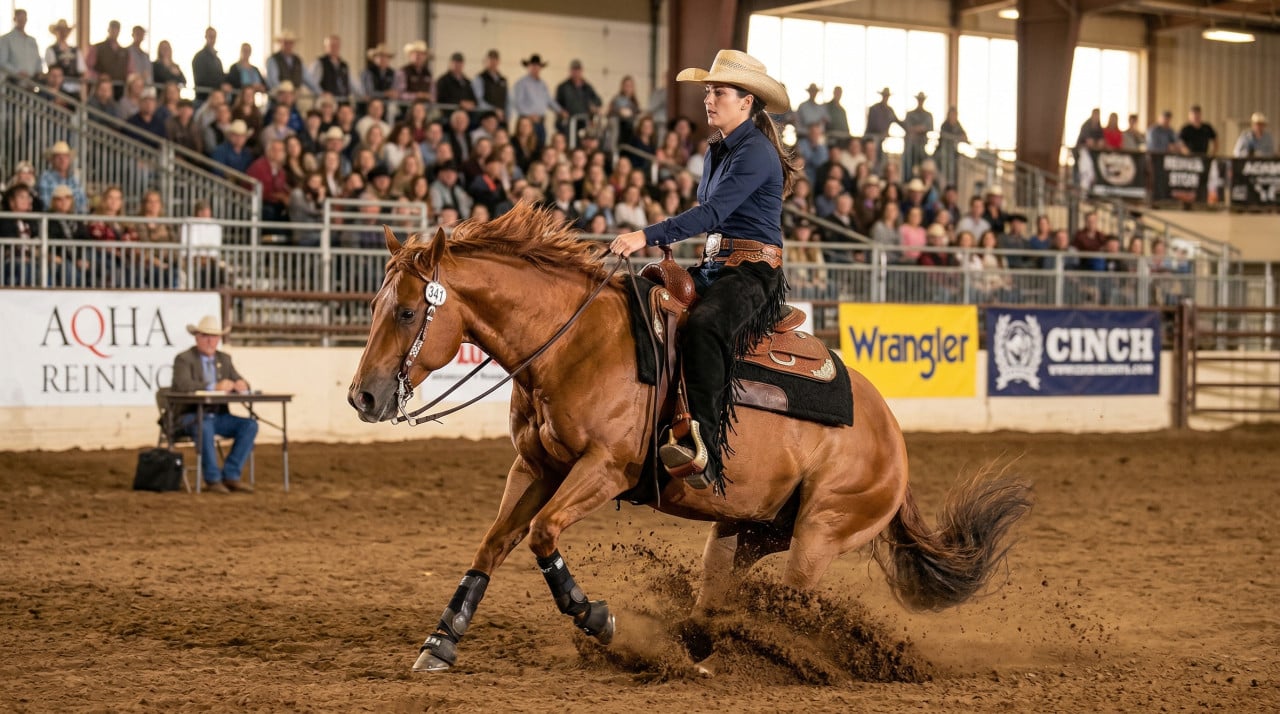
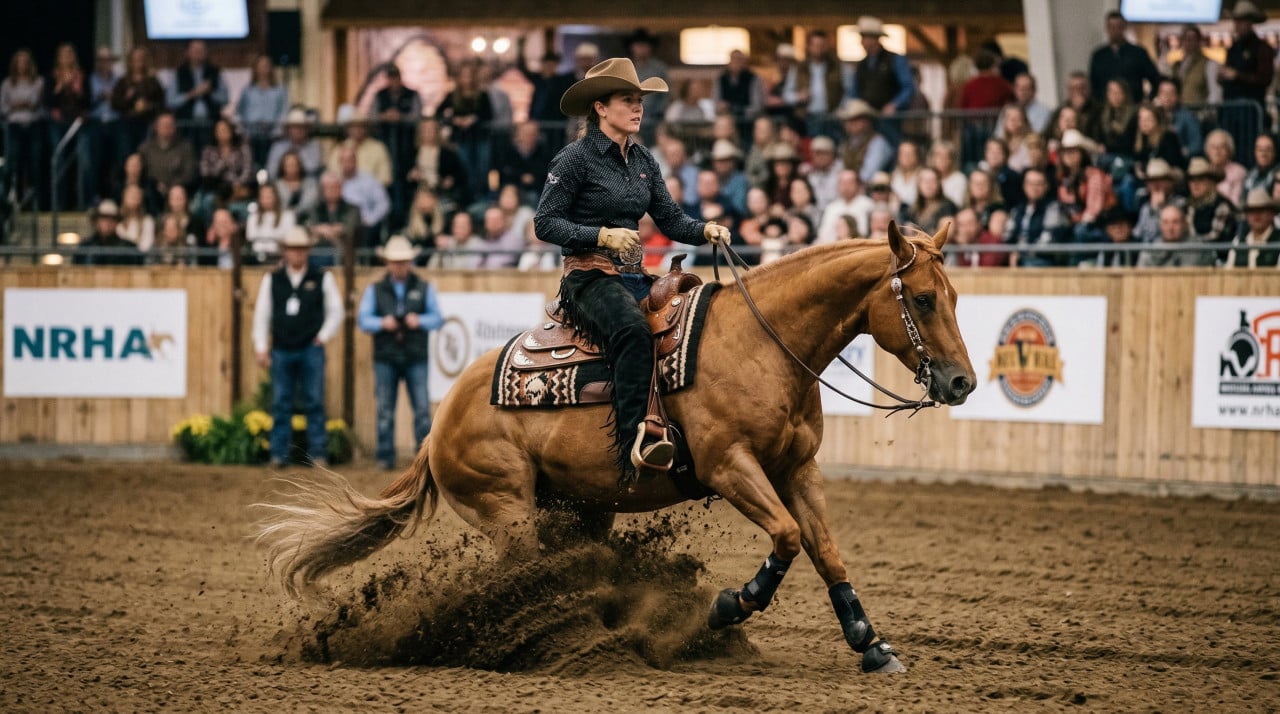
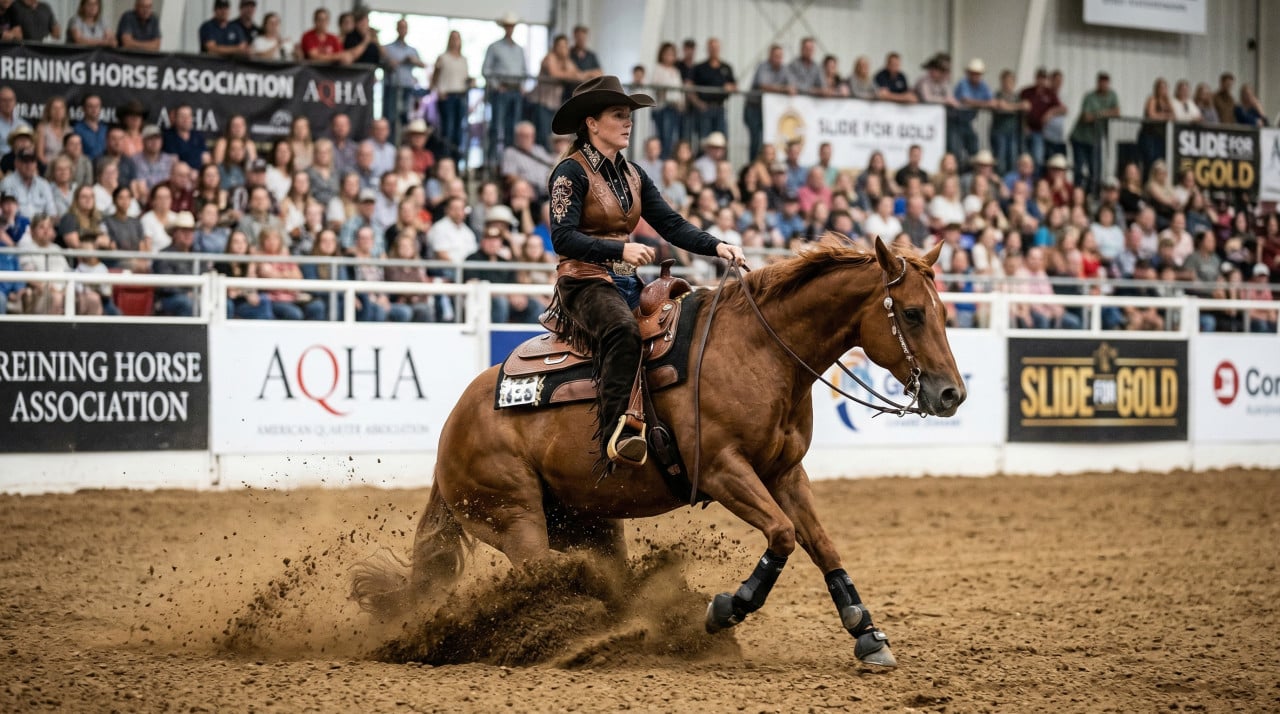
Sliding stop – a spectacular sliding halt in which the hind legs slide across the sand
-
Spins – fast 360-degree turns on the hind legs
-
Rollbacks – immediate 180-degree turns directly after stopping
-
Circles – large fast and small slow circles, performed with geometric precision
-
Backing – fast and straight, without hesitation
The judges assess not only the technical precision of the individual elements, but also the overall impression of the run. They observe whether the horse appears relaxed, cooperates willingly, and whether the rider can maintain the fluidity of the entire pattern. In the following sections, we will look at the history of this fascinating discipline, the judging rules, how to select a suitable horse, and the state of reining in the Czech Republic.
History of reining: from vaqueros to a modern sport
The roots of reining reach deep into the history of cattle work. What we see today as a sport with precise rules arose from everyday necessity—cattlemen needed horses that could stop immediately, change direction, and respond to the unpredictable movements of animals.
The origins of this riding tradition can be found on the Iberian Peninsula. Spanish and Portuguese riders developed a sophisticated system for training working horses known as doma vaquera. Through Spanish colonization, these techniques reached Mexico, where local vaqueros adopted them and adapted them to the conditions of the New World.
As the territory of the present-day United States was gradually settled, equestrian culture moved north. American ranchers began systematically breeding horses suitable for working cattle—this gave rise to the American Quarter Horse, which became the foundation of modern reining.
The first competitive patterns began to take shape in the United States during the first half of the 20th century. Working maneuvers that had previously been passed down from generation to generation were given written rules and a standardized form. The establishment of the National Reining Horse Association in 1966 was a key moment in the recognition of reining as a separate sport.
Today, reining is an FEI-recognized discipline with World and European Championships. It has a strong following not only in the United States, but also in Europe, including the Czech Republic.
Doma vaquera and its influence on reining
Doma vaquera is a traditional Spanish dressage method for preparing working horses to handle cattle. It is not merely a historical curiosity—the principles of this riding school directly influenced what we know today as reining.
Elements shared by doma vaquera and reining:
|
Element |
Function in cattle work |
|---|---|
|
Sliding stop |
Quick stop while tracking an animal |
|
Spins |
Immediate change of direction while herding |
|
Rollbacks |
Returning in the opposite direction without losing momentum |
|
Precise backing |
Careful maneuvering in confined spaces |
|
Transitions |
Adapting speed to the situation |
Spanish vaqueros developed a technique for guiding a horse one-handed on a long rein. This method left one hand free for the rider to work with a lasso, while the horse responded to subtle aids. The principles of quick reactions and maximum responsiveness passed into American Western riding and still form the basis of reining judging today.
Even modern reining patterns continue to reflect the logic of cattle work—sudden stops, changes of direction, and controlled transitions between speed and a slow pace.
National Reining Horse Association (NRHA) and judging rules
The NRHA, founded in the United States in 1966, serves as the global authority for reining rules, judging, and development. It organizes the most prestigious competitions, including the Futurity, Derby, and Maturity, divided according to the horses' ages and the riders' performance levels.
How the scoring system works:
-
The starting score is 70 points, representing an average performance of the pattern
-
For each maneuver, the judge may add or subtract between -1.5 and +1.5 points
-
A score above 70 indicates an above-average performance
-
At the international level, a score of 72 or more is considered very good
Errors resulting in penalties:
-
Breaking gait during a maneuver
-
Performing the wrong number of rotations during spins
-
Over- or under-rotating during a rollback
-
Deviating from the precise path of a circle
-
Changing direction too late or too early
-
Incorrectly performed backing
The judges also assess the rider's accuracy in executing the pattern. Deviating from a circle, miscounting spins, or failing to perform prescribed elements can result in substantial point deductions and, in extreme cases, disqualification.
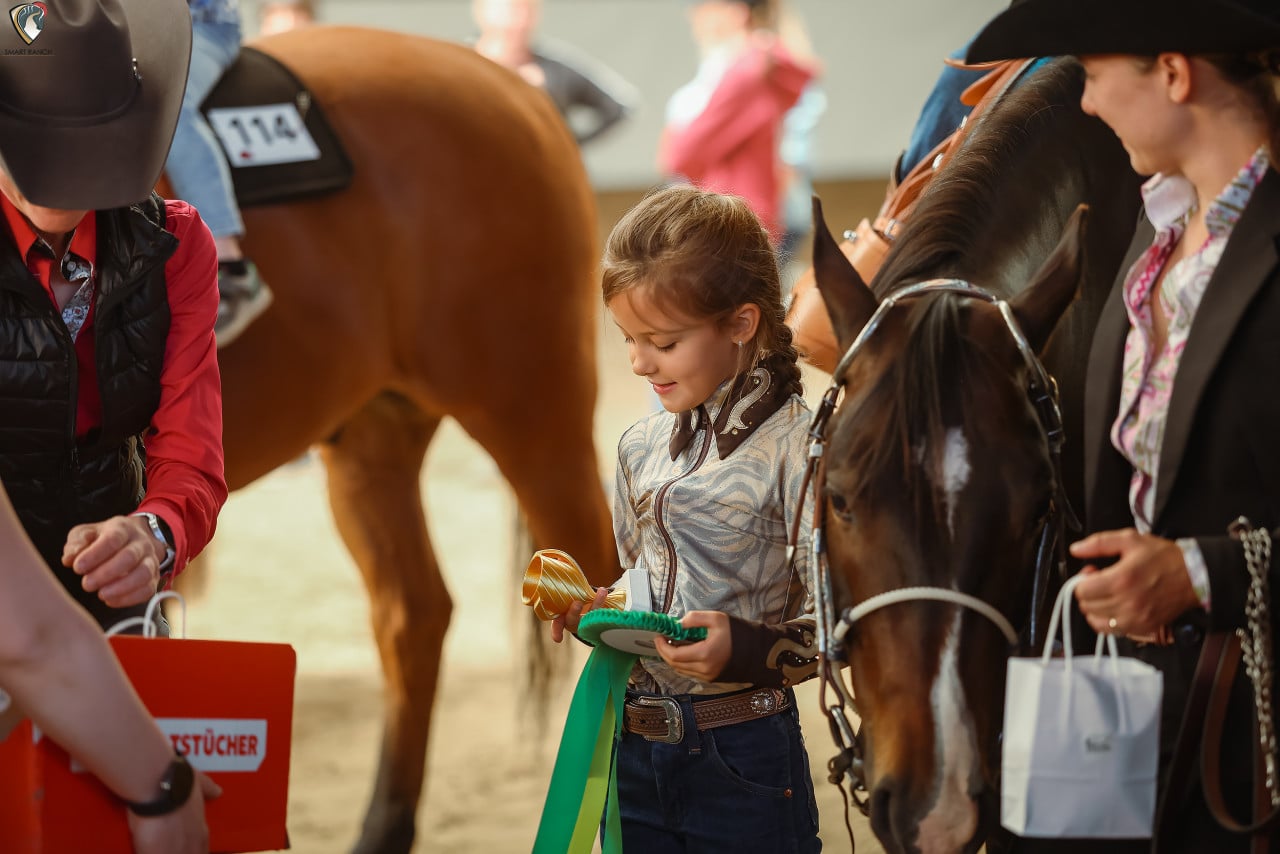
NRHA-approved competitions around the world are divided into Open (professionals), Non Pro (amateurs), and Youth categories, enabling fair competition among riders of comparable ability.
Definition of reining according to the NRHA and FEI
The NRHA defines reining as a discipline in which the horse must be guided with minimal effort from the rider and without visible resistance. Every movement should give the impression that it results from the rider's aids rather than the horse's own initiative.
This means that the horse:
-
Must not pin its ears or display threatening behavior toward the rider
-
Must not refuse to move forward
-
Must not kick up its hindquarters or move sideways
-
Must not wring its tail tensely in irritation
For international competitions, the FEI adopts the basic NRHA principles but adds its own requirements regarding horse welfare and rider qualification. FEI reining also includes team competitions at European or World Championships, and the official patterns are strictly defined.
To advance to top-level FEI competitions, riders must achieve a specified qualifying score at selected CRI (Concours de Reining International) events.
Selection and characteristics of a reining horse
A good reining horse combines a suitable breed, correct conformation, and a specific temperament. Together, these three factors determine whether the horse will be able to perform demanding maneuvers with ease and willingness.
The most common breed in reining is the American Quarter Horse, followed by the American Paint Horse and Appaloosa. However, functional conformation and a willing temperament are more important than pedigree.
Ideal conformation:
|
Body part |
Desired characteristics |
|---|---|
|
Hindquarters |
Strong and well-muscled, providing power for the sliding stop |
|
Tail |
Low-set |
|
Loin |
Short and strong |
|
Limbs |
Correctly aligned, with strong joints |
|
Back |
Shorter and compact |
People often speak of a “trapezoidal” horse—this refers to the balance between the forehand and hindquarters, which allows the horse to bring its hind legs well under its center of gravity. This quality is crucial for spins and rollbacks.
Temperament traits of an ideal reining horse:
-
A calm mind without excessive spookiness
-
Willingness to cooperate with the rider
-
Ability to concentrate even in the noisy environment of large arenas
-
A natural sense of balance
Talent for working on circles, turns, and transitions is assessed at a young age (2–3 years). Experienced trainers look for horses with a natural ability to “sit on their hindquarters” and respond to subtle aids.
Training a reining horse according to NRHA rules
From the outset, training should respect the NRHA definition—the horse must be guided without visible resistance and with minimal aids. The aim is not to force obedience, but to build a partnership in which the horse understands the rider's intentions and responds willingly.
Basic work with a young horse includes:
-
Riding straight and maintaining correct posture
-
Stopping in response to voice and seat aids
-
Transitions between walk and trot
-
Responsiveness to seat and leg aids
-
Gradually introducing the lope
Gradually introducing reining elements:
-
First, small turns on the hindquarters
-
Later, faster spins with precise counting
-
Short, precise backing in a straight line
-
Basic sliding stops at a slow speed
Training must be appropriate for the horse's age and physical maturity. Two- and three-year-old horses are at risk of overloading their tendons and joints if intensive sliding stops or fast spins are introduced too early.
The aim is to develop a horse that responds to a subtle touch of the rein and leg and can “switch off the engine” with an immediate stop without losing its mental composure. Consulting a trainer experienced in preparing horses for NRHA patterns can save years of work and prevent training mistakes.
Typical elements of a reining pattern
A pattern consists of precisely prescribed maneuvers performed in a given order and at designated locations in the arena. Each element has its own function and specific performance requirements.
Basic elements of a reining pattern:
|
Element |
Description |
Key judging criteria |
|---|---|---|
|
Large circles |
Performed at high speed |
Geometric precision, pace |
|
Small circles |
Slow and controlled |
Accuracy of the center, fluidity |
|
Spins |
360-degree turns on the hindquarters |
Number of rotations, fixed pivot foot |
|
Rollbacks |
Immediate 180-degree turn after a stop |
Fluidity, no hesitation |
|
Sliding stop |
Sliding halt |
Length of slide, straightness |
|
Backing |
Fast, straight, and precise |
Straight line, speed |
The sliding stop is one of the most visually striking elements. The hind legs slide across the arena surface while the front legs continue “walking” to maintain balance. A correct stop leaves a clear track from the hind shoes in the sand. The judges assess speed, fluidity, and the straight line of the slide.
Spins require the inside hind leg to serve as a fixed pivot point while the other legs move around it. Typical patterns require four rotations in each direction. The horse must maintain its rhythm and remain willing throughout.
The rollback follows immediately after the sliding stop. The horse must instantly push off with its hindquarters, turn 180 degrees, and immediately lope back. Any hesitation or loss of momentum lowers the score.
How to ride a pattern: precision and fluidity
A pattern is a prescribed test with numbered maneuvers. Both the NRHA and FEI have sets of standard patterns used at various types of competitions.
Rules for riding a pattern:
-
The rider must know the pattern by heart
-
Consulting notes during the run is not permitted
-
Mistakes in the order of maneuvers result in penalties or elimination
-
Precise adherence to the center line is crucial
The judges assess not only the individual maneuvers, but also the overall flow of the pattern. Smooth transitions between elements and the absence of pauses and hesitation all affect the final score.
Preparing for a competition:
-
Learn the pattern thoroughly by heart
-
Visualize every step before the start
-
If possible, walk through the pattern on foot in an empty arena
-
Memorize the exact positions of the center markers
Rider and horse equipment in reining
Reining requires specific Western equipment subject to strict rules. Violating the regulations may result in a penalty or disqualification.
Mandatory rider attire:
-
Long trousers (typically jeans)
-
Long-sleeved shirt
-
Western hat or approved helmet (depending on the category)
-
Western boots
Horse equipment:
-
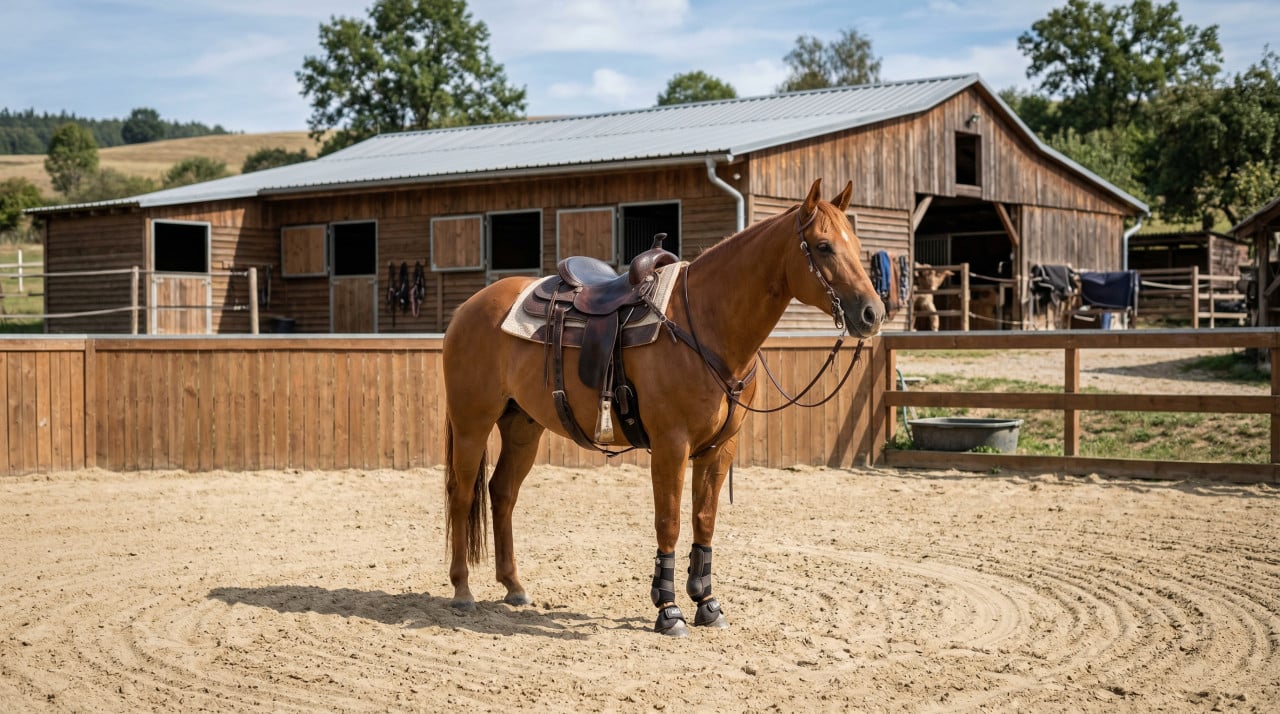
Western saddle suitable for reining (deeper seat, more open front)
-
Simple bridle appropriate for the horse's age
The type of bridle depends on the horse's age. Young horses (up to a specified age) may be ridden in a bosal or snaffle bit. Older horses must wear a curb bit and be ridden one-handed.
Prohibited aids:
-
Whips and crops
-
Martingales
-
Training reins that apply constant pressure
-
Spurs without rowels or with sharp points
-
Devices restricting tail movement
Permitted protective equipment for the horse:
-
Sliding boots for the hind legs
-
Bell boots for the front hooves
-
Protective boots for the front legs
These aids must not restrict the horse's natural movement.
Horse safety and welfare
Modern reining places great emphasis on protecting the horse's health and well-being. Both NRHA and FEI rules contain strict requirements concerning the treatment of horses.
Control mechanisms:
-
Equipment checks before the start
-
Prohibition of rough handling
-
Possible disqualification for inappropriate training methods
-
Stewards monitoring the competition
Judges and stewards check whether the rider is using excessive spur pressure, harsh hands, or an inappropriate correction bit. Any signs of horse abuse result in immediate disqualification.
Recommendations for caring for a reining horse:
-
Regular veterinary examinations of the musculoskeletal system
-
Special attention to tendons and joints
-
A high-quality arena surface for training
-
An appropriate workload suited to the horse's fitness
Sliding stops and spins place high demands on the musculoskeletal system. A high-quality arena surface—deeper, well-loosened sand or special mixtures—allows for safe sliding and reduces the risk of injury.
Reining in the Czech Republic: organizations, achievements, and events
Reining has had an established following in the Czech Republic since approximately the late 1990s, with links to the global NRHA scene. The discipline has developed significantly over the past two decades.
Key milestones:
|
Year |
Event |
|---|---|
|
~2000 |
Establishment of the CZRHA (Czech Reining Horse Association) |
|
2001 |
Reining recognized by the Czech Equestrian Federation as an official discipline |
The CZRHA operates as a regional NRHA affiliate focused on promoting the sport, education, and organizing competitions. Recognition by the Czech Equestrian Federation brought greater prestige and a larger number of events.
Main national events:
-
Czech Reining Championship
-
Competitions at specialized ranches (Paint Horse Ranch Kozlovice, Happy Hour Ranch in Krakovany)
-
Regional competitions and training events
The Czech Championship is held regularly, typically in September. Competitions are held in senior, youth, and amateur categories, allowing riders of different levels to participate.
Czech riders participate in European FEI structures, including the European Reining Championships. Both junior and senior categories are achieving increasing success on the international scene.
Courses and rider education
High-quality reining requires systematic rider education. Training camps and seminars with respected trainers are held regularly in the Czech Republic.
Benefits of educational events:
-
Opportunity to watch top trainers work in person
-
Consultation on specific issues involving your own horse
-
Learning the correct execution of reining elements
-
Familiarization with current rules and trends
We recommend that novice riders seek official training under the auspices of the Czech Equestrian Federation, CZRHA, or NRHA. Online broadcasts of major NRHA events (such as the Futurity in Oklahoma City) can provide inspiration—watching top horse-and-rider combinations helps riders understand what a high-quality performance should look like.
How to get started with reining: first steps for riders
Reining is not only for professionals. Almost anyone interested in Western riding and systematic work with horses can get started.
First steps:
-
Find a specialized Western riding trainer in your region
-
Master the basic Western seat
-
Practice circle work and changes of pace
-
Learn precise stops and simple turns
-
Include backing in your regular training
Lower-level categories are suitable for your first competitive experience:
-
Beginner – for complete beginners
-
Rookie – for riders with minimal experience
-
Youth – for young riders
In these categories, greater emphasis is placed on correct execution than on extreme speed or spectacular sliding stops.
Practical recommendations:
-
Follow the competition calendars of the Czech Equestrian Federation and CZRHA
-
Plan your season with sufficient time for preparation
-
Attend as a spectator first to understand how competitions work
-
Consider attending training camps before your first competition
Reining teaches patience, precision, and a deep understanding of the horse. It is not a discipline that produces quick results—it requires systematic work and building a relationship with the horse. For those willing to invest time and effort, however, it can become a lifelong equestrian journey filled with the satisfaction of progress.
Whether you dream of a sliding stop that leaves a track across the entire arena or are drawn to the precision of spins, reining offers a never-ending path toward mastery. The first step? Find a trainer and see how your horse responds to a subtle touch of the rein.