

Vector Technologies: A Fundamental Pillar of the Modern AI Data Stack
In recent years, artificial intelligence has become an integral part of our digital world. This revolution is driven, among other things, by advances in vector technologies— a critical yet often overlooked aspect of modern AI infrastructure. These technologies form a bridge between raw unstructured data and the ability of machines to truly "understand" this data and work with it in a way that approaches human understanding. Why should we pay attention to vector technologies? Simply because they represent a fundamental infrastructure component that enables the most advanced AI applications, from similar image search to sophisticated chatbots with long-term memory. In this article, we will delve into the world of vector technologies and explain how they work, where they are used, and why they are absolutely crucial to the future of artificial intelligence.
What Are Vector Embeddings and How Do They Work?
In the world of AI and machine learning, a "vector embedding" is a way to convert complex information (text, images, audio) into a numerical representation. Specifically, it is a list of numbers (a vector) that captures the significant properties of the original data. For example, imagine the word "apple." To a person, this word has a certain meaning; it evokes an image of fruit, color, and taste. To a computer, however, it is merely a sequence of characters without inherent meaning. A vector embedding converts this word into a series of numbers (for example, [0.2, -0.5, 0.8, ...]), where the values and their relationships encode the semantic meaning of the word. A key property of vector embeddings is that words or concepts with similar meanings have similar numerical representations. This allows a computer to "understand" that "apple" and "pear" are semantically closer to each other than "apple" and "automobile." This property enables:
- Semantic search: Searching based on meaning, rather than just keywords.
- Similarity analysis: Measuring how close two concepts are to each other.
- Classification: Assigning content to categories based on its properties.
Vector Databases: Modern Infrastructure for AI Data
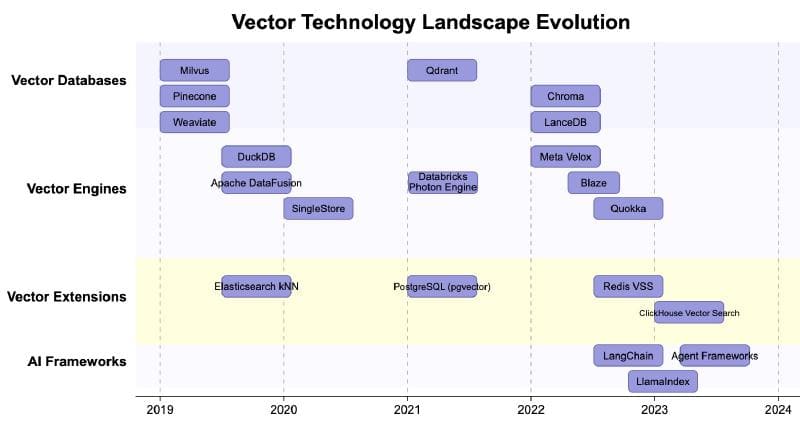
As the importance of vector embeddings has grown, so has the need to efficiently store and query billions of these high-dimensional vectors. This is where vector databases come in—specialized systems designed to work with vector data. Traditional relational databases (SQL) or document databases (NoSQL) are not optimized for similarity searches in vector space. Approximate Nearest Neighbor (ANN) searches in a high-dimensional space require entirely different approaches, algorithms, and indexing structures. Several dominant solutions for storing and querying vector data exist on the market:
- Pinecone: A fully managed vector database focused on simplicity, scalability, and performance.
- Milvus: An open-source vector database supporting various types of indexes and high performance.
- Weaviate: A vector-native database with knowledge graphs that combines vector search with the representation of structured data.
- Qdrant: Focused on high performance with support for filtering and metadata.
- Chroma: A simple, open-source database popular among developers of LLM-based applications.
- pgvector: A PostgreSQL extension that adds support for vector operations to this popular relational database.
Each of these solutions offers different trade-offs between performance, scalability, flexibility, and ease of use.
Vector databases and embeddings are used in many areas:
Semantic search
Unlike traditional search, which looks for exact keyword matches, semantic search understands the context and intent of a query. When a user searches for a "portable computer," the system understands that they are looking for laptops, even if they did not explicitly use that term.
Retrieval-Augmented Generation (RAG)
RAG is a technique that combines the retrieval of relevant information with generative models. Vector databases serve as "memory" for LLMs (Large Language Models), resulting in:
- More up-to-date and factually accurate answers
- Reduced "hallucinations" (the invention of false information)
- The ability to work with corporate or proprietary data
Recommendation systems
Vector representations make it possible to capture subtle nuances in user preferences and item characteristics. This leads to more accurate recommendations in e-commerce, streaming services, or news portals.
Similarity and duplicate detection
From uncovering plagiarism to finding similar items in product catalogs, vector technologies make it possible to efficiently identify similar or duplicate objects.
Multimodal applications
More and more applications work simultaneously with different types of data—text, images, and video. Vector representations make it possible to connect these different modalities, enabling advanced functions such as searching for images based on a text description or generating captions for images.
Architectural patterns and integration
- Batch processing pipeline - Data is periodically processed in batches, converted into vectors, and stored in a vector database. This approach is simple but can lead to outdated data.
- Real-time processing - Data is vectorized and stored immediately as it is created. This ensures up-to-date information but requires more robust infrastructure.
- Hybrid approaches - A combination of both approaches, where critical data is processed in real time while less important data is processed in batches.
Integration with existing data stack components
Vector databases often complement, rather than replace, existing database systems. Many organizations use an architecture in which:
- Relational databases store structured transaction records.
- Document databases store unstructured content.
- Document databases store unstructured content.
- Vector databases provide semantic search and similarity functions.
Challenges of Implementing Vector Technologies
Despite their promising benefits, the implementation of vector technologies faces several challenges:
Scaling infrastructure
As the volume of data grows, so do the demands on computing resources, storage, and throughput. Efficiently scaling vector databases can be challenging, especially while maintaining low latency.
Embedding quality
The quality of vector representations has a fundamental impact on the performance of the entire system. Poorly trained or unsuitable embeddings can lead to inaccurate results.
Maintenance and updates
As data changes over time, embeddings can become outdated. Effective strategies for updating embeddings are essential for the long-term usefulness of the system.
Measuring success
Evaluating the effectiveness of vector systems can be difficult. Metrics such as precision, recall, and latency offer only a partial view of their true value.
The Future of Vector Technologies
Vector technologies are developing rapidly, and several trends indicate their direction in the coming years:
Multimodal models and cross-modal retrieval
Future systems will work increasingly well with different types of media simultaneously, enabling queries such as "find videos similar to this image" or "find music that matches this mood."
Hybrid search
Combining semantic (vector) search with traditional keyword-based metrics and filtering will provide more balanced and contextually relevant results.
Distributed and edge computing deployment
As privacy and latency requirements increase, the ability to operate vector databases closer to end users, including on edge devices, will become more important.
Specialized hardware accelerators
Just as GPUs revolutionized neural network training, specialized hardware for vector operations can significantly accelerate vector computations.
Vector Technologies as a Fundamental Building Block of Modern AI
Vector technologies are rapidly becoming a fundamental part of modern AI infrastructure. Their ability to bridge the gap between unstructured data and machine understanding makes them a key component in the development of intelligent applications. Organizations that can effectively implement and leverage vector technologies will gain a significant competitive advantage through improved AI-based search, personalization, and automation. As these technologies continue to evolve, we will see even more sophisticated applications that will further blur the line between human and machine understanding of the world. For developers, data scientists, and IT leaders, understanding vector technologies and their place in the modern AI data stack is already a necessity, not a luxury. It is a fundamental skill for building the intelligent systems of the future.
Note: This article was created based on information from the Synthetic Systems Project (SSP) blog—the original content can be found at www.ssp.sh/blog/vector-technologies-ai-data-stack.


