The WSJ focused on hidden notes in the financial statements of the nine largest technology companies and found an amount that does not appear in ordinary press releases. It amounts to approximately three trillion dollars in future payments associated primarily with artificial intelligence that have not yet appeared on official balance sheets at all. The following day, well-known investor Michael Burry, who became famous for his successful bets against the U.S. mortgage market, responded by pointing out that he had highlighted this risk much earlier.
What reporters found in the notes
The authors of the analysis drew on the latest financial statements filed with the U.S. financial market regulator. Every quarter, major technology companies report enormous capital expenditures on data centers and chips. According to the authors, however, these figures fall far short of capturing the true extent of the commitments that Alphabet, Meta, Oracle, and other companies in the market have already made.
The difference is substantial. Conventional capital expenditures by the nine companies examined reached approximately 600 billion dollars in the latest reported year. However, contracted off-balance-sheet payments are five times higher and are growing significantly faster. At the same time, they are roughly three times greater than all the debt these companies collectively owe from current leases and long-term loans. The journalists reviewed the financial statements of Alphabet, Amazon, Microsoft, Meta, Oracle, Nvidia, Broadcom, SpaceX, and AMD.
Well-known investor Burry also weighed in
Michael Burry shared a graphic from the article on the social network X and added a note saying that readers could have learned this information some time ago, specifically in 2025. He also included a forward-looking jab, comparing the financial media's belated awakening with a risk that he believes the market has yet to face, estimating that it will not begin receiving coverage until 2027.
In recent months, Burry has repeatedly argued that investors are focusing on the wrong numbers. He considers the assumption that technology companies are such powerful cash-generating machines that the timing of expenditures relative to when investments in artificial intelligence begin to pay off does not really matter to be a critical weakness of the current market.
How a data center lease becomes an invisible item
The clearest example is Meta's project in Louisiana. The Hyperion data center covers an area equivalent to approximately 1,700 soccer fields, and the company initially leased it for four years beginning in 2029, with an option to extend the lease by up to twenty years. Meta also promised bondholders that it would compensate them for any losses if it did not remain in the project for the full two decades. However, because it does not consider such a payment likely, it did not record any item on its official balance sheet.
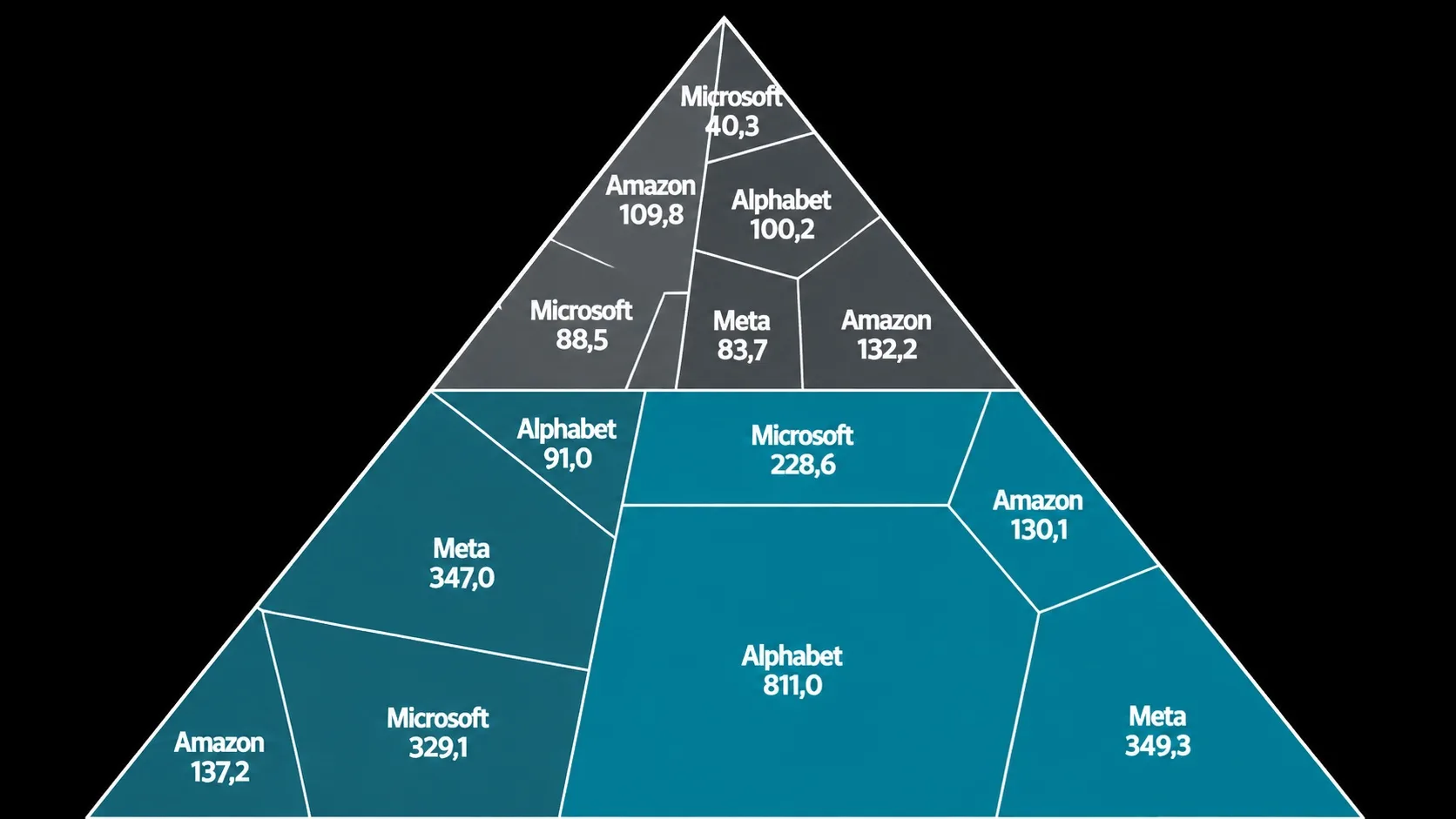
The accounting rules are simple. Until a company begins paying rent, there is no trace of the lease in its financial statements. Meta stated that the initial lease value for the Hyperion project is approximately 12 billion dollars. However, as of June, it reported 347 billion dollars for all leases that had not yet commenced. And that is just one company. Across all the companies analyzed, contracted payments from leases that had not yet commenced reached 1.2 trillion dollars, approximately four times more than a year earlier.
Chips and energy ordered decades in advance
The second major category consists of orders placed with suppliers. Data centers are being filled with advanced hardware, from Nvidia's computing chips to memory modules. Companies reserve production capacity far in advance to ensure sufficient supply. These contracts generally do not appear in financial statements until the supplier actually delivers the goods. The total value of such orders among the companies examined reached 1.9 trillion dollars.
Alphabet has been the most aggressive. As of June 30, it reported 811 billion dollars in purchase agreements. Just three months earlier, the figure was 332 billion dollars, and the company provided no explanation for what caused this massive increase. The description reveals only that these agreements primarily concern technical infrastructure, inventory, and energy supply arrangements for data centers. Some of these energy contracts run through 2054. By comparison, Meta has approximately 349 billion dollars in similar orders, Microsoft 229 billion dollars, and Amazon 130 billion dollars.
The same category also includes contracts that have nothing to do with either chips or concrete. Nvidia has committed to making 27 billion dollars in capital investments between the end of April and the end of its fiscal year in January 2027. In other cases, companies guarantee leases for third-party tenants or promise to purchase shares in partner companies in the future.
Concerns over the official figures
Alphabet, Amazon, Meta, and Microsoft collectively report 248 billion dollars in leases and 356 billion dollars in long-term debt. These are the figures that analysts routinely monitor and comment on. Yet next to the three trillion dollars hidden in the financial statement notes, they seem almost inconspicuous.
This is not an accounting trick that pushes the boundaries of the law. Most of these items are reported exactly as required by current rules. The problem lies in the timing and in how difficult it is to determine from the statements what a company has actually ordered. Even a diligent analyst has difficulty calculating the full extent of the risk precisely because each company discloses data at a different level of detail and interprets differently what still qualifies as a lease.
What is concerning is that companies long considered financially unshakable are now turning to the capital markets much more frequently. Both Alphabet and Amazon reported negative free cash flow in their latest financial results, a situation in which investments exceed the cash generated by operations themselves. And this equation still does not include the trillions of dollars in contracted payments, most of which can no longer be canceled, regardless of whether the expected revenue ultimately materializes.
Optimists have their counterargument ready. Demand for artificial intelligence tools is surging, driving stock markets higher and causing hardware shortages. Those who believe this view expect strong demand for years to come and assume that the money needed to pay the bills will arrive on time. The pessimistic scenario, however, looks completely different. In that case, the technology giants would end up with expensive infrastructure that they could not use profitably, and they would have to borrow even more money to pay their suppliers.
The differing views have also clearly been reflected in share price performance. Meta has lost nearly 11 percent over the past month and is down by approximately the same amount since the beginning of the year. Alphabet has lost just under 4 percent over the past month, although it remains up by more than 68 percent year over year. Microsoft, by contrast, gained just under 29 percent over the month, although it still shows a slight year-over-year decline. Amazon has gained 6 percent over the past month and has risen by just under 14 percent since January.
Sources: wsj.com and finance.yahoo.com