Thanks to MIT Scientists, You Can Train Robots Yourself Without Programming
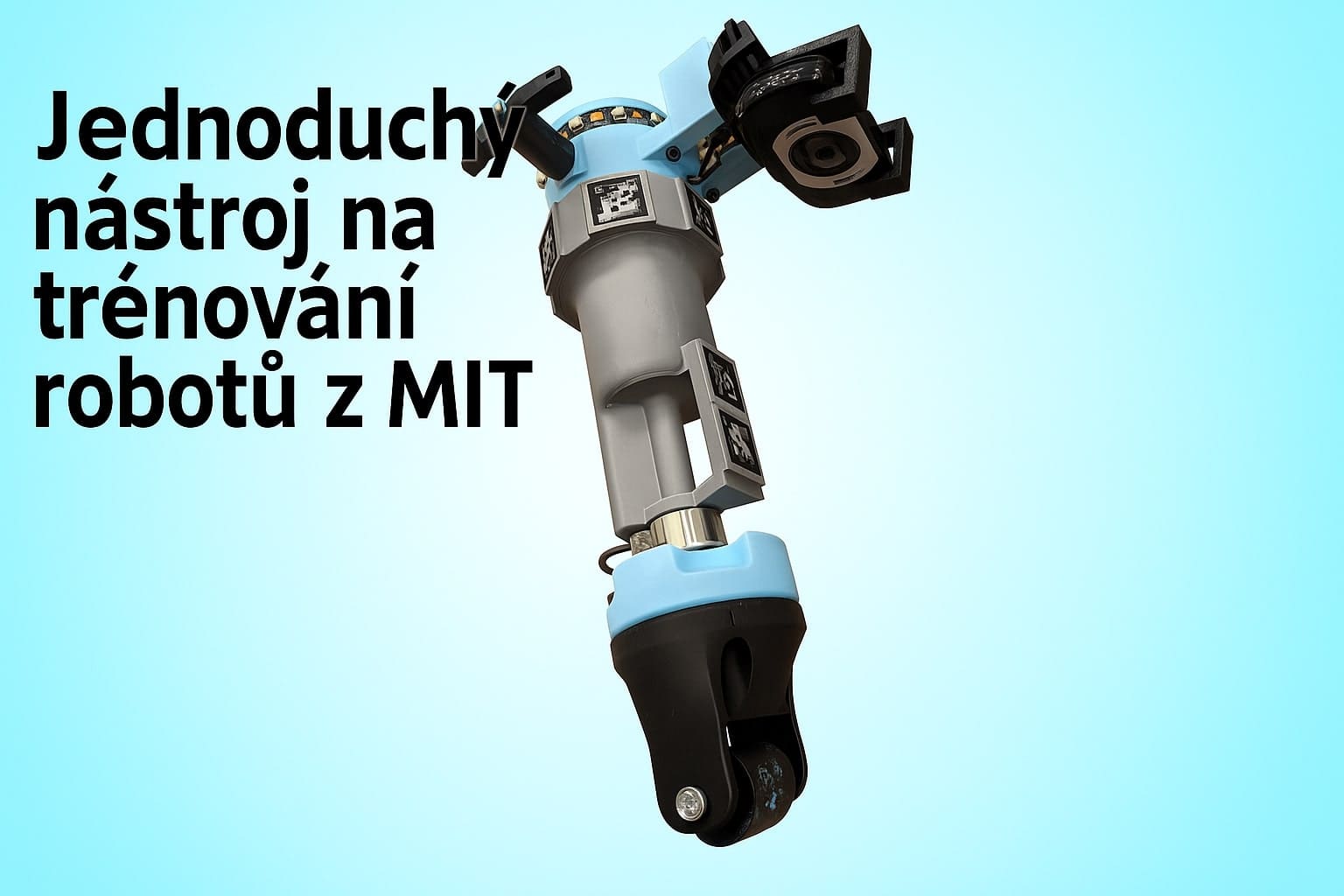
Imagine you are on a factory line and need to quickly teach a robot a new task—such as precisely pressing pins into holes or evenly rolling a rubber compound around a rod. Previously, this would have required a coding expert, but now anyone can do it. Engineers at MIT have developed a new tool that makes training robots natural and intuitive. This handheld device, called the versatile demonstration interface, supports three different teaching methods, opening the door to a wider range of people who can work with robots. Let’s take a look at how it works and why it could transform both manufacturing and households.
What Is This Tool and How Was It Created?
This innovative tool is a small, easily attachable device that can be mounted on a standard collaborative robotic arm. It was developed by MIT engineers, including postdoctoral researcher Mike Hagenow from the Department of Aeronautics and Astronautics, postdoctoral researcher Dimosthenis Kontogiorgos from the Computer Science and Artificial Intelligence Laboratory (CSAIL), alumnus Yanwei Wang, who recently earned a PhD in electrical engineering and computer science, and Professor Julie Shah, head of the Department of Aeronautics and Astronautics. Their goal was to create a system that would allow people to teach robots new skills “on the spot,” without having to interrupt their work and reprogram the software.
The device is equipped with a camera that tracks movement and position, as well as force sensors that measure the pressure applied during a task. When attached to a robot, it captures data from demonstrations and enables the robot to learn independently. This approach is based on the concept of “learning from demonstration” (LfD), in which a robot imitates human behavior instead of relying on complex programming. The team drew inspiration from existing methods but combined them into a single flexible tool, which is crucial for a variety of tasks—from handling toxic substances to precisely drawing a logo.
Three Training Methods
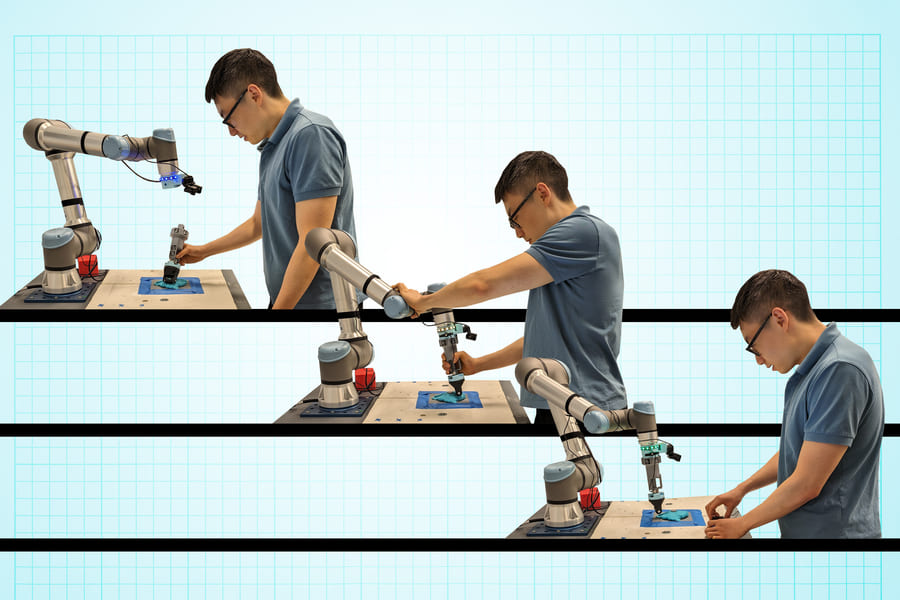
What makes this tool so exceptional? It supports three distinct teaching methods, which users can select according to their needs or preferences. The first is teleoperation: A person controls the robot remotely, for example using a joystick, which is ideal for dangerous tasks such as handling toxic materials. The second method is kinesthetic teaching, in which a person physically guides the robotic arm through the desired movements—perfect for adjusting its position while moving heavy packages.
The third and often most popular method is natural teaching: The device is detached from the robot and held by a person, who performs the task themselves. The camera records the movements and force, which the robot then imitates once the device is reattached. For example, during tests, volunteers used this method to teach a robot to evenly roll a rubber compound around a rod, resembling thermoforming processes used in manufacturing. This flexibility means that on a single production line, one person can teach a robot remotely, another can guide it physically, and a third can teach it naturally—all without complicated setup.
Real-World Testing
The team tested the device at a local innovation center where manufacturing experts learn about new technologies. The volunteers, all experienced in industry, used the interface to train a collaborative robotic arm to perform two common manufacturing tasks: pressing pins into holes and evenly rolling a rubber compound around a rod. Each volunteer tried all three methods.
The results? Natural teaching was the most popular because it felt the most intuitive. However, the volunteers noted that each method has its advantages: teleoperation for hazardous substances, kinesthetic teaching for heavy objects, and natural teaching for precise tasks such as drawing a logo. This feedback helped the team understand how the device expands the possibilities for human-robot collaboration, not only in manufacturing but potentially also in households or patient care.
Related Innovations and the Future
In addition to this interface, MIT is working on other tools that expand robot training capabilities. For example, the PhysicsGen system, developed at the Computer Science and Artificial Intelligence Laboratory (CSAIL), uses simulations to tailor training data to specific robots. This approach takes human demonstrations performed in virtual reality, maps them into a 3D simulator, and optimizes the movements for efficiency. From just a few demonstrations, it creates thousands of simulated examples, enabling robots to learn complex tasks such as manipulating objects in homes or factories.
Together, these innovations are lowering the barriers to robot adoption. According to MIT research, such tools could expand the use of robots across various industries where precision and adaptability are important. The team plans to improve the design based on feedback and test it on a broader range of tasks, which could lead to smarter robots that help with everyday life.
This development from MIT shows how technology is making robots more accessible. If you have ever dreamed of teaching a robot to cook or stack boxes, that possibility is now closer to reality than ever before. What do you think—would you try it?