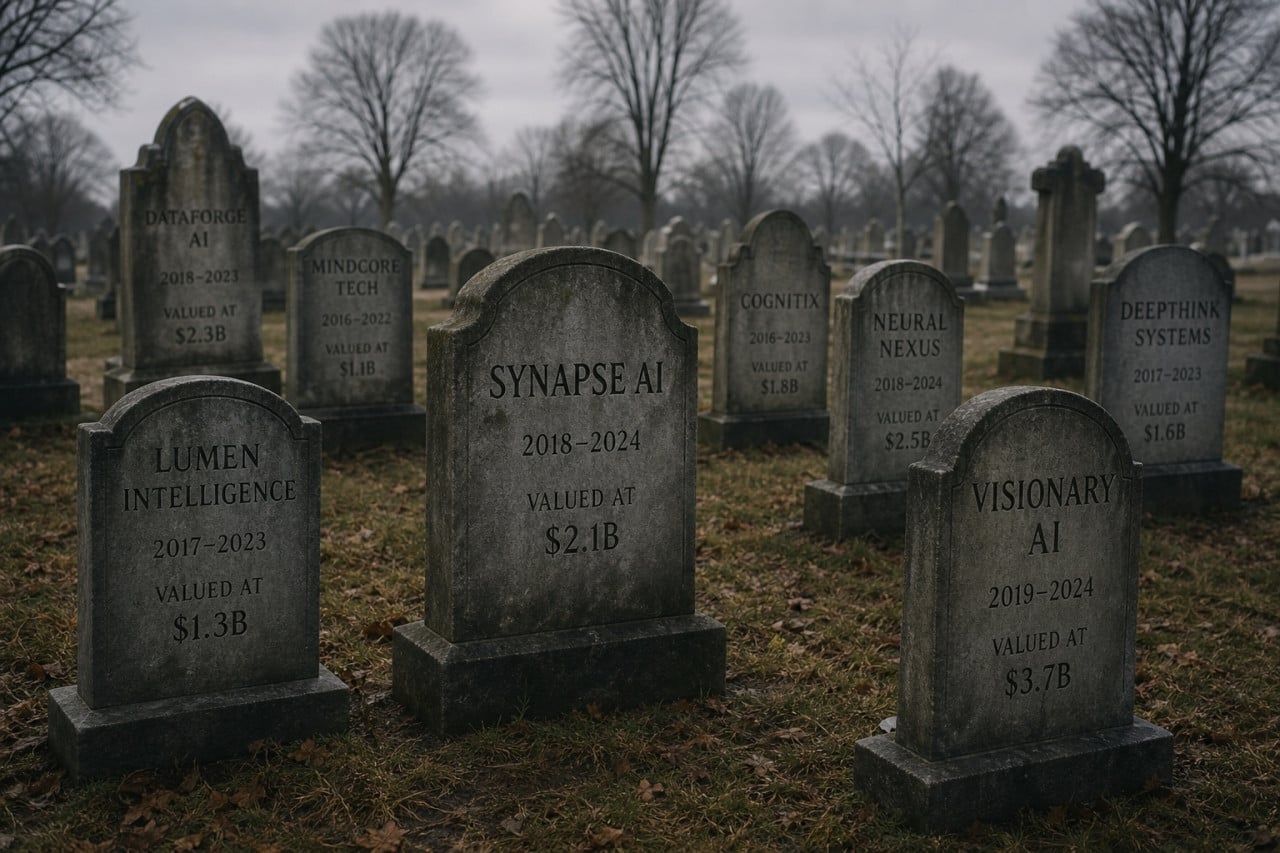
As long as the music was playing, cheap money was flowing, and the pandemic was driving consumer interest upward, startups were securing billion-dollar valuations one after another. Then the music stopped. And those who failed to get off in time came crashing down.
ChatGPT arrived in November 2022, bringing with it a brutal transformation of the entire startup world. Hundreds of companies that had reached valuations of more than a billion dollars during the boom years of 2020 and 2021 discovered that their technology had become obsolete before they had a chance to turn a profit. At the same time, it is becoming clear that the founders of today’s successful companies do not look at all like we thought they would.
The startup graveyard is filling up faster than anyone expected
The ToolDirectory.AI website has launched a project aptly named AI Graveyard. It currently lists 142 AI tools that have either shut down completely or been absorbed by larger companies. Nineteen of them announced their closure, 61 simply disappeared from the internet without any explanation, and 62 ended in acquisition.
April and May 2026 brought fresh additions: Avanzai, a financial data analysis tool; CollovGPT, an interior design tool; and Pipio, which generated videos featuring virtual actors. The biggest blow, however, was the shutdown of OpenAI’s Sora platform in March. OpenAI itself switched it off after realizing how expensive it was to operate.
And it is not just about small projects. OpenAI itself is under pressure to cut costs and has its own graveyard of announced deals that never reached the finish line. Critics such as journalist Ed Zitron point to a troubling pattern: a large share of the AI industry’s revenue comes from companies that are themselves losing billions every year and survive only thanks to a constant influx of additional capital. A self-sustaining cycle.
Valuations are collapsing. Sometimes by 80 percent
According to data from analytics company PitchBook, there are 857 startups in the US valued at more than one billion dollars. But almost half of them have not raised any new funding in the past three years. Their valuations are therefore outdated, reflecting an era that no longer exists. Companies that last raised funding in 2021 are now worth an average of 68 percent less. Those from 2022 have lost more than half their value. The result is more than 220 so-called fallen unicorns—companies that once crossed the billion-dollar threshold but have been unable to return to it.
The list includes some big names. Glossier, the cosmetics brand popular with Generation Z, fell from $1.8 billion to less than $1 billion. Calendly, the scheduling tool that has become ubiquitous in Western companies, lost three-quarters of its value, leaving it worth just under $800 million from an original $3 billion. 3D printer manufacturer Formlabs fell from $2 billion to $820 million. The education platform Articulate, previously valued at $3.75 billion, is now worth less than $700 million. That is a decline of 82 percent.
"Many of these companies are from the pre-AI era, not only in terms of their cost structure but also in terms of the product itself," says Immad Akhund, CEO of fintech company Mercury. "If you are not an AI-first company, you now have to show really strong numbers to raise any money at all." And this is not a local fluctuation. Valuations have shrunk roughly sixfold since their 2021 peak. Back then, startups were selling for 50 times their projected revenue; today, that multiple is a fraction of what it was. A company with the same revenue is now worth about 85 percent less on the market than it was five years ago.
Why SaaS companies are falling the fastest
Of the more than 220 fallen unicorns, the largest group consists of software companies that sell subscriptions under the so-called SaaS model. There are 75 of them, twice as many as financial technology companies, the second-largest category. David Zhu, former head of engineering at DoorDash, where he led more than 200 engineers, sees it this way: "My thesis is that all software companies built around employees’ repetitive workflows will either be displaced or disappear within the next decade."
The traditional SaaS model is based on a company paying for every employee who uses the software. But with the arrival of autonomous AI agents capable of automating workflows, this entire model is losing its purpose. "The question I ask every time someone from one of these companies pitches me is: why can’t OpenAI, Anthropic, or Google do this? And most of the time, the answer is: they can," one investor said in a report for CNBC. Startups built after the arrival of ChatGPT, by contrast, are performing differently. "The companies I invested in after 2022 are making more money than most of those from the pre-ChatGPT era. And they have existed for less time," investor Falvey said.
Who are the founders of unicorns?
While the market is shedding the remnants of the boom, SignalFire analyzed more than 2,000 founders from approximately 800 US startups that achieved billion-dollar valuations between 2010 and 2024. The findings shatter one of Silicon Valley’s most persistent myths.
The image of a nineteen-year-old student who drops out of school, codes an app, and becomes a billionaire over the weekend has always been more of a fairy tale than a statistical reality. And the data confirms it. In 2010, the average unicorn founder had about eight years of professional experience. In 2025, it is almost 14 years. An increase of 70 percent over fifteen years.
Today’s successful startups are being created in fields where knowing how to code is not enough. Healthcare, energy, financial oversight, and AI infrastructure all require deep industry expertise, operational maturity, and the ability to navigate complicated rules and processes. Such things cannot be replaced by enthusiasm or a weekend project.
Where were these founders educated?
Not where you might expect. The traditional American elite universities—Harvard, Yale, Princeton, and others—produce fewer unicorn founders than the six leading technical schools: Stanford, MIT, UC Berkeley, Georgia Tech, Carnegie Mellon, and Caltech. While those six technical schools educated 16.3 percent of founders, the entire eight-member Ivy League produced 13.8 percent. Stanford ranks first with nearly 7.5 percent, Harvard is second with 4.6 percent, and MIT and Berkeley share third place with 3.2 percent.
More than 22 percent of founders earned a degree outside the US. And from an unexpected direction: seven Israeli universities ranked among the top twenty non-Chinese foreign schools whose graduates go on to found US unicorns. Tel Aviv University, Technion, and the Hebrew University of Jerusalem are now names that carry weight with investors. Israel simply produces world-class technology founders relative to its population.
Their fields of study? More than 29 percent of founders studied computer science. Nearly a quarter studied economics, finance, or business. More than half have a background in science or engineering.
Founders from DeepMind and OpenAI have overtaken Google
Historically, investors looked at whether a founder had worked at Google, Microsoft, or Meta. The numbers of former employees from these companies who go on to found startups are still the highest. But when SignalFire adjusts the data for the companies’ total number of employees—in other words, when it normalizes the figures—a completely different ranking emerges. DeepMind is the most effective factory for unicorn founders. OpenAI is right behind it. Palantir ranks third, D.E. Shaw fourth, followed by Square, Dropbox, Airbnb, McKinsey, Stripe, and Nutanix.
Why DeepMind and OpenAI in particular? Their former employees work at the very frontier of what AI can do and understand deep technical problems better than anyone else. As a result, the startups they found receive high valuations from investors even before they demonstrate any business results.
As for the roles founders come from, mechanical engineers top the list, followed by founders of other startups and then product managers. Product managers in particular are on the rise: they think systematically, know the customer, and understand how to connect technology with business.