

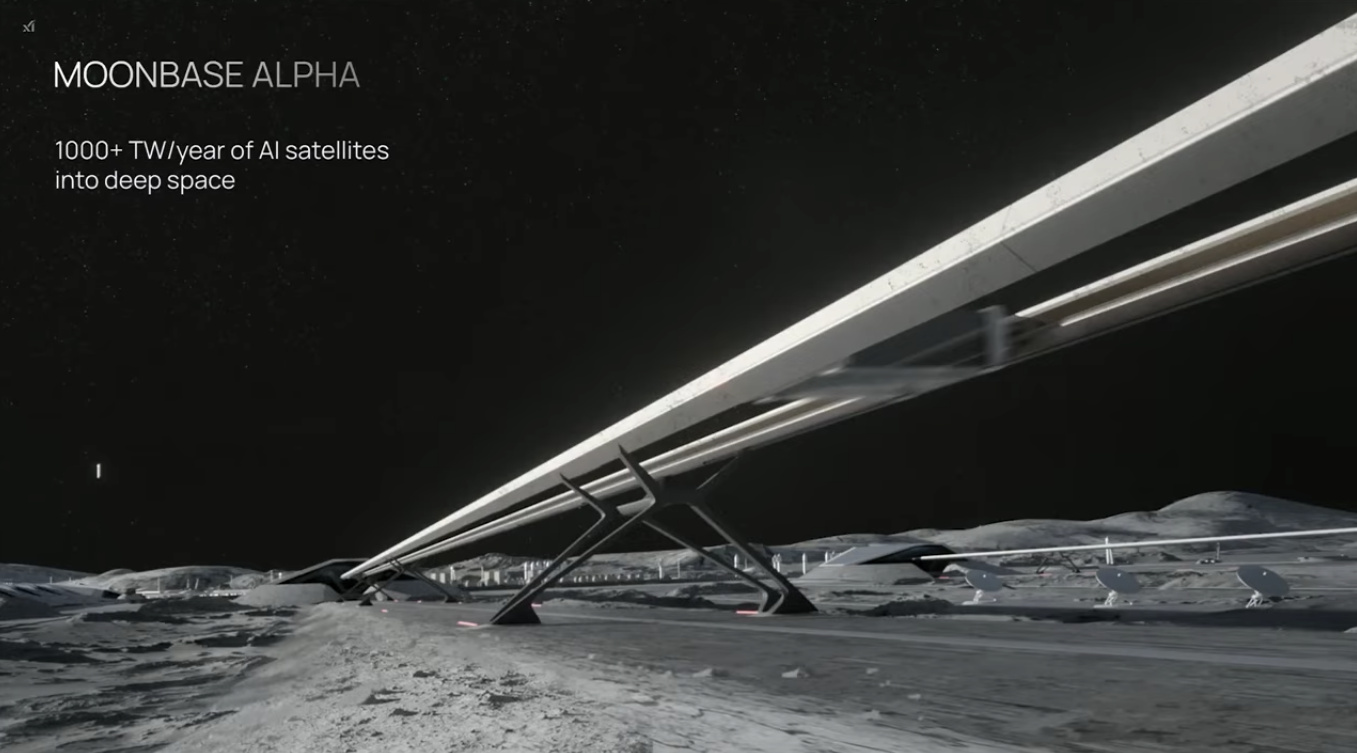
Elon Musk unveiled ambitious plans at an internal xAI meeting to build a lunar base that would manufacture and launch artificial intelligence satellites into deep space. This vision comes at a time when the company is undergoing a reorganization and facing the departure of key founders.
Following the recent merger of xAI with rocket company SpaceX and ahead of a planned initial public offering, Musk needed a new, motivating vision for his employees. Instead of the previous focus on colonizing Mars, which SpaceX had long championed, Musk is now turning to the Moon as a key location for the future of artificial intelligence.
"I really want to see a mass driver on the Moon launching AI satellites into deep space," Musk said during Tuesday's meeting, which the company published on the X platform on Wednesday. The 45-minute video revealed details about the company's product roadmap and plans.
Since xAI was formed just 30 months ago, the small and talented team has made remarkable progress.
— xAI (@xai) February 11, 2026
The future has never looked more exciting! pic.twitter.com/QZ73H2mpBj
Lunar factory and electromagnetic catapult
Musk's vision includes building a self-sufficient city on the Moon that would manufacture advanced computers and satellites. These satellites would then be launched using an electromagnetic catapult – essentially a giant magnetic track similar to a maglev train. "What if you want to go beyond just one terawatt per year?" Musk asked his employees. "To do that, you have to go to the Moon." According to him, the lunar base could harness several percent of the Sun's energy to train and operate AI models.
For his vision, Musk draws on the Kardashev scale – a theoretical measure of galactic civilizations created by a Soviet astronomer in the 1960s. This scale measures energy use – early civilizations learn to harness all the energy resources on their planet, then (hypothetically) move into space and build infrastructure to capture the Sun's energy. "It's hard to imagine what intelligence on that scale would think about," Musk told his team, "but it will be incredibly exciting to see."
Reorganization and founder departures
The meeting came as the company faces a wave of departures. Of the original 12 founders, only six now remain. This week, two more co-founders – Tony Wu and Jimmy Ba – announced their departure. Musk explained the departures as part of a necessary reorganization. "Because we have reached a certain size, we are organizing the company to make it more effective at this scale," he said. "Naturally, when that happens, some people are better suited to the early stages of a company and less suited to the later stages."
On Wednesday, Musk clarified on the X platform that the departures were not voluntary. "xAI was reorganized a few days ago to improve speed of execution," he wrote. "As a company grows, especially as quickly as xAI, the structure must evolve. This unfortunately required parting ways with some people."
xAI was reorganized a few days ago to improve speed of execution. As a company grows, especially as quickly as xAI, the structure must evolve just like any living organism.
— Elon Musk (@elonmusk) February 11, 2026
This unfortunately required parting ways with some people. We wish them well in future endeavors.
We are… https://t.co/kfmSmBlieb
The company is now divided into four main teams: one focused on the Grok chatbot (including its voice version), another on the application's coding system, a third on the Imagine video generator, and finally a team focused on the Macrohard project, which encompasses everything from simulating computer use to modeling entire corporations.
"Macrohard is capable of doing anything on a computer that a computer is capable of doing," said Toby Pohlen, who will lead the project. "Rocket engines should be fully designed by artificial intelligence."
Orbital data centers
Plans for space-based data centers face significant technical and economic challenges. According to an analysis by engineer Andrew McCalip, a 1 GW orbital data center could cost approximately 1.08 trillion Czech korunas – almost three times more than its terrestrial equivalent. A key factor is the cost of transport into orbit. While the current Falcon 9 rocket offers a price of approximately 91,000 Czech korunas per kilogram, making space-based data centers economically viable would require achieving a price of around 5,000 Czech korunas per kilogram – an 18-fold improvement.
Product updates
New usage and revenue figures were also announced during the meeting. Nikita Bier, head of product at the X platform, said that X had just surpassed 25.4 billion Czech korunas in annual recurring subscription revenue.
Executives also said that xAI's Imagine tool generates 50 million videos per day and more than 6 billion images over the past 30 days. However, these figures cannot be separated from the wave of deepfake pornography that flooded the X platform during this period.
The launch of a standalone XChat app and a new transactional app called X Money is expected in the coming months. XChat will allow users to use only the messaging feature without having to visit the X platform and will support video calls with multiple participants. "With X Money, we have actually had X Money live in closed beta within the company, and we expect to move to a limited external beta in the next month or two and then launch worldwide for all X users," Musk said. "And it is really meant to be the place where all the money is, the central source of all monetary transactions."
From Mars to the Moon
The lunar base comes after SpaceX publicly stepped back from its long-standing goal of colonizing Mars. In the nine years since the plan to explore and colonize Mars was unveiled, the vision served as an effective recruitment tool for SpaceX employees. T-shirts bearing the slogan "Occupy Mars" offered a visible symbol of the company's ambitions.
The problem was that no one wanted to pay SpaceX to go to Mars. Plans announced in 2016 to turn the Dragon spacecraft into a Mars lander were abandoned the following year after the technical challenges became too costly.
Now, with xAI in the corporate structure, Musk needs a new science-fiction metaphor for the future. As one departing company executive put it: "All AI labs are building exactly the same thing, and it's boring." Mass-producing a solar-system-scale supercomputer on the Moon may not be boring – but it is certainly not the same as everything else.
Sources: techcrunch.com and businessinsider.com


