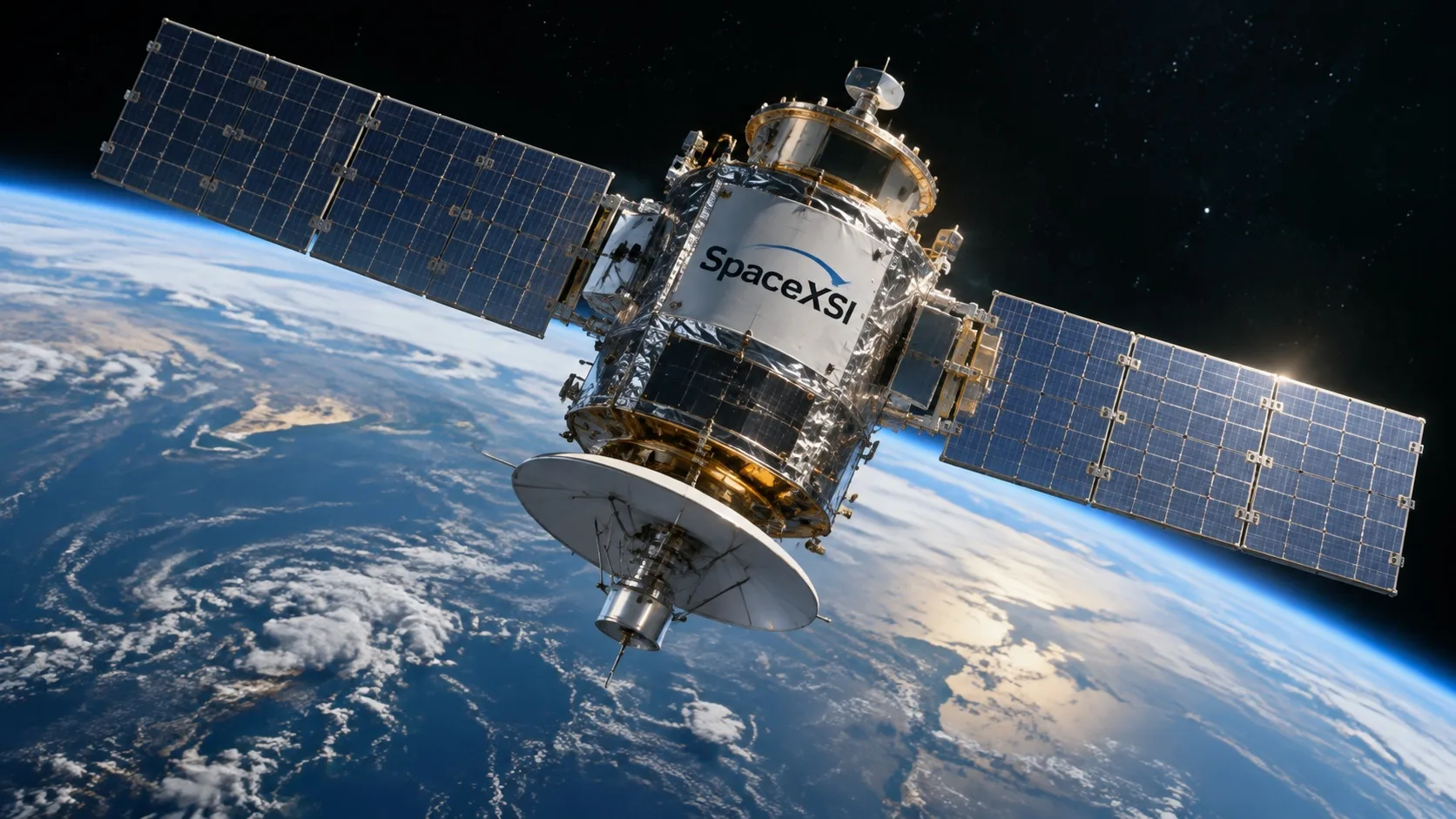
Elon Musk wants to take artificial intelligence where it will not be hindered by land constraints, overloaded power grids, or lengthy building permits. In the third quarter of 2027, SpaceX will begin sending StarMind computing systems, which it is developing jointly with Nvidia, into orbit. Musk believes that computing power in space will grow so quickly that by the end of 2028 it will surpass all new capacity built on Earth. According to him, terrestrial data centers will be tiny compared with orbital ones.
He discussed the project at the 33rd annual Baron Investment Conference in New York, where he was interviewed by investor Ron Baron. He is keeping the details secret for now, but he is not holding back on bold claims. When we reveal the details of the StarMind computer next year, it will blow people’s minds, he said.
Nvidia chips in orbit
SpaceX is building its first orbital systems around the Vera Rubin NVL72 platform, with Nvidia directly involved in their design. The powerful technology that currently occupies enormous data center halls will thus be moved off the planet on a large scale for the first time. Following the initial launches in 2027, SpaceX plans to significantly accelerate deployment in 2028 and 2029.
However, a supercomputer in orbit needs to transmit data quickly back to Earth and between satellites. That is why Musk is betting on a new generation of Starlink. According to him, Starlink V4 satellites are expected to handle ten times more than the current third-generation version, which itself offers ten times the capacity of the second generation. Each satellite will be equipped with ten next-generation laser links, each capable of transmitting more than 10 terabits per second.
Musk’s plans do not end there. A network of more than 100,000 satellites, each carrying roughly one hundred lasers, could, according to him, outperform undersea cables. His argument is based on physics. Light travels through space about 40 percent faster than through optical fiber, and a signal in orbit does not have to follow the contours of continents, allowing it to take a more direct route.
Base in Memphis
Thanks to xAI, SpaceX already has substantial computing power on Earth. According to estimates by the Epoch AI organization, the Colossus 2 center in Memphis has computing power equivalent to more than one million Nvidia H100 graphics chips, making it the world’s largest artificial intelligence computing facility.
At the conference, Musk described how he is personally involved in its construction. He lives in an Airstream trailer right next to the power plant that supplies the center. According to him, the company built the energy infrastructure in roughly a year, even though it usually takes about five years. The power plant now supplies more than one gigawatt. I pulled power cables as thick as an anaconda, Musk boasted, adding that he also connected optical links and network switches. He walks around the site up to five times a day to experience firsthand the challenges his people face.
He also defended the benefits of large data centers for the city. According to him, restaurants and hotels in Memphis have more customers, wages are rising, and the city is collecting more tax revenue.
Musk also wants to meet demand for computing power with his own chips. Tesla is building a semiconductor research factory at Gigafactory Texas, where it aims to shorten a development process that normally takes about a year to roughly one month. Designs that prove successful will then be transferred to the Terafab factory in Grimes County, which will focus on high-volume production.
Cooling, radiation, and hundreds of billions of dollars
On paper, space offers clear advantages for artificial intelligence. The sun shines there continuously, there are no building permits to obtain, and SpaceX controls the rockets that will deliver the hardware into place. But the technical obstacles are just as real. Cooling powerful chips in a vacuum is difficult, cosmic radiation can damage electronics, and chips become obsolete so quickly that expensive satellites may lose their value before the end of their service life. Experts therefore warn that one factor will be decisive: whether SpaceX can demonstrate that computing in orbit is cheaper than building another data center on Earth. Starship launch costs will also play a role, as will whether customers show interest in orbital computing power.
Musk’s comments came shortly after Shaun Maguire of Sequoia Capital published a financial model for SpaceX. It projects revenue growth from more than $50 billion in 2026 to over $270 billion a year later and more than $730 billion in 2028. These are an investor’s estimates, not the company’s own forecast. The model assumes that SpaceX’s computing capacity on Earth will grow from approximately one gigawatt at the beginning of 2026 to 21 gigawatts by the end of 2028, with each gigawatt generating nearly $40 billion annually. However, capital expenditures could reach almost $370 billion in 2028, and the company would not begin generating free cash flow until the middle of that year.
Sources: interestingengineering.com and finance.yahoo.com