

Something interesting is happening in South Korea – people and businesses there now spend more money each month on artificial intelligence (AI) subscriptions than on Netflix. According to data from December 2025, payments for seven major AI services, such as ChatGPT and Gemini, totaled CZK 1.365 billion. That is more than Netflix's average monthly revenue in the country in 2024, which was around CZK 1.275 billion. This increase is no coincidence: the number of credit card transactions for AI services jumped from 52,000 in January 2024 to 1.666 million in December 2025. Individual users pay an average of CZK 590 per month, while businesses spend as much as CZK 1,826. ChatGPT has the largest share at 71.5%, followed by Gemini at 11% and Claude at 10.7%. Kim Hyung-min, head of Hankyung Aicel, sees this as a sign that generative AI is becoming a standard subscription, much like other services.
Political Strategy for AI
South Korean President Lee Jae-myung launched a policy called AI for All, which aims to make the country one of the world's three leading AI powers. In 2025, after taking office in June, he appointed Ha Jung-woo, head of the AI Innovation Center at Naver Cloud, as the first Secretary for AI and Future Planning. The National AI Strategy Committee was established in September 2025. Five companies, including LG AI Research, SK Telecom, and Naver Cloud, were designated as national AI champions to lead the development of the domestic ecosystem. This effort responds to serious challenges, such as the declining birth rate of 0.75 children per woman and an aging population in which one-fifth of people are over the age of 65. AI is intended to help maintain productivity because the country is resistant to a larger influx of migrant workers.
OpenAI's Economic Blueprint
OpenAI has released an economic blueprint for South Korea proposing ways to maximize the benefits of AI for economic growth. The country has strong foundations in semiconductor manufacturing, devices, and networks, as well as an educated workforce and a government that has made AI a national priority. In October 2025, OpenAI announced its first partnerships in the Asia-Pacific region, including the Stargate initiative, under which Samsung and SK are expanding supplies of advanced memory for AI. Together with the Ministry of Science and ICT (MSIT), they are exploring the construction of AI data centers. The blueprint recommends a dual strategy: building domestic AI capabilities in models, infrastructure, and data governance while also collaborating with OpenAI developers. Priority areas include exports in industries such as semiconductors, automobiles, and shipbuilding, where AI assists with design and supply chain optimization. In healthcare, AI is expected to support doctors, reduce errors, and expand access, especially as the population ages. In education, AI tutors personalize learning and assist teachers outside major cities. For small and medium-sized businesses, AI assistants simplify paperwork and exports, supporting growth beyond Seoul.
Balancing the US and China
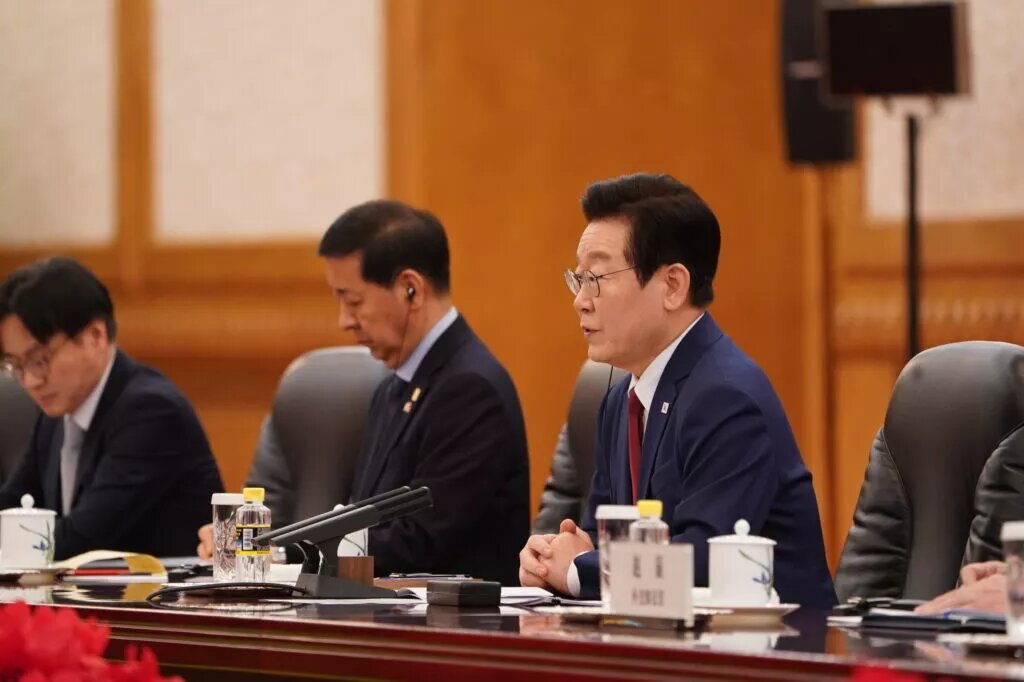
South Korea's rapid AI development is also creating geopolitical tensions. The country is strengthening cooperation with the US in defense technologies, including SK Group's partnership with Amazon Web Services on a data center in Ulsan and an agreement with Nvidia for 260,000 graphics processing units. This helps combat cyber threats from North Korea, such as the Lazarus Group, which collaborates with Russian actors such as Gamaredon. AI machine learning systems, for example, improve attack detection and response. However, this close relationship with the US, including interest in AUKUS Pillar 2, complicates relations with China. President Lee Jae-myung is pursuing pragmatic diplomacy – he met with Chinese President Xi Jinping at the 2025 APEC summit and visited Beijing in January 2026, marking the first state visit to China by a South Korean president since 2019. If cooperation with the US deepens, China could respond with sanctions, as it did in 2017 following the deployment of the US THAAD system (an air defense system), when it restricted tourism to South Korea. In November 2025, China issued a travel warning for Japan, demonstrating how it uses tourism as a tool of pressure.
Infrastructure and Support for AI Growth
For South Korea to succeed, it needs robust infrastructure. OpenAI's blueprint emphasizes partnerships under Stargate to expand computing capacity and data centers, with a focus on location, energy, and efficiency. Operational readiness, such as testing, monitoring, and incident response, is also important. For data, it proposes interoperable platforms with rules for consent and anonymization, along with regulatory sandboxes for safe experimentation. Chris Lehane, OpenAI's Chief Global Affairs Officer, says South Korea has a historic opportunity to lead thanks to its strengths in semiconductors, digital infrastructure, and talent. If it combines its own capabilities with partnerships, it can develop an exportable package of AI technologies, financing, and expertise, similar to those for nuclear energy or smart cities.
Sources: aibase.com and openai.com


