What do you do when the US government cuts off your access to the best models on the market overnight? Japanese company Sakana AI has an answer. It is called Fugu, and instead of relying on a single large model, it uses an entire group of available models, choosing among them based on the task it needs to solve. Sakana claims that its flagship version, Fugu Ultra, keeps pace with Anthropic's Claude Fable 5 and Mythos Preview on the most demanding engineering, science, and logic tests. And it does so without using any of these banned models.
Just around 10 days before the release, a US export order forced Anthropic to withdraw its most powerful models from worldwide availability. Entire countries lost access, and these are precisely the customers Sakana is addressing: you do not need banned models to achieve their level of performance.
How the Fugu model works
Fugu is Japanese for pufferfish, the fish that chefs must prepare carefully to keep it from being poisonous. The system itself is also highly sophisticated in its own way. It is a language model capable of calling other models from a prepared group. Even itself.
You send a request to a single endpoint, and Fugu decides everything on its own. It selects a model, breaks down the task, verifies the results, and assembles them into a final answer. It handles simple tasks itself, while for more complex ones it puts together a team of specialized models. It draws on publicly available models such as Google's Gemini 3.1 Pro, OpenAI's GPT-5.5, and Claude Opus 4.8.
Sakana offers two versions through a single OpenAI-compatible interface. The standard Fugu balances performance and speed for everyday work. Fugu Ultra is tuned for demanding tasks such as AI research, cybersecurity analysis, and patent exploration.
Test results
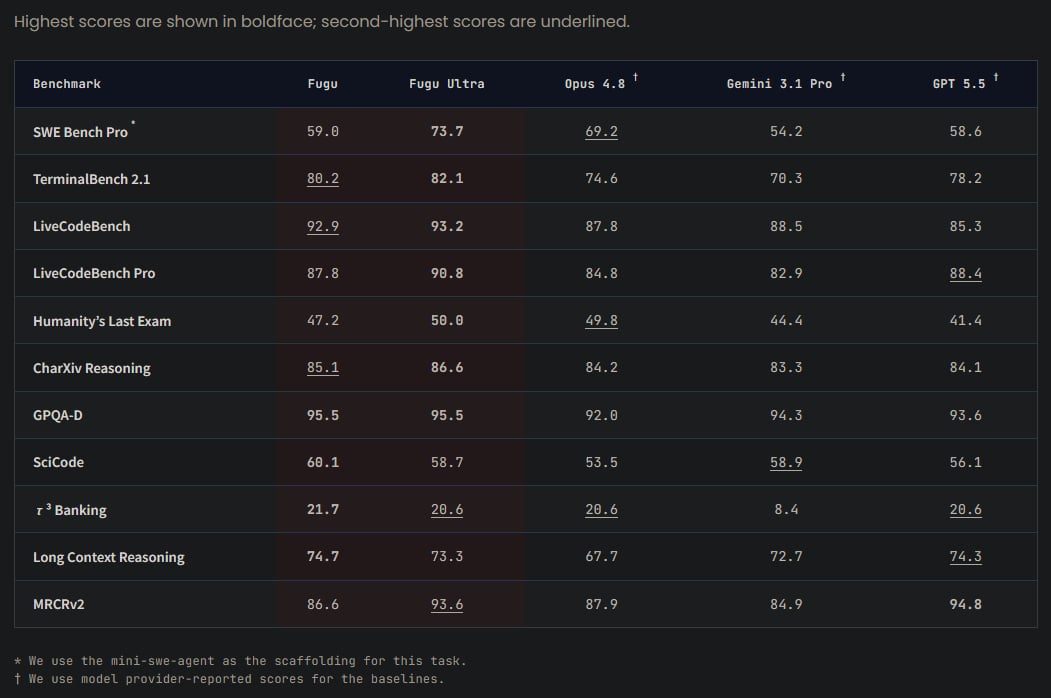
What do the tests say? On LiveCodeBench, an open programming benchmark, Fugu Ultra scored 93.2 points, beating Claude Fable 5 with 89.8. On GPQA-D, a set of 198 graduate-level questions in biology, physics, and chemistry, both versions of Fugu scored 95.5 points, surpassing the older Mythos Preview with 94.6. On SWE-Bench Pro, Fugu Ultra then scored 73.7 points compared with 69.2 for Opus 4.8.
Critics point to a weakness that cannot be overlooked. Fugu can only be as good as the models it can access. And Fugu still lags behind the banned Fable 5 on several more difficult tasks.
Sakana put Fugu Ultra through several practical showdowns against three competing models, which it anonymized as models A, B, and C for fairness. Fugu emerged victorious among them. It independently improved the training code for a smaller model, grew a ten-thousand-dollar portfolio to nearly twelve thousand using fifty weeks of stock market data, played blindfold chess without losing track of the pieces, and designed a functional mechanical iris in CAD where its competitors failed.
A message to countries cut off by Washington
For Sakana CEO David Ha, export bans are the main reason Fugu was created. He believes that the most powerful systems will not be solitary giants, but collaborating groups. “Human intelligence is fundamentally collective intelligence,” he wrote on X. According to him, relying on a single company's model for national infrastructure is an enormous gamble, because access to the best models can disappear overnight. Fugu circumvents vendor restrictions by making its entire group of models interchangeable.
Why are Anthropic's banned models so sensitive in the first place? Fable 5 is built on a foundation called Mythos, which the company kept out of public reach because it considered it too powerful. There were concerns that attackers could misuse it to target critical infrastructure or produce biological weapons. Mythos was reportedly able to find vulnerabilities in every major operating system and browser it tested. Fable 5 therefore received a safeguard that caused it to switch itself back to the less capable Claude Opus 4.8 if anyone attempted to misuse it.
Not everyone is applauding Sakana
Prime Intellect engineer Elie Bakouch described Fugu as a closed orchestrator built on closed models and argues that users now have even less control than before. It is not cheap either: Fugu Ultra is priced the same as GPT-5.5, at 35 dollars per million tokens in total. The discussion under the announcement on X quickly became lively. One of the most-liked comments mockingly summed up Fugu as: “Four Qwens in a trench coat.”
Tokyo-based Sakana AI was founded in 2023 by Llion Jones, one of the authors of Google's seminal 2017 paper titled “Attention Is All You Need,” together with David Ha, the former head of research at Stability AI.
Introducing Sakana Fugu: A full multi-agent orchestration system accessible via a single model API.
— Sakana AI (@SakanaAILabs) June 22, 2026
Our ‘Fugu Ultra’ model matches the performance of Fable and Mythos, delivering frontier capability without the risk of export controls.
Try it: https://t.co/aDEFyySWlS 🐡 pic.twitter.com/43wzMAhyzT
Sources: timesofindia.indiatimes.com and ndtv.com