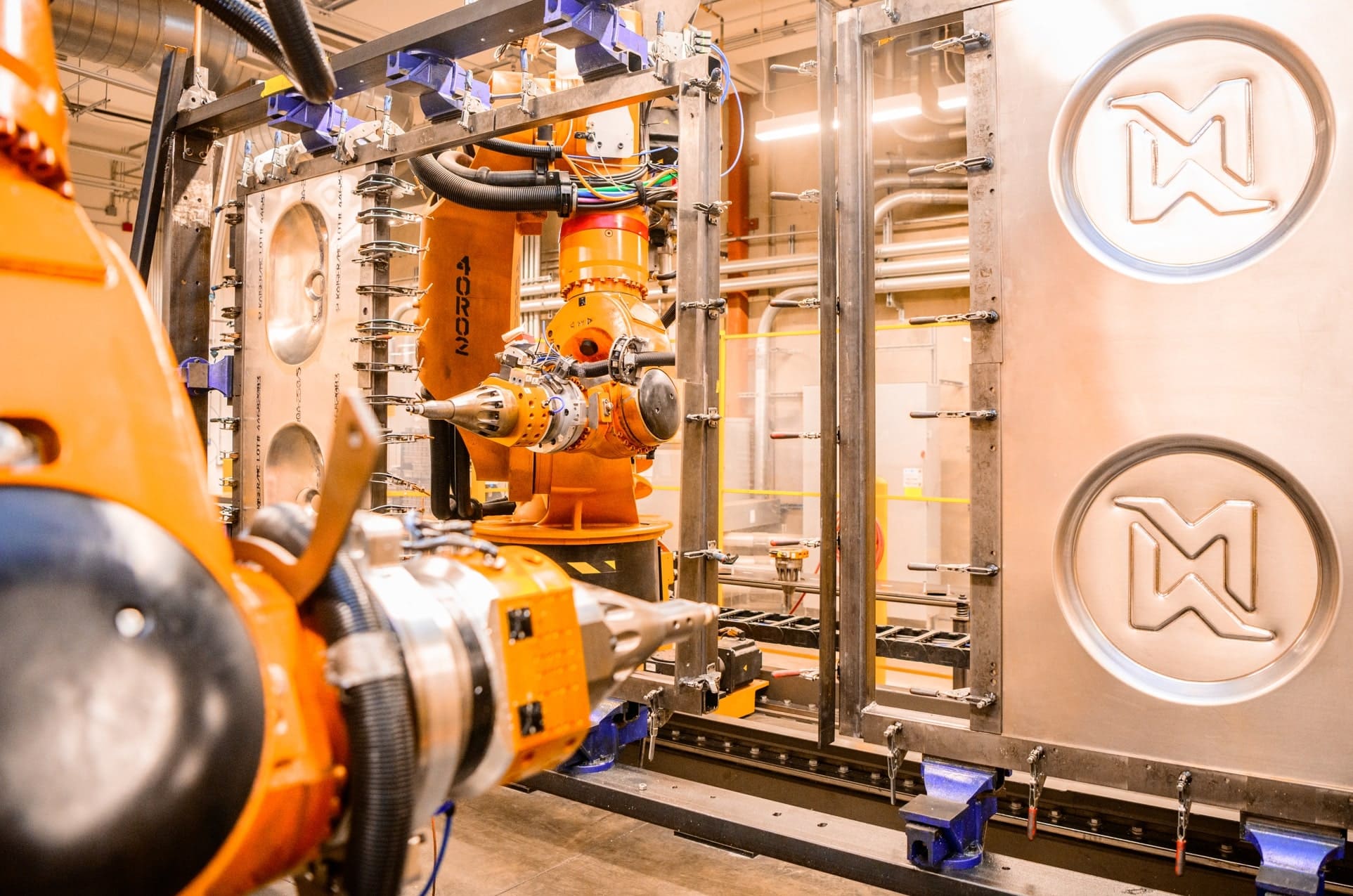
Machina Labs, a company founded in 2019, is introducing a new way to manufacture automotive bodies. Its approach replaces enormous and heavy traditional tooling, weighing more than 20 tons, with flexible robotic systems. These systems make it possible to produce customized sheet metal panels quickly and without the need for special dies for each model. According to co-founder and CEO Edward Mehr, traditional dies take up two-thirds of factory space, and replacing them takes anywhere from several months to a year. With Machina Labs technology, the first part can be manufactured within hours of completing the design.
The company is based in Los Angeles and focuses on manufacturing complex metal structures for the aerospace, defense, and automotive industries. Its Robo Craftsman platform combines advanced robotics with artificial intelligence for process control. This system operates as a cellular matrix, where 200 to 300 units replace traditional production lines. Edward Mehr describes it as a data center for manufacturing, where unmanned ground vehicles are used for various tasks such as metal forming, trimming, and quality control.
Modern Die-Free Sheet Metal Forming
Traditional automotive body manufacturing relies on stamping sheet metal using expensive and bulky dies, which limits vehicle variability. Machina Labs is changing this with its Robo Forming technology, which uses robots to gradually shape sheet metal into the desired form. This process eliminates the need for dies, reducing storage costs and accelerating production changes. For example, the company can create a topographic map of Los Angeles on a car hood, demonstrating its customization capabilities.
The technology makes it possible to work with materials that previously could not be formed at room temperature, such as titanium or nickel alloys. The accessories and customization market for trucks alone reached a value of $2.4 billion in 2024. Machina Labs claims that its systems make it possible to manufacture these parts in small batches directly next to the assembly line, without the need for separate storage or packaging.
Collaboration with Toyota
Machina Labs announced its progress at the UP.Summit, along with a pilot project with Toyota Motor North America. This project applies Robo Forming technology to customized automotive body panels, with the goal of achieving mass-production-level quality and performance at low volumes. Zach Choate, general manager of manufacturing and engineering at Toyota Motor North America, expressed enthusiasm about the opportunity to deliver unique products to customers.
The company received a strategic investment from Woven Capital, Toyota's investment arm. George Kellerman, founding managing director of Woven Capital, emphasized how artificial intelligence is transforming product design and manufacturing at scale. Machina Labs plans to integrate its systems into automotive production next year to handle thousands of vehicles. It initially focused on the defense industry, which has high variability and low volumes, such as unmanned aircraft or missiles, but is now expanding into the automotive sector.
Benefits for the Future of Manufacturing
Machina Labs' systems simplify process flows in factories by enabling on-demand production. Instead of separate warehouses and assembly lines for customized parts, everything can be produced dynamically near the main line. Edward Mehr notes that the automotive industry has been forced to manufacture the same models for years to amortize the cost of dies, which are stored for up to 15 years. The new approach opens the door to customization, much like before Henry Ford's era of mass production, but now available to everyone.
Co-founders Babak Raeisinia and Edward Mehr demonstrated their system on a custom rear vehicle panel. Machina Labs has been working with Toyota for several years to understand standard practices in the automotive industry. This approach delivers flexibility, speed, and lower costs, allowing engineers to move more quickly from concept to finished product without the constraints of traditional supply chains.
Source: therobotreport.com