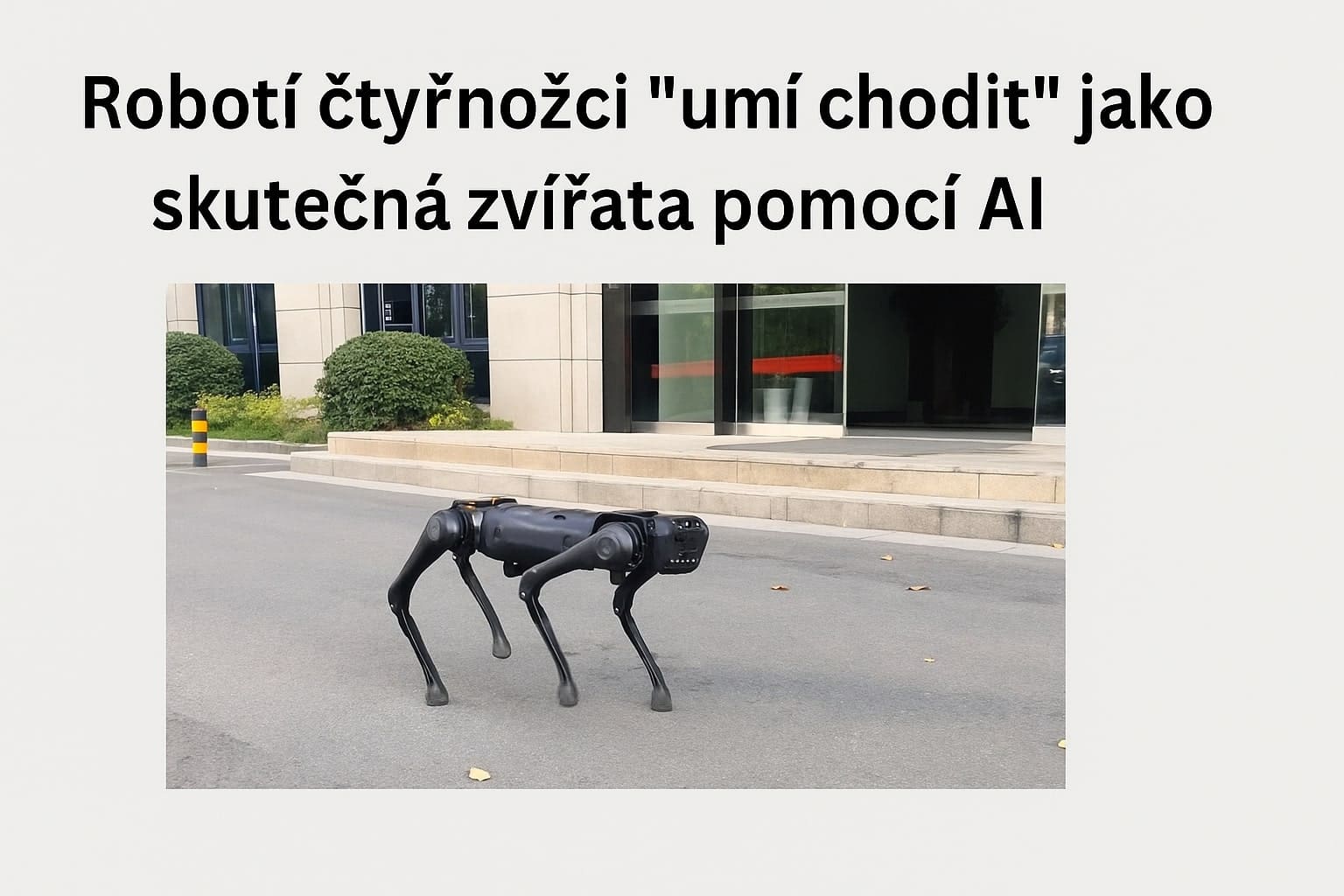
Robot quadrupeds "can walk" like real animals using AI
Researchers Joseph Humphreys from the University of Leeds and Chengxu Zhou from University College London have developed a groundbreaking system that allows quadruped robots to adapt their gait to the terrain in a manner similar to animals. Their published work in the prestigious journal Nature Machine Intelligence represents a significant advance in robotic locomotion.
Three pillars of animal locomotion in robotics
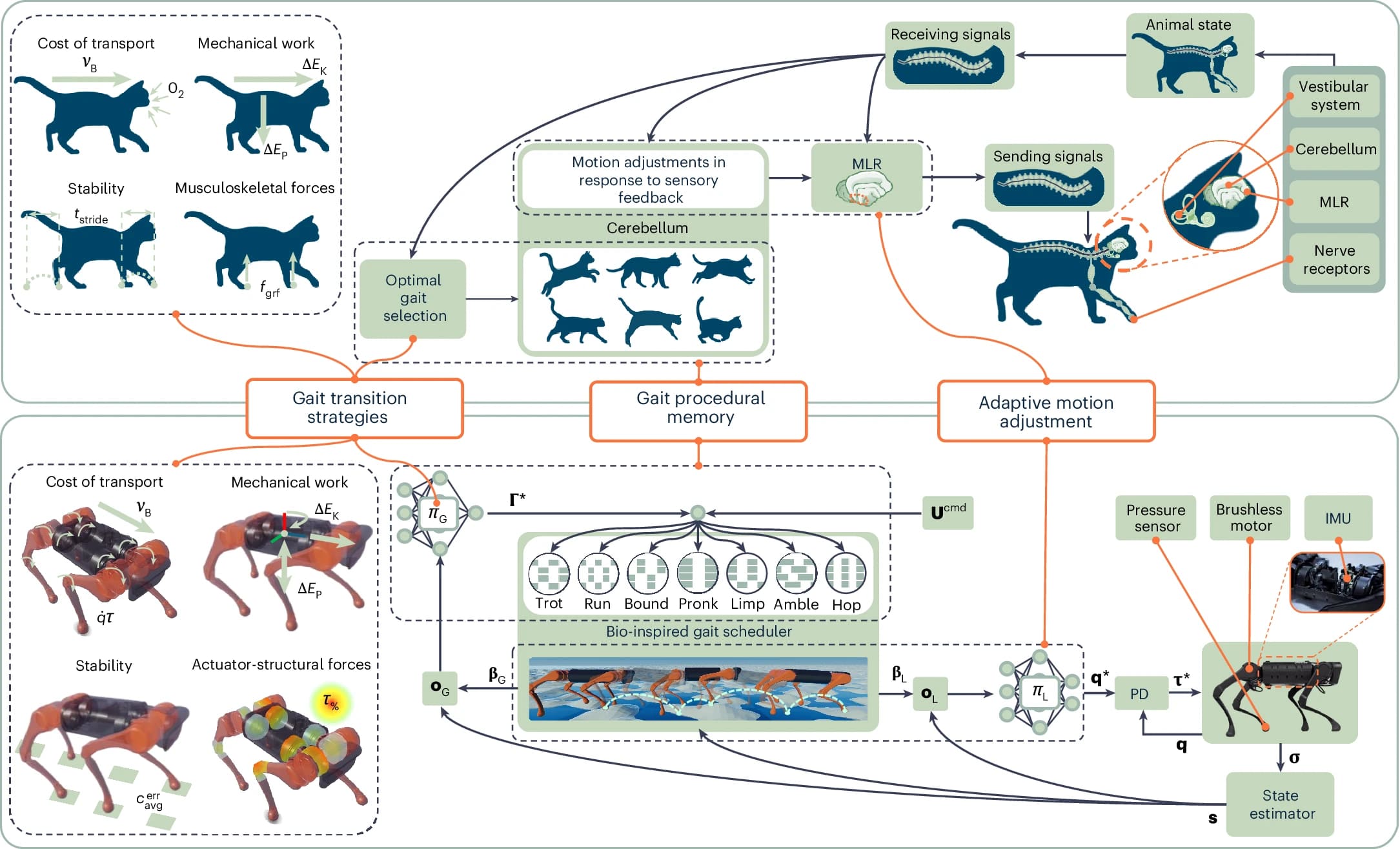
The research team identified three key attributes of animal locomotion that had not previously been implemented in robotic systems. These are gait transition strategies, procedural gait memory, and real-time movement adaptation. In animals, these principles are controlled by different parts of the brain—the mesencephalic locomotor region and the cerebellum.
While current Deep Reinforcement Learning (DRL) systems achieve remarkable results, they remain limited to individual gait types. By contrast, animals transition smoothly between different modes of movement—from trotting and running to specialized gaits such as bounding or hopping when escaping predators.
Biomechanical metrics for optimal gait selection
The researchers developed a system based on four biomechanical metrics inspired by animal locomotion. Cost of transport measures energy efficiency, torque saturation characterizes stress on the actuators and structure, external work evaluates mechanical work, and foot-contact tracking error indicates system stability.
These metrics are unified within the gait selection policy (πG), which selects the optimal gait based on the robot's current state from eight available options: standing, trotting, running, bounding, pronking, limping, ambling, and hopping.
Bio-inspired gait scheduler
A key component of the system is the Bio-inspired Gait Scheduler (BGS), which functions as a pseudo-procedural gait memory. The BGS generates reference gait patterns based on high-level parameters and the robot's current state. This system enables smooth transitions between any pair of gaits, which is essential for real-world adaptability.
The BGS uses modified Raibert heuristics to calculate reference foot positions in Cartesian coordinates, with limits of 0.3 m along the x-axis, 0.2 m along the y-axis, and 0.1 m along the z-axis from the nominal local foot position. The system also implements the Froude number (Ω) to determine the inherent stability of different gaits.
Testing on real-world terrain
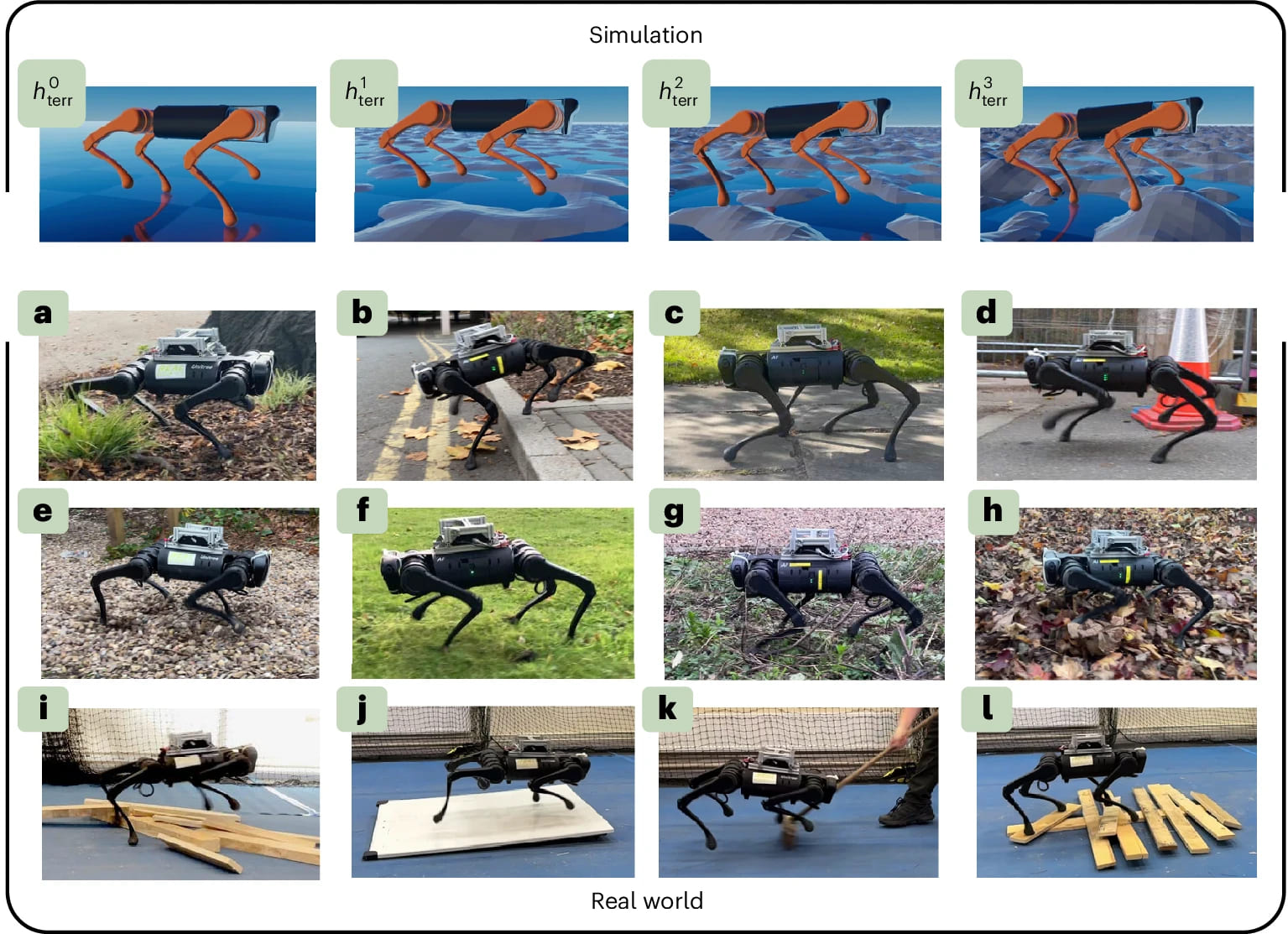
The Unitree A1 robot, with 12 degrees of freedom, was tested on a wide range of real-world terrain, including wood chips, concrete slabs with large cracks, asphalt, deep gravel, grassy terrain, overgrown roots, fallen leaves, loosely laid beams, and low-friction surfaces.
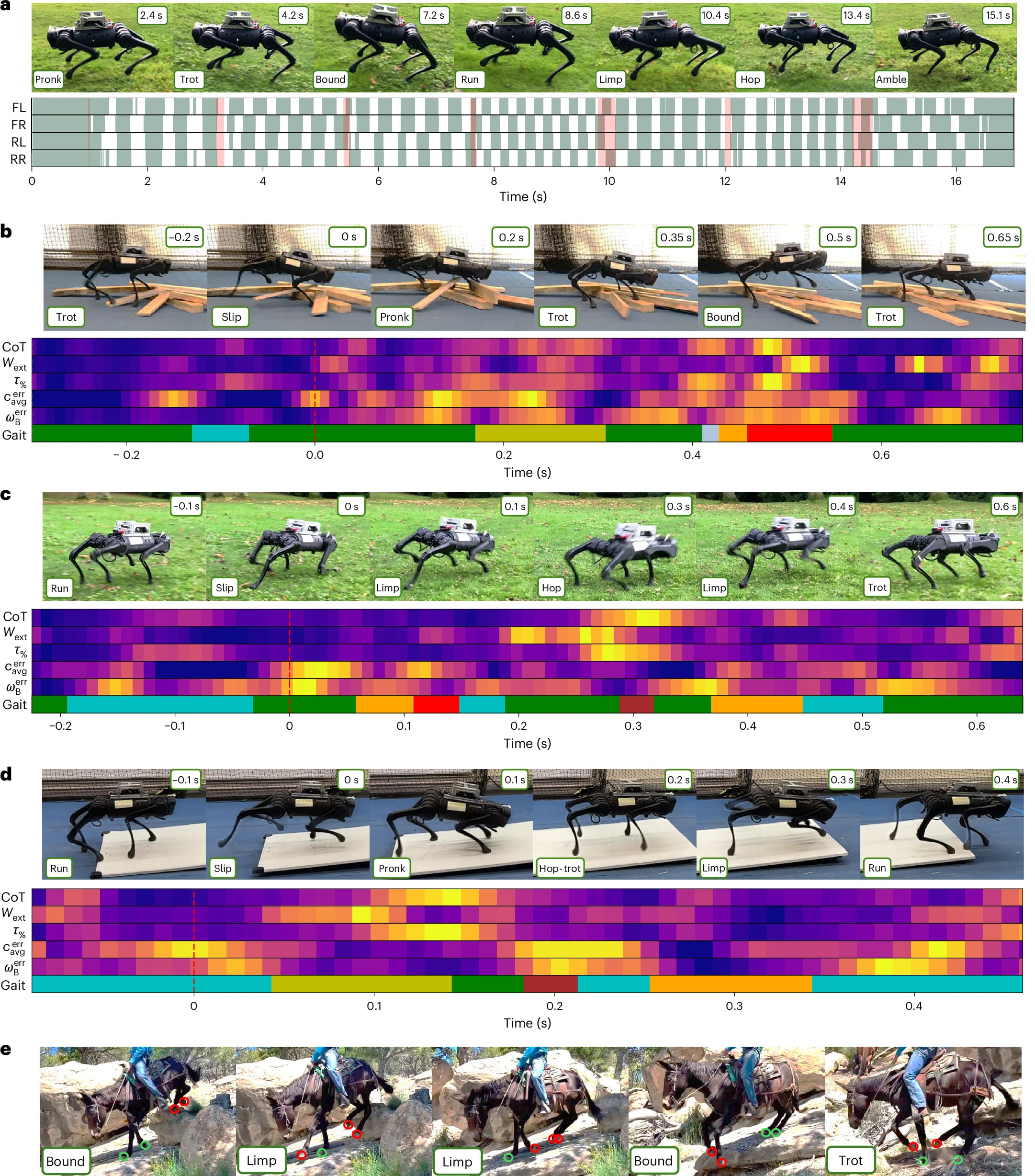
During the experiments, the robot demonstrated the ability to transition autonomously between nominal gaits (trotting and running) under normal conditions and to use auxiliary gaits (bound, pronk, limp, amble, hop) to manage instability. This behavior pattern closely mirrors strategies observed in animals.
Comparison with animal strategies
The researchers conducted a detailed comparison with data obtained from dogs, horses, and opossums. They found that their πG^uni system faithfully replicates animal gait transition strategies. As speed increases, the robot predominantly uses trotting at low speeds and running at high speeds, oscillating between the two gaits during acceleration with an increasing preference for running.
This behavior was never explicitly programmed but emerged from the minimization of biomechanical metrics, supporting the hypothesis that unifying these metrics genuinely encodes the complexities of animal gait transitions.
Results without external sensing
Remarkably, the entire system operates using only internal sensors—without any external sensing of the environment. The robot relies on an IMU (inertial measurement unit), internal joint feedback, and a State Estimator to process sensory data.
This capability is essential for practical deployment because visual systems often cannot detect changes in the terrain's coefficient of friction or structural changes beyond the reach of the robot's front legs. The system thus overcomes significant limitations of current robotic platforms.
The future of adaptive robotics
The research represents a significant step toward robust, efficient, and versatile robotic locomotion. The authors plan to integrate their work with methods focused on Froude-free locomotion (movement at a desired walking speed relative to the ground plane), such as jumping between platforms or climbing over obstacles.
This work demonstrates how animal motor intelligence can shape the next generation of adaptive machines and opens up new possibilities for deploying robots in unpredictable real-world conditions.