Reka has released a research preview of Rho-1, a 19-billion-parameter model that both processes and generates text, images, video and robot actions in a single checkpoint. Generated media and control signals remain in a shared context, allowing subsequent steps in the same session to build on them without transferring state between separate models.
From a lighthouse image to video editing
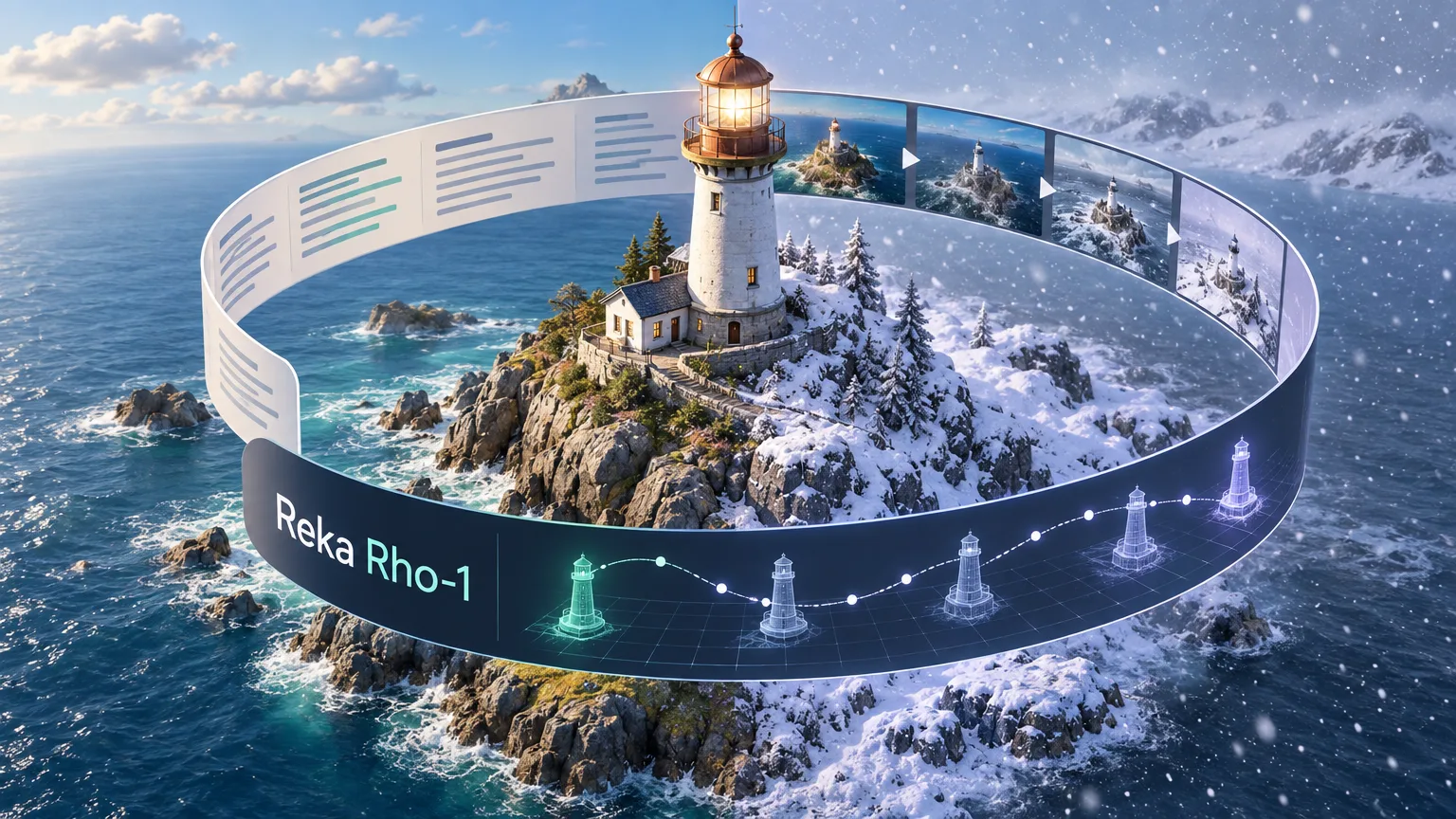
Reka demonstrated how the tasks connect using a lighthouse scene. The model first created an image, then responded to another instruction by marking the lighthouse with a bounding box. It animated the scene as a drone fly-in before adding a snowstorm to the video while retaining the camera movement.
Finally, Rho-1 explained the differences between the resulting videos. A single model handled the sequence, maintaining session state across drawing, object localization, animation and a verbal comparison of the results.
Two computational streams with shared attention
According to Reka's research description, each transformer block splits into two streams that share an attention operation. The understanding stream handles language, reasoning tokens and visual information, producing discrete tokens. The generation stream instead uses flow matching to remove noise from continuous internal representations and produce images and video.
The distinction also applies to data formats. Text, symbolic reasoning and high-level commands are represented as discrete tokens. Continuous representations carry internal image representations and video frames, as well as robot actions and proprioception—measurements such as joint position and movement.
Rho-1 Flash and direction changes during generation
Reka reports that the base Rho-1 uses 99 denoising steps, achieves a median generation rate of 0.79× real time and starts streaming after roughly six seconds. The distilled Rho-1 Flash uses eight steps and, according to the company, generates a 5.3-second video in about one second. For video editing, it reports re-rendering a roughly one-second clip in about 1.1 seconds using the same number of steps.
Another Reka demonstration showed changes to flight direction while a video was being generated. Instructions to bank left or right arrived half a second into an aerial sequence. The two resulting branches retained identical opening frames before continuing along different trajectories.
Robot actions in the LIBERO simulation
Reka demonstrated the robotics component in a LIBERO simulation task. Rho-1 simultaneously produced seven action channels and a predicted view from the robot's wrist camera. The demonstration paired control output with visual prediction in simulation, rather than in a documented deployment on a physical robot.
In its research, the company also pairs Rho-1 with its inverse-dynamics model. That model estimates the control signals that could have caused movement observed in a video and can turn suitable unlabeled footage into inferred action data. The usefulness of that data depends on domain fit and the accuracy of the estimated controls.
A shared backbone trained on 320 GPUs
The checkpoint used for the published results was trained from scratch over three months on 320 Nvidia H100 GPUs. That run covered language, visual understanding, media generation and control in a single shared backbone.
According to Reka's research description, training uses two objectives concurrently. Predicting the next token handles discrete sequences, such as text and symbolic commands. Flow matching is used for continuous generation of images, video and action trajectories.
Longer videos lose spatial consistency
Reka identifies structural drift during longer generation as a limitation. A 30-second stream can retain textures and fine details while the room's layout becomes spatially inconsistent. Native video generation is capped at a resolution of 672 × 384 pixels.
According to the company, bounding boxes work on static images but do not reliably track objects through video. Targeted edits also succeed on selected prompts but remain unreliable across a broader range of inputs.
Access through collaboration on Reka Cloud
Rho-1 is currently available as a research preview through collaboration on Reka Cloud. Reka has not released public weights or a public API, so developers cannot directly integrate the model into their applications.