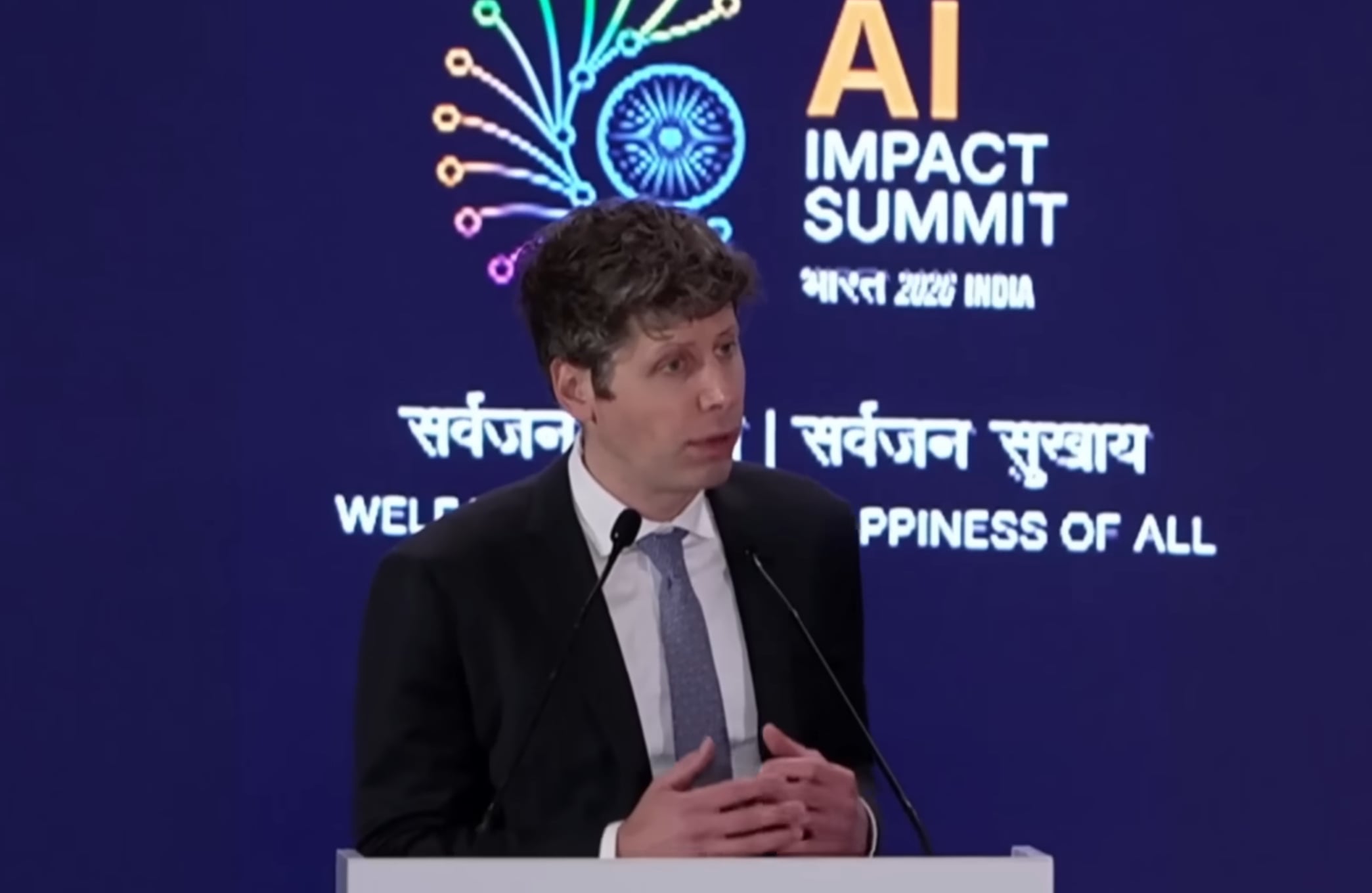
Sam Altman stood on the stage at India’s AI summit in New Delhi. Before him was a friendly audience; behind him, a week full of headlines. And then he uttered a sentence: “Raising a human also takes a lot of energy.” It sounds harmless. But the reaction that followed was anything but.
The summit, the questions, and Altman’s counterattack
Altman arrived in India as a star. OpenAI has more than 100 million weekly active ChatGPT users there – its second-largest market in the world after the US. At the summit, he had interviews, photos with Prime Minister Modi, and talks about the future of AI lined up.
But journalists also asked uncomfortable questions. Specifically, how much energy and water ChatGPT consumes. Altman first dismissed the most widespread claim – that a single ChatGPT query uses 17 gallons of water – as “complete nonsense, totally insane, with no connection to reality.” He acknowledged, however, that the problem had existed in the past, when data centers used evaporative cooling. Not anymore, he claimed.
Then came the part that attracted the most attention. Altman became impassioned about what he considers an unfair comparison. Critics, he said, compare the energy required to train an entire AI model with the energy used by a single human query – and to him, that is like comparing apples and oranges.
“But raising a human also takes a lot of energy,” he said. “It takes 20 years of life and all the food you eat during that time before you become intelligent. And not only that – it took all of evolution, hundreds of billions of people who ever lived, learned not to run away from predators, and figured out science, just to create you in the first place.”
His conclusion? If you ask ChatGPT a question, AI is probably more energy-efficient than a human – once the model has been trained. The argument has a certain logic. But the way Altman presented it ignited a firestorm.
The internet’s reaction
Social media immediately seized the opportunity. User David Fairchild wrote one of the most widely shared comments: “It doesn’t seem to me that he’s merely defending AI’s energy consumption. He’s smuggling in an entire anthropology in which humans are essentially inefficient meat computers that you have to stuff with food and years before they become useful. And once you accept that, the next step is obvious – if humans are just costly biological training runs, then burning mountains of electricity on synthetic intelligence begins to sound not merely equivalent, but superior.”
Another user was more concise: “I don’t understand how someone like that can have so much power and shape our future.”
Why the backlash? Transparency is the real issue
Altman’s remark might have gone unnoticed if it had not been part of a broader context. Technology companies are not legally required to disclose the energy or water consumption of their data centers. Employees and partners are also bound by nondisclosure agreements. Scientists therefore try to estimate consumption independently, only to run into a wall.
In other words, Altman says the concerns are exaggerated. But no one outside the company can verify that. And that is precisely what frustrates people the most. Altman himself admitted that AI’s total energy consumption is a real problem – not per query, but in aggregate. According to him, the world must quickly transition to nuclear energy or renewable sources. That is a reasonable position. But comparing people to inefficient biological processors overshadowed it.
Brilliant rhetoric, or a troubling signal?
Altman’s argument is technically defensible. If you really compare the energy used by a single AI query with the energy required for a single human response, the numbers may favor AI. But comparing a human being’s existence with training a model is something else. People are not in the system to answer queries. They are in it because they are human. And this is exactly where Altman missed the mark. Not factually, but morally.
The question is not only “how much energy does it use?” – but also “what do we get in return, and who pays for it?” Rising electricity prices, overloaded grids, ecosystems strained by data centers – these are real impacts that cannot be dismissed by pointing out that children eat too.
The summit in Delhi ended. Altman flew home. But the debate he sparked remains – and it is unlikely to disappear anytime soon.