

Qwen3-235B-A22B-Instruct-2507: A Giant AI Model That Rules the Open-Source Models
A new language model that can handle conversations in dozens of languages, solve complex mathematical problems, and even use tools like a professional—all with amazing efficiency. That is exactly what Qwen3-235B-A22B-Instruct-2507 is, a new release from Alibaba's Qwen team launched in July 2025. This model is designed specifically for instruction-based tasks, where it excels at logical reasoning, text comprehension, mathematics, science, programming, and tool use. What's more, there is also an optimized version with FP8 quantization that saves memory and speeds up computation. Let's take a closer look, step by step, to understand why this model is such a hit.
Bye Qwen3-235B-A22B, hello Qwen3-235B-A22B-2507!
— Qwen (@Alibaba_Qwen) July 21, 2025
After talking with the community and thinking it through, we decided to stop using hybrid thinking mode. Instead, we’ll train Instruct and Thinking models separately so we can get the best quality possible. Today, we’re releasing… pic.twitter.com/9QmPaPkANi
Model Overview: What's Under the Hood?
Qwen3-235B-A22B-Instruct-2507 is a causal language model based on a Mixture-of-Experts architecture (MoE for short). It has a total of 235 billion parameters, but only 22 billion of them are activated during each computation—specifically, 8 out of 128 experts are engaged at a time. This ensures high capacity without unnecessarily wasting computing power. The model has 94 layers, 64 attention heads for queries (Q), and 4 for keys and values (KV), thanks to Group Query Attention (GQA).
One of its biggest attractions is native support for a context length of up to 262,144 tokens, which means it can process truly long texts—ideal for document analysis or complex conversations. This model is an improved version of the previous Qwen3-235B-A22B in non-thinking mode, meaning it does not create thought blocks such as in its responses. Instead, it focuses on direct, useful outputs. The FP8 quantized version (Qwen3-235B-A22B-Instruct-2507-FP8) uses fine-grained quantization with a block size of 128, reducing hardware requirements—for example, fewer GPUs are sufficient for inference, such as 4 for tensor parallelism.
The model underwent pre-training and post-training, giving it strong capabilities in instruction following, logical reasoning, and text comprehension. According to official data from Hugging Face, it offers significant improvements in covering long-tail knowledge across many languages, better alignment with user preferences, and higher-quality text generation for open-ended tasks.
Performance and Comparison: The Numbers Speak for Themselves
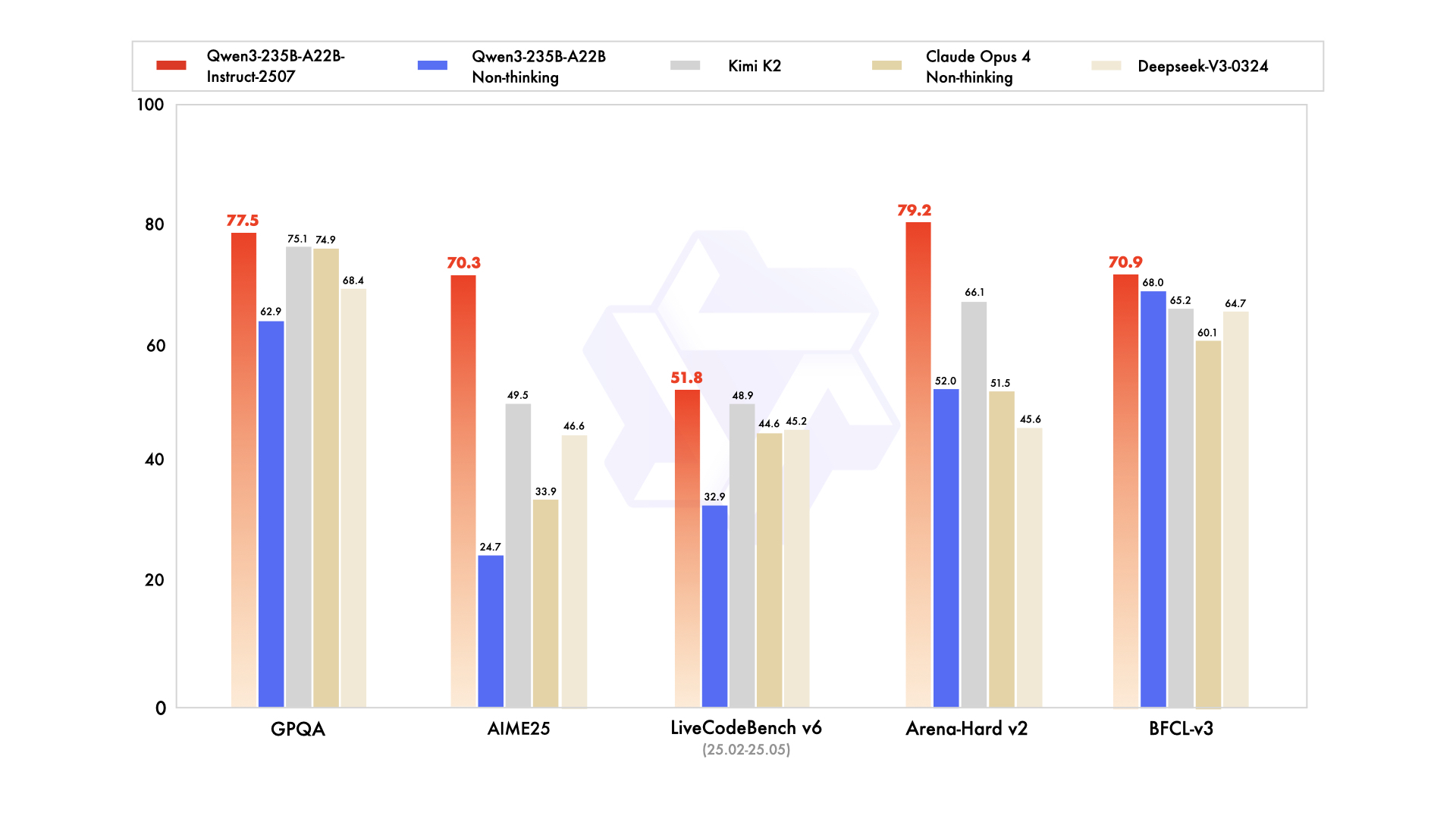
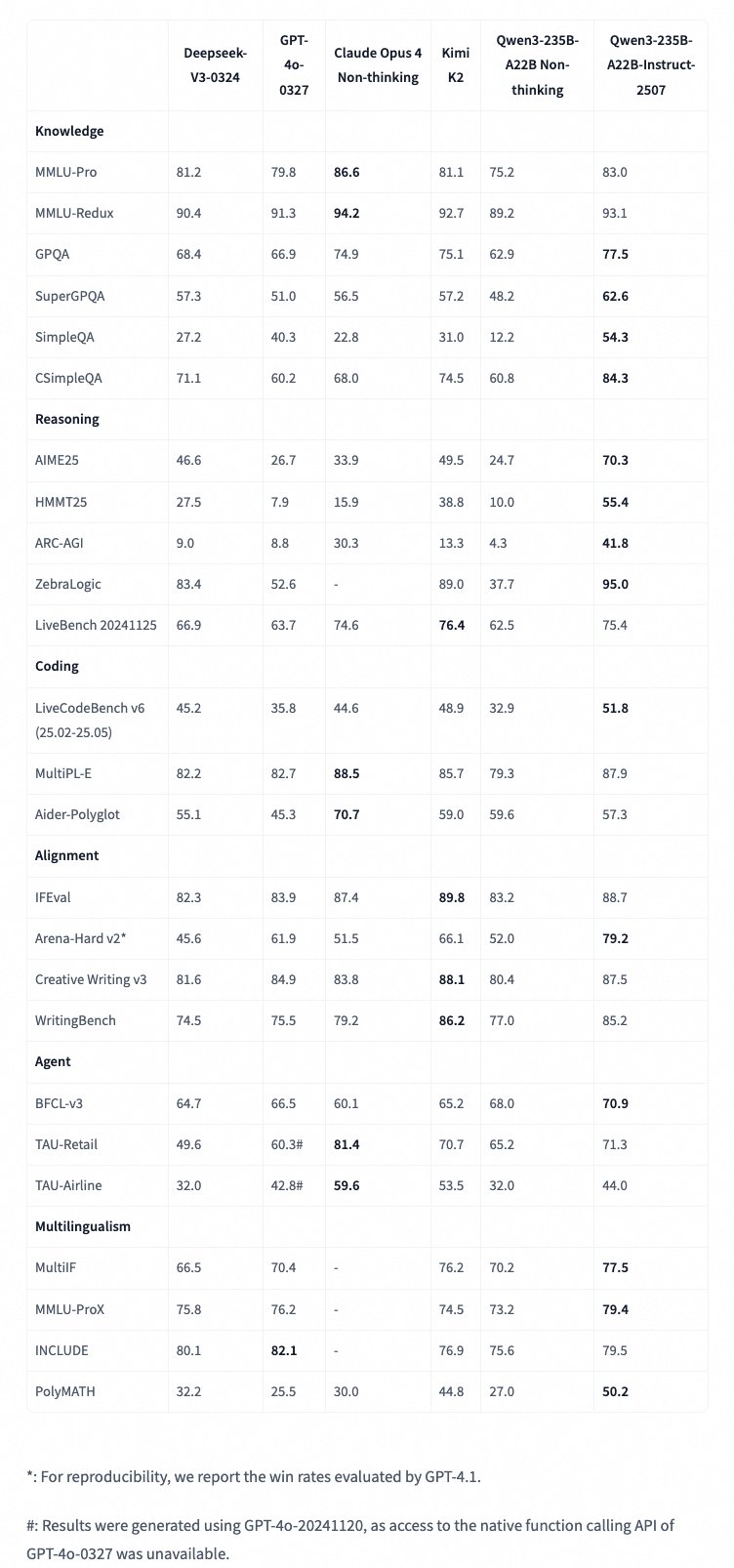
When it comes to performance, Qwen3-235B-A22B-Instruct-2507 outperforms many competitors in key benchmarks. For example, it achieved a score of 83.0 in the MMLU-Pro test, which is better than Deepseek-V3-0324 (81.2) or GPT-4o-0327 (79.8). In GPQA (Google Proof Questions and Answers), it scored 77.5 points, placing it ahead of Claude Opus 4 Non-thinking (74.9). In mathematical tests such as AIME25, it achieved an impressive 70.3 points, while HMMT25 gave it 55.4—both top-tier results compared to other models.
In programming, it excels with 51.8 points in LiveCodeBench v6 (for the period from February to May 2025), outperforming Kimi K2 (48.9). For agent tasks, it scored 70.9 points in BFCL-v3, 71.3 in TAU-Retail, and 44.0 in TAU-Airline. Its multilingual capabilities are also excellent: It achieved 79.4 in MMLU-ProX and 50.2 in PolyMATH, demonstrating support for more than 100 languages and dialects.
The FP8 version maintains the same performance but with lower requirements—for example, it needs less computing power to run, making it ideal for smaller servers. According to benchmarks from the Qwen blog and GitHub, the model has significantly improved its understanding of long contexts of up to 256K tokens, making it suitable for complex scenarios such as analyzing long documents or conducting multilingual conversations.
Use and Deployment: How to Run It in Practice?
If you want to try the model, it is easy thanks to integration with tools such as Hugging Face Transformers (version 4.51.0 and later). A Python code example shows how to load the model and tokenizer, prepare the input, and generate a response—for example, for the prompt "Give me a brief introduction to large language models," the model will generate text of up to 16,384 new tokens. For deployment, SGLang (version 0.4.6.post1) or vLLM (0.8.5) are recommended, allowing you to run a server with tensor parallelism across 8 GPUs for the full context length of 262,144 tokens. If you experience memory issues, reduce it to 32,768.
For agentic use, Qwen-Agent is ideal, as it simplifies tool calling—for example, integration with MCP configurations for time or fetch operations. The model is also supported by local applications such as Ollama, LM Studio, and llama.cpp. Recommended generation parameters: temperature 0.7, TopP 0.8, TopK 20, and MinP 0. For mathematics, add "Please reason step by step and put the final answer in \boxed{}" to the prompt.
What Does the Community Say?
Online sources such as QwenLM/Qwen3 on GitHub and the Qwen blog show that the model is publicly available with downloadable weights, including GGUF formats for easy integration. The communities on OpenRouter and LM Studio praise it for its speed and accuracy in real-world applications such as code generation and multilingual tasks. Quantized variants are also available, such as a 4-bit version for MLX, making it easier to use on less powerful hardware. According to the arXiv report (2505.09388) by the Qwen Team, the model brings significant improvements in alignment with user preferences, resulting in more useful responses without unnecessary repetition—simply set presence_penalty between 0 and 2.
This model is not just a technical achievement, but a genuine assistant for developers, scientists, and everyday users alike. If you are looking for AI that can handle complex tasks with ease, Qwen3-235B-A22B-Instruct-2507 is the right choice. Just try it and see for yourself!


