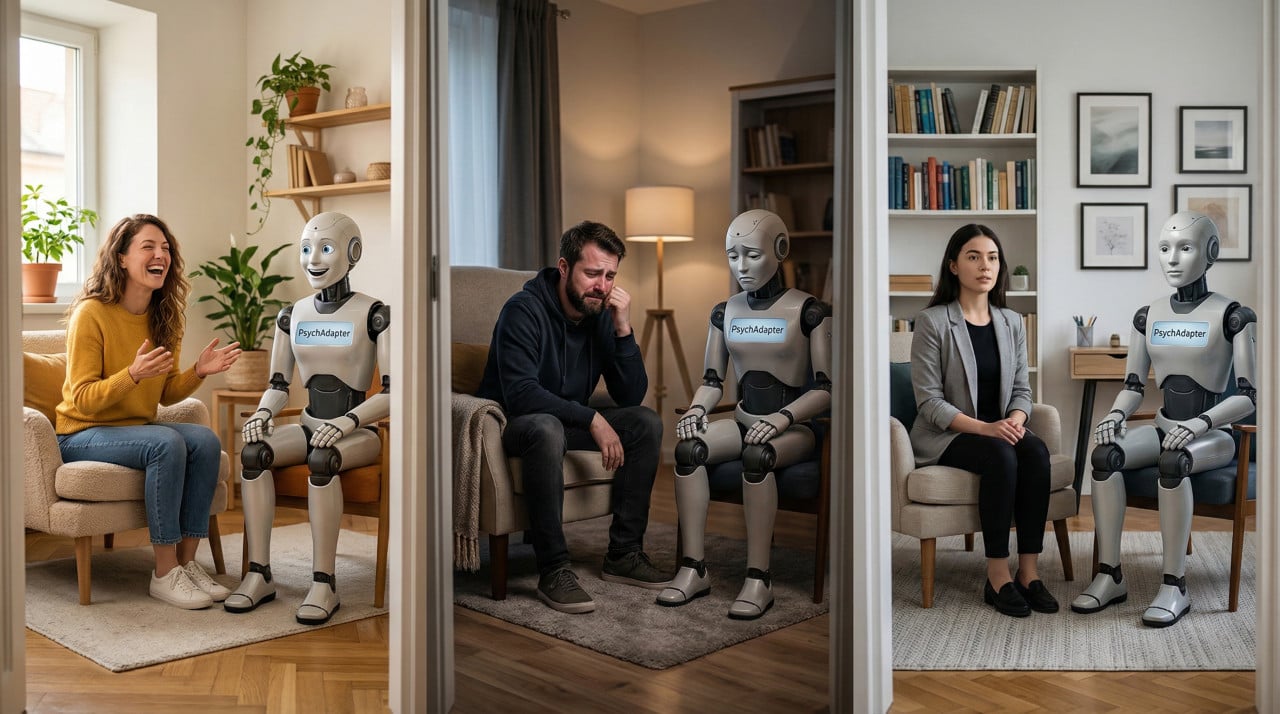
Chatbots, translators, assistants. All these tools have one thing in common: they write in an average way. They generate text that could have been written by anyone—or rather, by no one in particular. No personality, no character, no hint as to whether the person behind the keyboard is a struggling introvert or an energetic extrovert. A team of scientists from several American universities decided to change that. The result is PsychAdapter—a lightweight add-on for large language models that gives them something they have lacked until now: a psychological profile.
How does PsychAdapter work?
In short, it takes existing language models such as GPT-2, Gemma-2B, or LLaMA-3 and adds a layer that understands human psychology. Specifically, it works with the Big Five model, which describes human personality using five dimensions: openness, conscientiousness, extraversion, agreeableness, and neuroticism. It also adds mental health variables such as depression and life satisfaction, as well as demographic information such as age.
How does it work technically? Instead of telling the model through a prompt to "write like an extrovert," PsychAdapter directly modifies the transformer architecture. Each layer of the model receives numerical personality trait scores as input. For example, a value of +3 for extraversion means that the model generates text typical of a highly sociable person. A value of -3, on the other hand, produces the language of a loner. And here is what is interesting: the added parameters account for less than 0.1% of the original model's size. For Gemma-2B, with its two billion parameters, this amounts to just 55,000 additional values. Yet it fundamentally transforms the entire model.
Results that surprised even the scientists themselves
The team evaluated the results in two ways: using human evaluators with a background in psychology and using Anthropic's Claude 3.5 Sonnet model. And the numbers are impressive.
Human experts correctly identified the personality traits in the generated text in 87.3% of cases. When the model was also guided by an initial prompt such as "I like to...," accuracy jumped to 91%. For mental health variables—depression and life satisfaction—accuracy even reached 96.7%. Claude performed even better as an automated evaluator: 93.5% for personality traits and a full 100% for mental health.
What does this mean in practice? When PsychAdapter is set to high extraversion, the model writes about friends, social events, and fun. Low extraversion produces texts about solitude, quiet activities, and one's inner world. High neuroticism generates expressions of anxiety and rumination. This is neither a coincidence nor a trick. It is the result of the model learning real linguistic patterns from data produced by actual people.
Where could it be useful? There are many possibilities
This is not just an academic toy. The scientists describe a wide range of practical applications, some of which are genuinely interesting.
Training crisis hotline staff and psychologists. A crisis hotline trainee can practice through simulated conversations with "patients" exhibiting different levels of depression or different personality traits. There is no risk to real people and no ethical complications. The model can imitate how a person with severe depression speaks, allowing a therapist to learn how to recognize warning signs.
Personalized content and translations. Text tailored to the reader's age, education, or personality profile. Chatbot responses that match the way a specific user communicates. Customer service that adapts depending on whether the caller is a nervous introvert or a confident extrovert.
Psychological research. PsychAdapter can generate entire sentences typical of a particular trait, not just isolated words. This is valuable to researchers because context changes everything. The word "play" means something different in a neurotic person's text than in an extrovert's text.
Age, gender, and combinations of traits: the model can handle those too
One of PsychAdapter's most interesting features is its ability to combine multiple variables at once. Do you want text typical of a young person with depression? Set depression = +3 and age = -3. The result reflects how young people going through a difficult period actually write.
The scientists went even further and tested the Interpersonal Circumplex, a psychological model that describes interpersonal behavior using the axes of dominance and warmth. PsychAdapter was able to generate texts corresponding to different positions in this model, with results that matched theoretical expectations. The experts evaluating the texts achieved 100% accuracy in distinguishing combinations of high and low age with different levels of mental health.
Better than prompting alone?
You may be wondering: isn't it enough to simply write "write like a depressed introvert" in the prompt? It is not. The scientists tested this directly. With smaller models of around two billion parameters, prompting achieved an accuracy of only 53%, while PsychAdapter achieved 77% with the same model. The difference is substantial.
Why? Because a prompt takes up part of the context window, and the model may interpret it in different ways. PsychAdapter, by contrast, affects text generation at the level of every transformer layer, without depending on how the prompt is phrased. Moreover, the psychological score is a continuous number, not a discrete category. This means the model can accurately reflect specific results from a psychological questionnaire, rather than merely broad categories such as "high" or "low."
A direction LLMs may take
PsychAdapter points to a direction in which language model development may head. Until now, we have had models that write in an average voice for everyone. Now we have a tool that can write for a specific person—or at least for their psychological profile. And it does so with an accuracy that surprised even the experts.
Of course, this also raises ethical questions. Who will use such a tool, and how? Simulating a depressed patient to train therapists is one thing. But what about manipulative content tailored to the psychological vulnerabilities of specific groups? The scientists mention these questions in the article and call for a responsible approach.
For now, PsychAdapter is available as an open-source project on GitHub. It works with GPT-2, Gemma, and LLaMA-3. And the results are consistent across all three models. This suggests that the approach is scalable. Perhaps we are only at the beginning of an era in which AI will no longer speak for everyone at once, but will be able to speak for each person individually.