

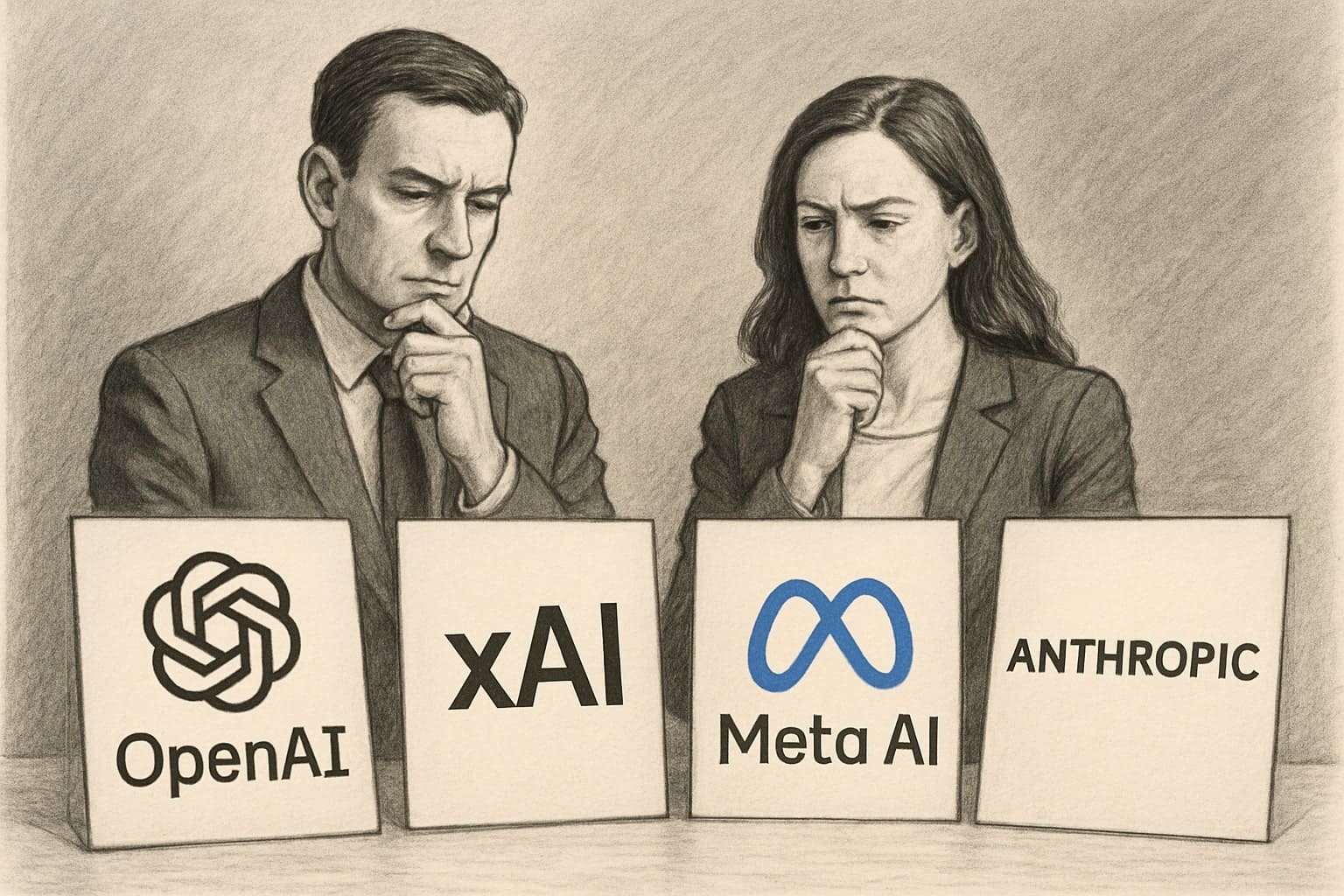
The high cost of artificial intelligence is becoming a major problem for startups. According to reports from The Wall Street Journal, companies such as Notion are seeing AI features eat into their profit margins by as much as 10%, and that is just for basic tools. Large language models, such as those from OpenAI or Anthropic, require enormous expenditures for training and operation, and these costs are not falling as many had hoped. Instead, they are increasing because the models are more complex and require more computing power for every user interaction.
Generative artificial intelligence companies themselves are suffering enormous losses. OpenAI lost $5 billion in 2024 (approximately CZK 115 billion), while Anthropic lost $5.3 billion (approximately CZK 122 billion). These losses are continuing this year, mainly due to the cost of computing power for training and inference, which is the process of generating outputs for each request. Startups that build on these models pay large sums to their providers, who in turn pay cloud giants such as Amazon, Google, or Microsoft. So far, even they are not reporting profits from selling AI computing power.
Inference costs are not falling; on the contrary, they are rising as model complexity increases. The entire ecosystem—from startups and model providers to cloud companies—is struggling with profitability. The only path to survival may be passing the full costs on to users, but this faces resistance because the value to end customers may not justify the high prices.
Major Providers and Their Prices
OpenAI, with its ChatGPT models, is among the largest players. Its pricing model is based on tokens (tokens are units of text) or subscriptions. The price is around $0.03 (approximately CZK 0.69) per 1,000 input tokens and $0.06 (approximately CZK 1.38) per 1,000 output tokens. A ChatGPT Pro subscription or enterprise version can cost $200 (around CZK 4,600) per month or more. The trend is moving toward premium plans for professionals and businesses.
Anthropic offers the Claude 3 family of models with token-based pricing via an API (application programming interface) and tiered subscriptions on Claude.ai. Claude Max and Claude Pro subscriptions range from $20 to $200 (CZK 460 to CZK 4,600) per month. In August 2025, the company introduced new weekly usage limits for Claude Pro and Max, which, according to its data, will affect fewer than 5% of subscribers. This helps control costs and improve predictability in its SaaS (software as a service) offering. Its strengths include a long context window and a focus on safety.
Google, with Gemini through Vertex AI, uses subscriptions combined with character- or token-based pricing. Gemini Advanced starts at $20 (CZK 460) per month, while the enterprise version of Gemini Ultra costs up to $250 (CZK 5,750) per month. Its advantage lies in the fast Gemini 2.5 Flash models, optimized for performance and cost.
Mistral AI offers a usage-based model with competitive rates: around $0.40 (CZK 9.2) per million input tokens and $2 (CZK 46) per million output tokens. Its models are nearly on par with GPT and are openly published for easy integration.
China's DeepSeek provides open models with low infrastructure costs. DeepSeek V3 was trained for just $6 million (about CZK 138 million), one-tenth of the estimated cost of GPT-4. This makes it an alternative for budget-conscious companies.
Why Are Costs Rising?
AI usage is exploding, with companies deploying it in real-world applications ranging from virtual assistants to automated processes. Average monthly AI spending per organization rose from $63,000 (CZK 1.45 million) in 2024 to $85,500 (CZK 1.97 million) in 2025, an increase of 36%. Nearly half of all companies now spend more than $100,000 (CZK 2.3 million) per month on AI infrastructure or services.
Training and operating large models requires cutting-edge chips and data centers. AMD's latest AI chips have risen in price by 67%, from $15,000 (CZK 345,000) to $25,000 (CZK 575,000). Google increased its annual infrastructure investment to $85 billion (CZK 1.96 trillion), much of which is going toward AI capacity.
AI talent is extremely expensive. Meta is offering some candidates contracts worth $100 million (CZK 2.3 billion). These costs are indirectly reflected in prices for end users.
Subscription models are shifting to usage-based pricing, leading to unpredictable bills. Many companies face unexpected overage charges, especially when integrating AI into customer-facing products.
Hidden Risks and Open Models as a Solution
Despite growing budgets, only 51% of companies track the return on their AI investments. The others risk overpaying without understanding what works. Hidden costs include integration, developer support, licensing fees, or quota overage charges.
One solution is open language models. They offer zero usage fees, full customization, improving quality, and support from ecosystems such as Hugging Face or LangChain. Models such as Mistral 7B, Meta LLaMA 3, DeepSeek V3, or Yi-1.5 support contexts of up to 128,000 tokens and are suitable for large data volumes without unpredictable costs.
These models are suitable for companies with technical teams that want to avoid dependence on proprietary systems. They are not ideal for nontechnical teams or applications requiring cutting-edge accuracy, such as GPT-4 Turbo or Claude Opus.
How to Manage AI Costs
Choose the right model for the task—lighter models such as Mistral or Claude Haiku are sufficient for many use cases at a fraction of the cost. Model token consumption and estimate costs before scaling. Set budgets and alerts for real-time monitoring. Keep track of innovations in open models, which are improving rapidly.
Sources: wsj.com and bitskingdom.com


