

Pixar and Apple Specialists Have Created a New Platform for Generating AI Videos
Two veterans from leading technology companies, Charles Migos and Bharat Vasan, have joined forces with other former employees of Pixar, Apple, Google, and Unity to create Intangible - a web application with the potential to change the way AI videos are generated. Their platform aims to solve one of the most fundamental problems with current AI video generation tools - the lack of control over the final output.
"To achieve professional results in creative industries such as film, advertising, events, and games, directors, producers, and all creatives need control over scene design, shot composition, art direction, pacing, cameras, and other aspects," explains Charles Migos, who serves as Chief Product Officer at Intangible.
The Problem with Current AI Video Generators
Although current generative AI video tools achieve incredible quality and are often indistinguishable from reality, their use remains highly unpredictable. According to Migos, creating videos using existing tools such as Google's Veo 3 or Kling is "like rolling the dice." There is a gap between the creator's vision and what the AI engine actually produces.
The main problem is that current models rely on extensive text prompts, while language alone is not sufficient to convey creative intent. Every person and every artificial intelligence visualizes any given text differently. This can be beautiful when reading a book, but it represents a significant limitation when creating a specific vision.
Sample video here: https://images.fastcompany.com/image/upload/q_auto,c_fit,w_1024,h_1024/wp-cms-2/2025/07/i-1-Intangible.webm
Spatial Intelligence as the Key Solution
Migos and CEO Bharat Vasan believe that to truly unlock the potential of generative AI for video production, "spatial intelligence" must be added to the interface. This concept was defined by Fei-Fei Li, known as the godmother of artificial intelligence, as the ability to perceive, interpret, reason about, and interact with the three-dimensional world.
"By incorporating interactive 3D from the very beginning, Intangible's world model enables generative AI models for image and video generation to be more precise without extensive prompts," says Vasan. This precision is exactly what current text-to-video tools fundamentally lack.
Intangible grounds generative AI models in structured 3D scenes with real camera control and spatial logic, which, according to Vasan, "provides the best coherence in results, which we further improve using object descriptions, reference images, and model fine-tuning (LoRA - low-rank adaptations)."
How Intangible Works
The platform allows users to create their own 3D scenes using drag-and-drop objects, set up cameras, and control them. The interface is relatively simple - you can start with a preset scene or an empty world. The main viewport displays the scene with a base ready for placing buildings, characters, and other objects from a library containing more than 5,000 assets.
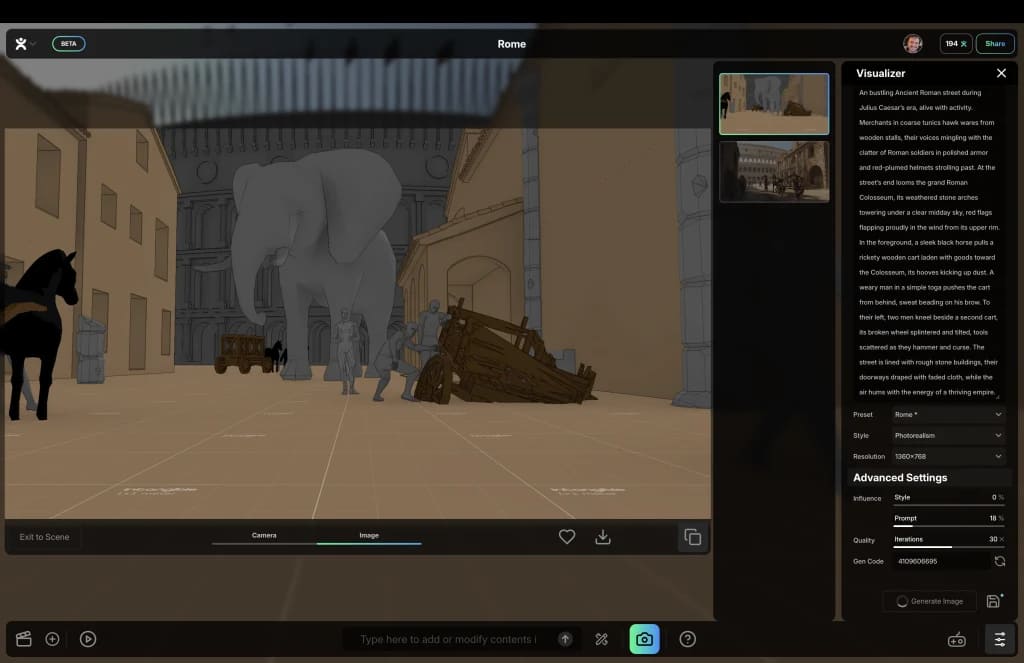
At the bottom of the interface is a toolbox containing all the necessary tools. On the left are icons for opening the scene panel, where you can add and rearrange all the shots that will make up your final video. In the center is the main prompt for adding new objects using text. To its left are three icons for adding objects to the scene - a palette for selecting objects from the library, primitives (spheres, cubes, pyramids), and "interactive elements" (cameras, characters, waypoints for camera movement).
Objects in the scene can be moved using standard 3D handles - arrows for movement, cubes for scaling, and arcs for rotating objects along all three axes.
Technology and Rendering
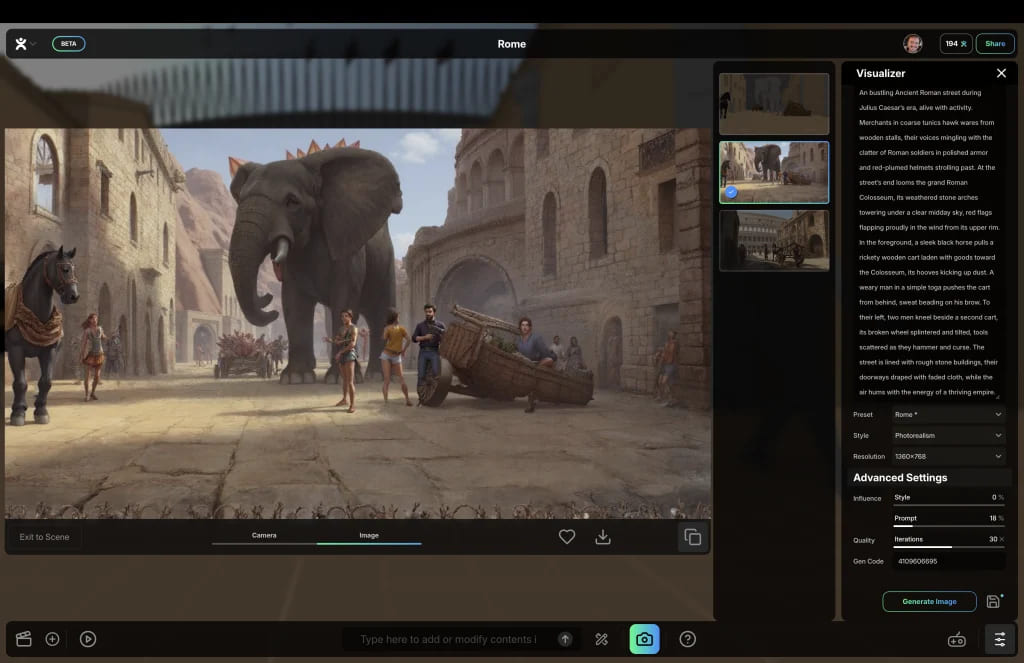
To the right of the prompt field are two icons for switching between editing and visualization modes. The latter opens a side panel on the right side of the screen containing everything needed to tell the generative AI how to render the scene - the appearance of objects, their interactions with one another, lighting, atmosphere, and other parameters.
The platform also offers options for setting the time of day or the final look of the video, including modes such as photorealism, 3D cartoon, or film noir. After entering a prompt, simply click the "generate" button to start the process.
Interestingly, Intangible does not actually use its own generative AI engine to interpret the 3D scene directly. Instead, it passes your static image to the latest version of Kling- a popular realistic rendering engine from China that can transform any image into a lifelike video based on a prompt.
The Future of the Platform
Migos and Vasan are optimistic about the future. "Over the next three years, we expect tools like Intangible to be able to cover all aspects of pre-production and digital production for existing forms of media," they say. They also believe that "AI tools offer an opportunity to expand visual storytelling as an art form and create new categories in which human creativity can thrive."
They expect tools like Intangible to be simple enough yet powerful enough to empower a new generation of creatives, not only those who are technically proficient or experts in prompting.
Another video example: https://images.fastcompany.com/image/upload/q_auto,c_fit,w_1024,h_1024/wp-cms-2/2025/07/i-2-Intangible.webm


