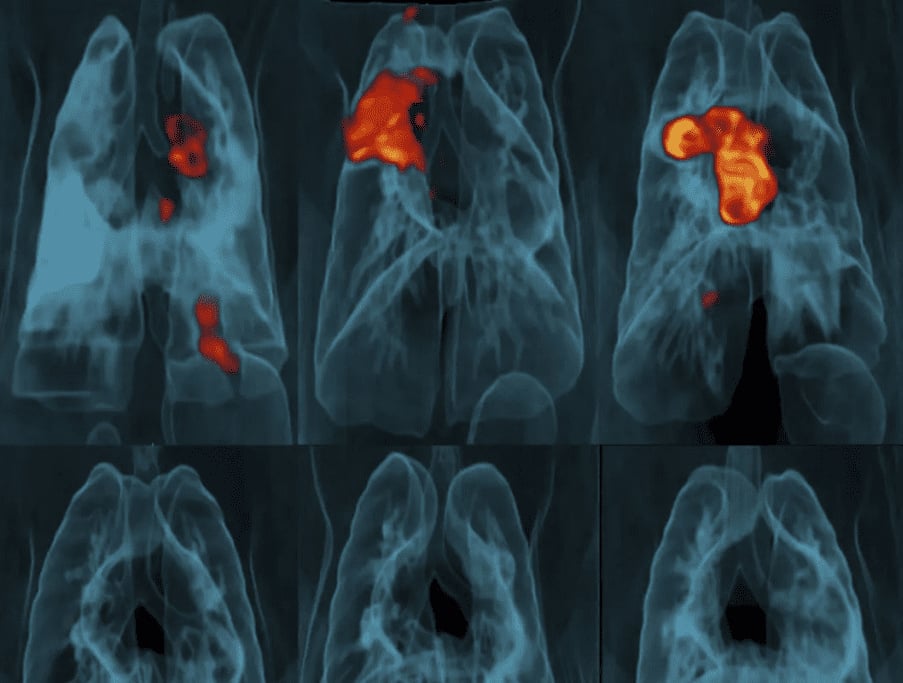
A doctor stands in front of a screen. Before them is a patient with lung cancer, a mountain of test data, and dozens of possible treatment options. How do they choose the right one? This is precisely the question that the European OPTIMA project is seeking to answer. Since October 2021, it has brought together 36 partners from 13 countries with a single goal: to use artificial intelligence to ensure that every cancer patient receives treatment tailored to their individual needs.
The Goal of the OPTIMA Project
Advances in oncology have brought more treatment options than ever before. However, this also means that doctors must absorb an ever-growing number of diagnostic methods, recommendations, and procedures. And this is where the problem arises. Not every patient receives the treatment that would be best for them—not because the doctor lacks expertise, but because even the most experienced specialist can find it difficult to navigate the flood of information.
OPTIMA, short for “Optimal Treatment for Patients with Solid Tumours in Europe Through Artificial Intelligence,” aims to solve this problem. Funded by the Innovative Medicines Initiative (IMI) and the related Horizon 2020 programs, the project is based on the idea that properly configured artificial intelligence can lend doctors a helping hand at the right moment rather than replace them.
The foundation of the entire project is the creation of Europe’s first interoperable platform for oncology data. The platform will collect real-world health data from more than 200 million people, and the entire system is designed to comply with strict personal data protection rules under the European GDPR.
In practice, this means that datasets, analytical tools, artificial intelligence algorithms, and tools for so-called federated learning—a method in which models are trained on data without that data leaving the hospital or country of origin—will all be available in one place. The data processed in this way will then be used to develop clinical practice recommendations that will be directly integrated into electronic health records. Put simply, a doctor will open a patient’s records, and the system will provide a recommendation based on data from across Europe.
Three Types of Cancer
OPTIMA focuses on the diagnosis of prostate, breast, and lung cancer. These are among the most common cancers in Europe, where every improvement in treatment can benefit an enormous number of patients.
The project is jointly led by Professor James N'Dow of the European Association of Urology and the University of Aberdeen and Dr. Hagen Krüger, Medical Director of Oncology at Pfizer Germany. The consortium includes hospitals, universities, pharmaceutical companies, and patient organizations, including the European Respiratory Society and the European Lung Foundation.
At the consortium’s annual meeting in Brussels in May 2026, the project devoted an entire session to discussing how patients perceive artificial intelligence in cancer care. A survey by the European Lung Foundation showed that patients welcome AI as such, but want reassurance that a real doctor will always be involved in decisions about their treatment. “Patients want artificial intelligence to be used, but in conjunction with medical experts. Treatment decisions should be made through collaboration between a specialist doctor, such as an oncologist, and artificial intelligence,” said Ximena Montano, a member of the PPAB and a representative of Europa Donna.
Trust Is Essential
The discussions in Brussels revolved around issues that are not merely technical. Who makes the decisions: the doctor or the algorithm? How is patient data protected? Do patients understand what the system recommends? Transparency and clarity have proven to be essential conditions without which even the best tool will fail to earn the trust of those for whom it was created. And without the trust of patients and doctors, even the most sophisticated platform will remain merely an interesting technological exercise.
OPTIMA will run until September 2026. Six major pharmaceutical companies, more than twenty universities and research organizations, and several patient groups are involved in the project. The total budget exceeds €22 million, of which more than €10 million is covered by a European Union contribution.
Sources: europeanlung.org and ersnet.org