OpenAI introduces the o3 and o4-mini models: Smarter artificial intelligence with enhanced reasoning capabilities
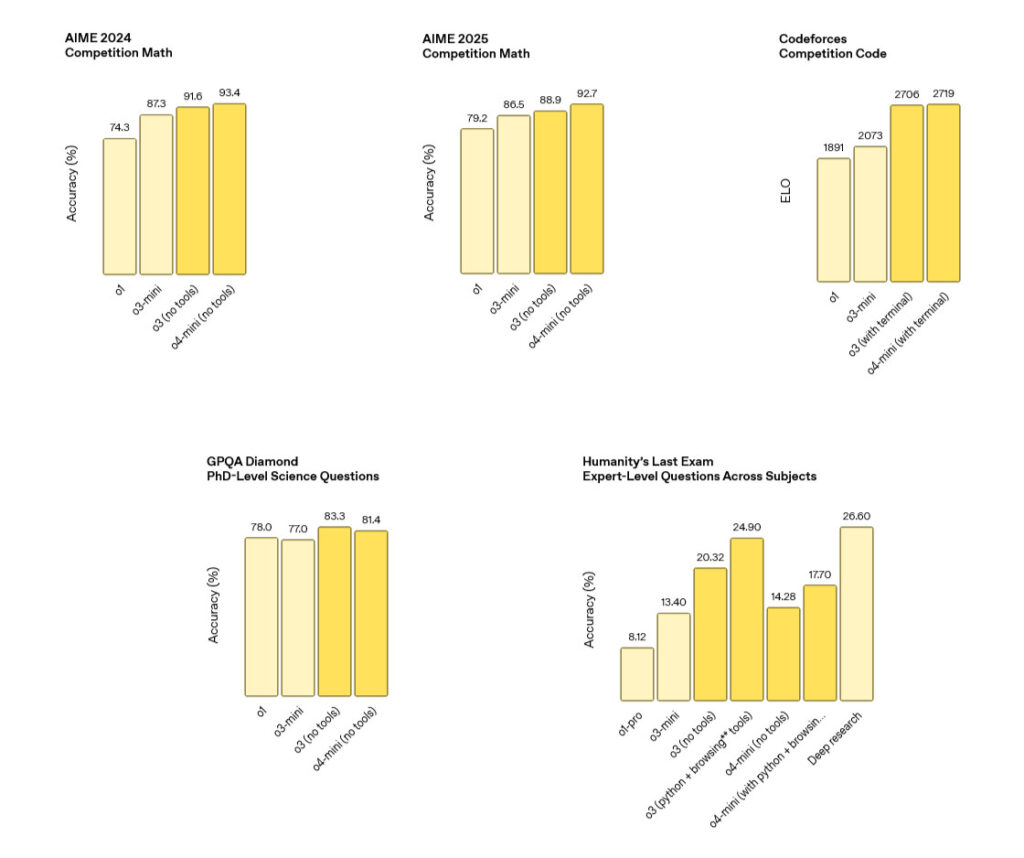
In April 2025, OpenAI introduced two new models from its “o-series” lineup: o3 and o4-mini. These models bring significant improvements in the field of artificial intelligence, particularly in areas such as logical reasoning, programming, mathematics, science, and visual perception. What exactly has changed, and why are these new developments important?
Key changes and improvements
-
Significantly better logical reasoning and analytical capabilities
The o3 model is now OpenAI’s flagship for tasks requiring deep, multi-step thinking. Compared to previous generations, it makes 20% fewer serious errors when solving real-world tasks. This means it is more reliable, for example, when handling complex programming or scientific queries.
-
Multimodal capabilities – working with text and images
Both models, o3 and o4-mini, can not only “see” images but also actively work with them as part of their internal reasoning process. This means they can analyze charts, diagrams, or photographs and incorporate them into their responses just as naturally as text. This integration expands AI capabilities in areas where visual and textual information need to be combined.
-
Efficiency and costs
While o3 is designed for the most demanding tasks, o4-mini is optimized for speed and low costs. Although it is smaller and cheaper (up to 9x cheaper per token than o3), it achieves nearly comparable performance in many tasks, especially when it can use tools such as the Python interpreter. This makes it an ideal choice for companies and developers who need to process large volumes of data or are looking for an affordable solution.
-
Full tool support
Both models have access to the full suite of OpenAI tools – from Python and web search to working with files and images. This means they can not only answer questions but also perform calculations, analyze data, or generate visual outputs.
These models can naturally perform operations such as cropping, zooming, and rotating images during their analysis, enabling a more human-like understanding of visual content. This capability has proven incredibly useful for tasks such as:
- Explaining complex diagrams or charts
- Analyzing screenshots of code or error messages
- Interpreting scientific data visualizations
- Providing feedback on design proposals
As OpenAI explains: "You can upload a photo of a set of economics problems and receive detailed, step-by-step explanations, or share a screenshot of a build error and quickly get a root cause analysis."
Practical applications and availability
Both models are now available through ChatGPT and the OpenAI API, although with different usage limits. ChatGPT Plus, Team, and Enterprise subscribers can access o3 with a weekly message limit, while o4-mini offers more generous daily limits. For developers, the API pricing structure reflects the different positioning of the models. The o3 model costs $10 per million input tokens, positioning it as a premium offering for complex tasks. o4-mini provides a more economical alternative at just $1.10 per million input tokens, with substantially higher throughput limits.
User experience and limitations
Users praise the more natural conversation, better ability to follow instructions, and greater usefulness of the responses. Compared to older models, the responses are less prone to errors and better reflect previous conversations. On the other hand, some users have noticed that the length of outputs (for example, when generating long pieces of code) is sometimes shorter than before. This may be the trade-off for greater efficiency and lower costs, especially with the o4-mini model.
Who is each model intended for?
o3: The best choice for tasks where accuracy, depth of analysis, and complex reasoning are essential. Ideal for programmers, analysts, or scientists.
o4-mini: Excellent for companies and projects that need to process a large number of requests quickly and inexpensively without significantly compromising quality.
You can watch the demonstration video here.