The Smartest AI Today: OpenAI Introduces GPT o3-Pro!
Artificial intelligence is not just a tool for writing emails or finding answers to questions. It has become a very important work tool in fields that require accuracy, reliability, and the discovery of deeper connections. And that is precisely why AI models must become increasingly smarter and better. This has not escaped the attention of OpenAI, which introduced the o3-Pro model this month. It not only reasons and corrects its own mistakes, but also excels where other models fail—in mathematics, science, coding, and working with large datasets.
What Is o3-Pro?
The o3-Pro AI model belongs to OpenAI's “o” family of models. Unlike its predecessor o1 (which can solve problems at the level of a PhD university student) or its sibling o3, it can reason in even greater detail and perform even more complex operations before answering.
In short, this model is ideal for tasks that require more reasoning and greater computing power. The o3-Pro AI examines connections and concepts in great detail and delivers the most accurate results of any current language model.
More Time, Fewer Errors
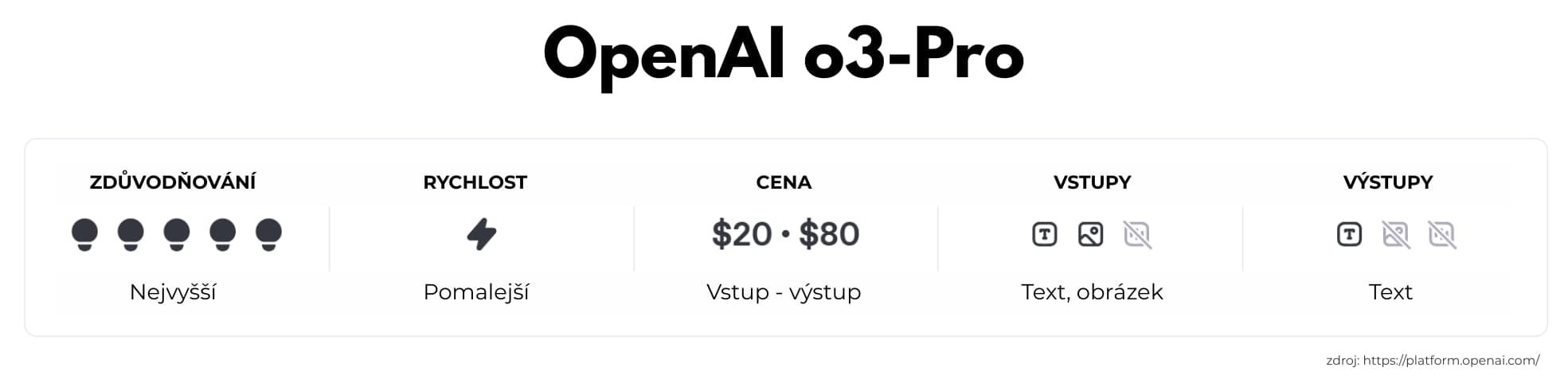
GPT o3-Pro is slower than other large language models. This may seem like a step backward, but the opposite is true. Its slower responses are the result of its highly thorough chain of thought.
Waiting for an answer can therefore take several minutes. However, it is still important to remember that finding the answer to such questions would take a person several hours. O3-Pro is therefore an excellent tool for science and research, with no equal in the AI world to date.
Mathematics, Science, and Programming
The o3-Pro model is built on the same foundation as the o3 model. However, its reasoning and ability to work with complex problems requiring deeper analysis have been enhanced.
According to experts, this model excels in the fields of science, mathematics, coding, advanced writing, and education. All it needs is broad context, an assigned task, a defined goal, and time to produce the result.
Among other things, it also boasts web search and the ability to work with images. These two key capabilities enhance its accuracy, instruction following, and clarity of outputs.
Does o3-Pro Have Any Competition in the AI World?
Most language models compete in terms of speed and performance. However, the o3-Pro model takes a completely different approach—it is not focused on speed and immediate conversation. Instead, it prioritizes reliability, detailed chains of thought, and the depth and sophistication of its answers.
However, it is certainly not alone in the field of advanced reasoning AI. Branching thought processes and a deeper understanding of a topic are also strengths of competing language models such as Claude 4 Opus or Sonnet, Gemini 2.5 Pro, or DeepSeek. However, because it approaches tasks differently, making a direct comparison is relatively difficult.
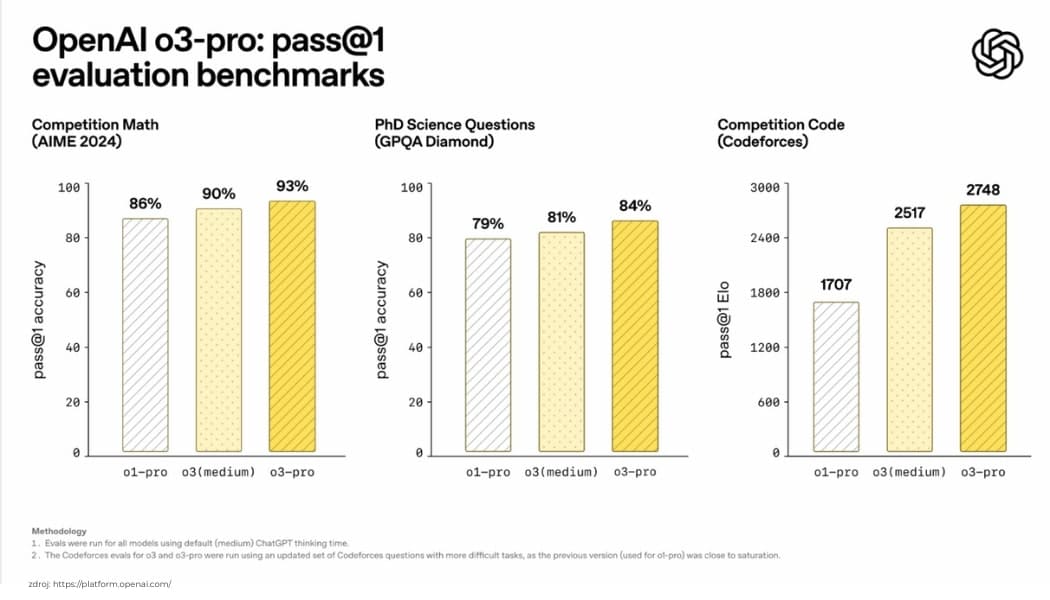
Nevertheless, benchmark tests show that it outperforms at least its peers from the “o” family.
Who Is o3-Pro Ideal For?
If you are looking for a conventional conversational chatbot, GPT-4 or the o3 or o4-mini models are a better choice. O3-Pro is not designed for fast conversational work. Rather than engaging in discussion, it is better suited to working independently on an assigned task. It focuses on more relevant and accurate answers, deeper analysis of topics and data, and, above all, the ability to handle even highly complex fields.
Unlike conventional models, it can work with large data inputs, modify and fine-tune code—whether in Python, SQL, or other languages—develop strategies and forecasts, and work with complex scientific principles. This makes it a powerful assistant for scientists, researchers, engineers, programmers, data analysts, and anyone looking for more than just a conventional chatbot.