

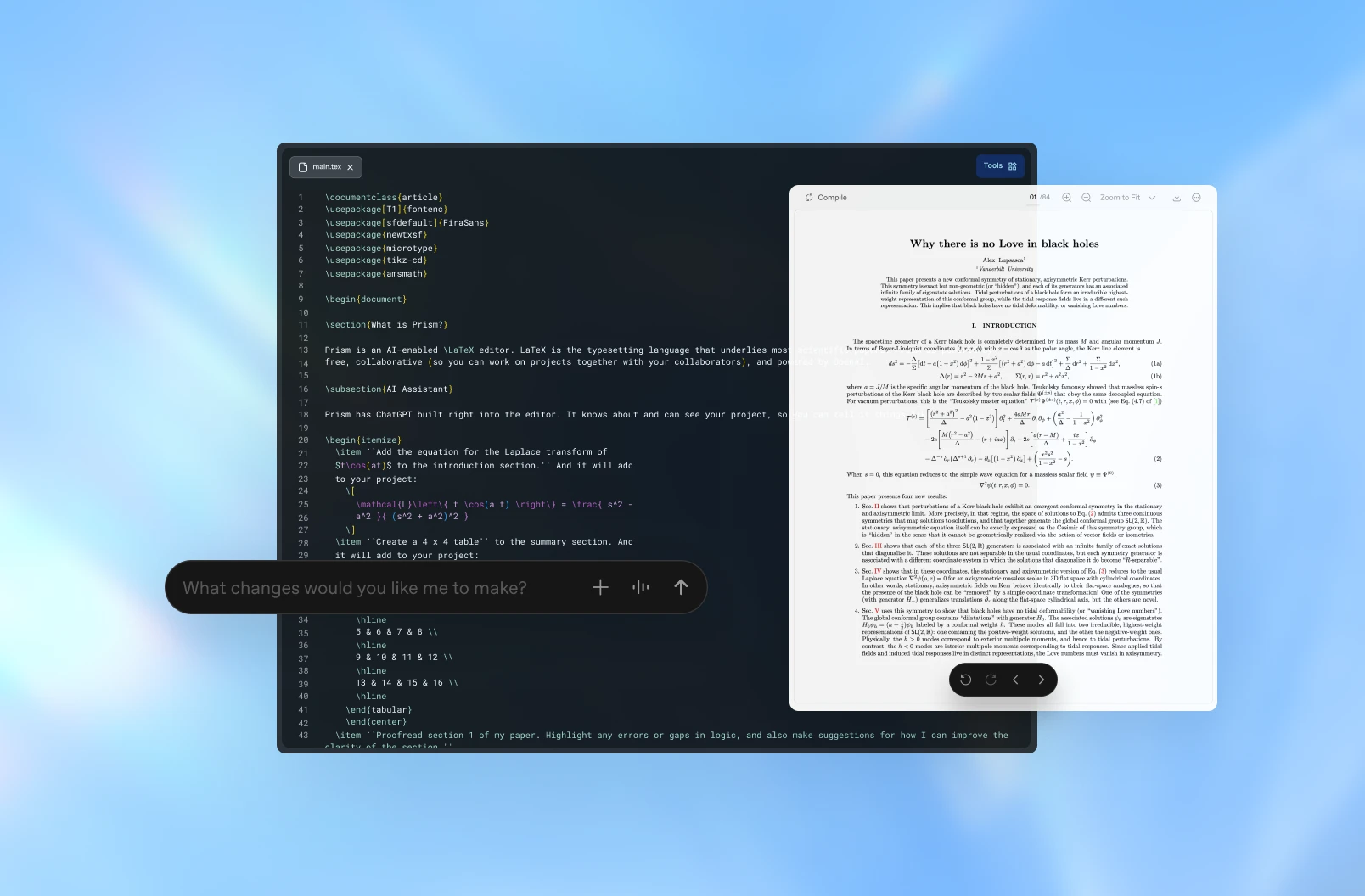
OpenAI has launched Prism, a new free platform designed for scientific writing and collaboration. This tool integrates advanced artificial intelligence directly into the process of creating scientific papers.
What Is Prism
Prism is a cloud-based workspace designed specifically for scientific writing that uses GPT-5.2—the most advanced OpenAI system for mathematical and scientific reasoning. The platform is available free of charge to anyone with a ChatGPT account and offers an unlimited number of projects and collaborators. Kevin Weil, OpenAI's vice president of science, said at a press conference: "I think 2026 will be for AI and science what 2025 was for AI and software engineering."
The platform builds on Crixet, a cloud-based LaTeX system that OpenAI acquired and subsequently developed into Prism. LaTeX is an open system used to format and typeset scientific papers.
Key Platform Features
Prism offers scientists a range of advanced features. Users can chat with GPT-5.2 Thinking to explore ideas, test hypotheses, and think through complex scientific problems within the context of their project. The system allows them to write and revise papers with the full context of the document, including surrounding text, equations, citations, images, and overall structure.
Researchers can search for and incorporate relevant literature, such as from arXiv, within the context of the current manuscript. The platform also allows users to create, revise, and reason about equations, citations, and images, while the AI understands how these elements relate to one another throughout the paper. One practical feature is the ability to convert equations or diagrams from a whiteboard directly into LaTeX. Scientists can collaborate with co-authors, students, and advisors in real time, with edits, comments, and revisions immediately reflected in the document.
TechCrunch noted that Prism is not designed to conduct research independently and without human guidance. Executives believe it will accelerate the work carried out by human scientists and compared Prism to programming interfaces such as Cursor and Windsurf. The program uses GPT-5.2's visual capabilities, allowing researchers to create diagrams from online whiteboard drawings. When users open a ChatGPT window through Prism, the model has access to the full context of the research project, making its responses more relevant and intelligent.
Availability and Pricing
Prism is free to use, and anyone with a ChatGPT account can start writing immediately. There are no subscriptions or limits on the number of seats. Because the platform is cloud-based, no local LaTeX installation or environment management is required.
More powerful AI features will be made available over time through paid ChatGPT plans. The company also said that Prism will soon be available to organizations using ChatGPT Business, Enterprise, and Education plans.
Ownership Concerns
Jonathan Schaeffer, professor emeritus of artificial intelligence at the University of Alberta and co-founder of AI developer Synsira, expressed concerns about intellectual property in an interview with Decrypt. "The standard protocol is that if I write a paper, everything I do is documenting my scientific research, and it is my intellectual property and I own it," Schaeffer said. "Now, if you use ChatGPT to write these papers, then you are actually exposing your intellectual property to a multinational corporation." Schaeffer also highlighted the ongoing problem of AI hallucinations and predicted that "hallucinations will not go away. They will never reach zero." He recommends thinking of AI as "augmented intelligence" rather than artificial intelligence.
OpenAI's Strategy
The launch of Prism coincides with a strategic shift in OpenAI's leadership. Last week, OpenAI CFO Sarah Friar published a blog post outlining the evolving business model for AI developers beyond subscriptions and API fees. In her post, Friar wrote that as AI moves into "scientific research, drug discovery, energy systems, and financial modeling, new economic models will emerge." "Licensing, intellectual property-based agreements, and outcome-based pricing will share in the value created," Friar wrote.
The company says that ChatGPT receives an average of 8.4 million messages per week on advanced topics in the natural sciences. In mathematics, AI models have been used to prove a number of long-standing Erdős problems. A statistical paper published in December used GPT 5.2 Pro to create new proofs for a central axiom of statistical theory.
During a public meeting, OpenAI CEO Sam Altman warned that despite recent progress, today's models still fall short of being able to work independently in scientific research. "I think it is still a long or reasonably long way from models conducting truly fully closed-loop autonomous research in most fields," Altman said.
The platform is now available at prism.openai.com to anyone with a ChatGPT account.


