

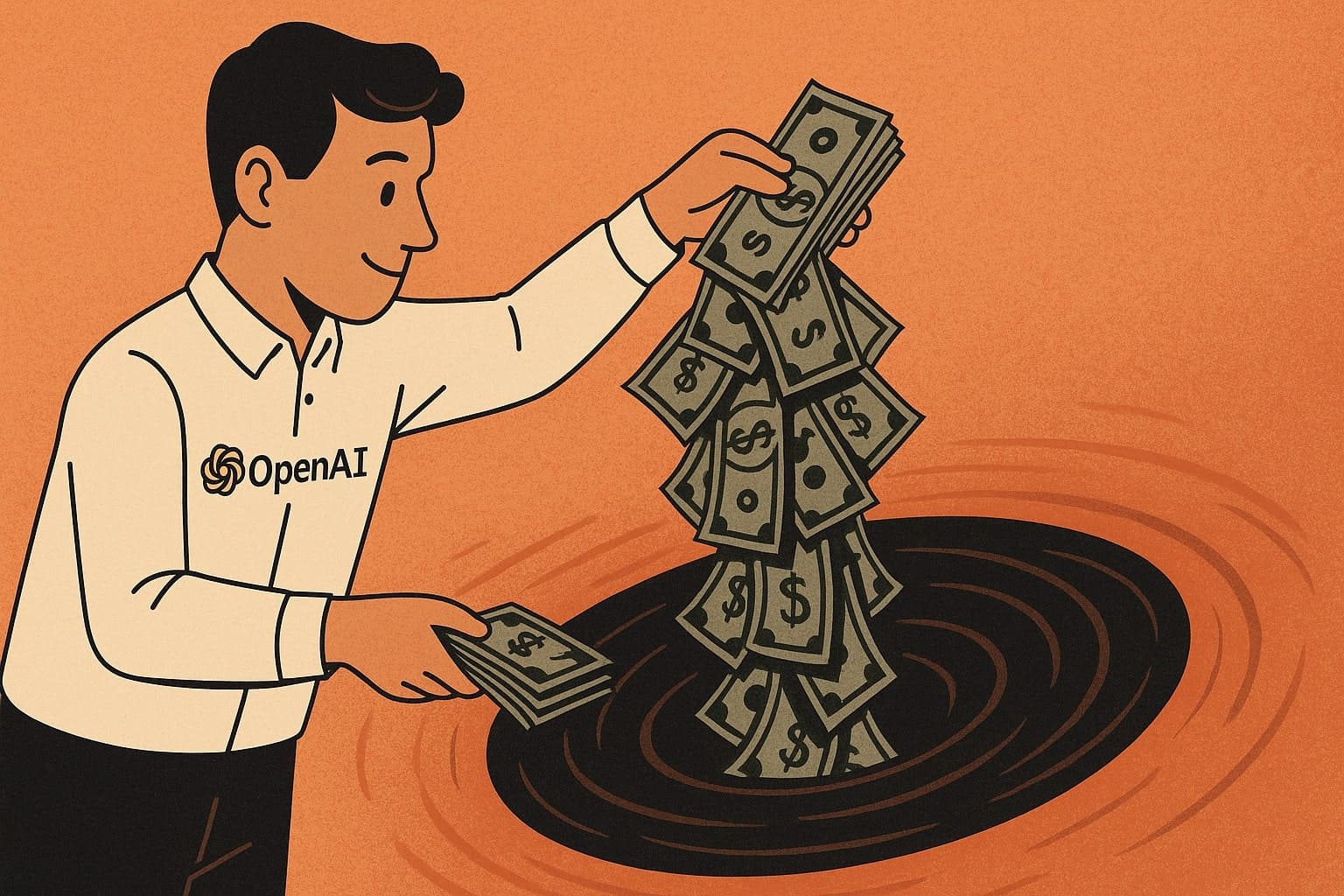
OpenAI Is Losing Billions Despite Massive Investments
OpenAI, the company behind the popular ChatGPT, is facing serious financial problems that could threaten the entire artificial intelligence sector. Despite raising at least $60.9 billion in private funding since launching ChatGPT two and a half years ago, the company loses billions of dollars every year. According to MSNBC, its losses in 2024 amounted to approximately $5 billion.
Ironically, this astronomical loss does not seem to concern OpenAI's leadership, which hopes to reach annual revenue of $125 billion by 2029. The gulf between the company's ambitious plans and its actual financial situation reveals what technology critic Ed Zitron calls a "subprime AI crisis."
A Parallel With the 2007 Mortgage Crash
In his analysis, Zitron highlights troubling similarities to the 2007 subprime mortgage crash that triggered the Great Recession. Just as banks then issued far more loans than they could realistically expect to be repaid, Wall Street is now investing billions of dollars in the hope that OpenAI will miraculously continue to increase in value.
According to MSNBC, ChatGPT is currently valued at roughly 30 times its revenue—representing an astonishing level of confidence. As Zitron notes, this notion is not based on sound financial analysis, but rather on a surge of "magical thinking."
"I assume that some kind of subprime AI crisis is brewing," Zitron wrote, "where almost the entire technology industry has bet on technology sold at a significantly reduced price, heavily centralized and subsidized by major technology companies. What happens when the entire technology industry relies on the success of software that only loses money and does not create much value?"
A Chain Reaction of Price Increases and Layoffs
The answer to Zitron's rhetorical question is already beginning to emerge in the form of massive layoffs, price increases, and declining quality in software that relies on companies such as OpenAI and Anthropic for its infrastructure.
One example is Anysphere, which operates Cursor—an "AI code generator" based on Anthropic's large language model (LLM) infrastructure. Despite raising nearly $1 billion in funding in June, it recently introduced massive price increases for its users.
This outraged its loyal user base of software engineers and programmers. Following the price increase, they flocked to social media to express their frustration and flooded Reddit with posts bearing titles such as "Cursor: pay more, get less, and don't ask how it works" and "Cursor's new pricing model is absolute garbage."
According to Zitron's analysis, "Anysphere, despite raising $900 million in funding, is running out of money, or at least believes that continuing to operate as it did less than a month ago would cause it to do so."
The Problem Goes All the Way to the Foundations
Following the money upstream reveals the real source of the rate limits: the pressure placed on Anysphere by Anthropic's own recent price increase—the first of its kind and a bad omen for the future.
As for OpenAI, it is difficult to see where else revenue could come from if not from price increases. ChatGPT already boasts 800 million weekly active users, or, according to CEO Sam Altman, "something like 10 percent of the world." The vast majority of them are free users, and it is difficult to imagine that they would be too pleased if their favorite chatbot were suddenly locked behind a paywall.
Evidence of this is that OpenAI recently introduced price increases similar to Anthropic's, offering "priority processing" to businesses willing to pay more. Regular users have already experienced OpenAI arbitrarily imposing limits, such as in May, when the company restricted ChatGPT image requests because its GPUs were "melting" under the weight of its vast user base.
Bleak Prospects for the Future
Looking ahead, the question is not "if" prices will climb into the stratosphere, but who will trigger it and when. Zitron sums it up succinctly: "There is no way this situation will lead to the growth that would turn Anthropic and OpenAI into profitable, sustainable businesses, and [it] will have the opposite effect on their revenue in the long term."
The situation is all the more troubling because other industry experts are expressing similar concerns. In addition to Zitron's criticism, other analysts are also warning about the unsustainability of the current business model, pointing out that the entire generative AI sector is highly unprofitable and heavily subsidized by investments from major technology companies. OpenAI's financial problems are therefore not an isolated case, but perhaps a harbinger of a larger crisis in artificial intelligence that could have far-reaching consequences for the entire technology sector.


