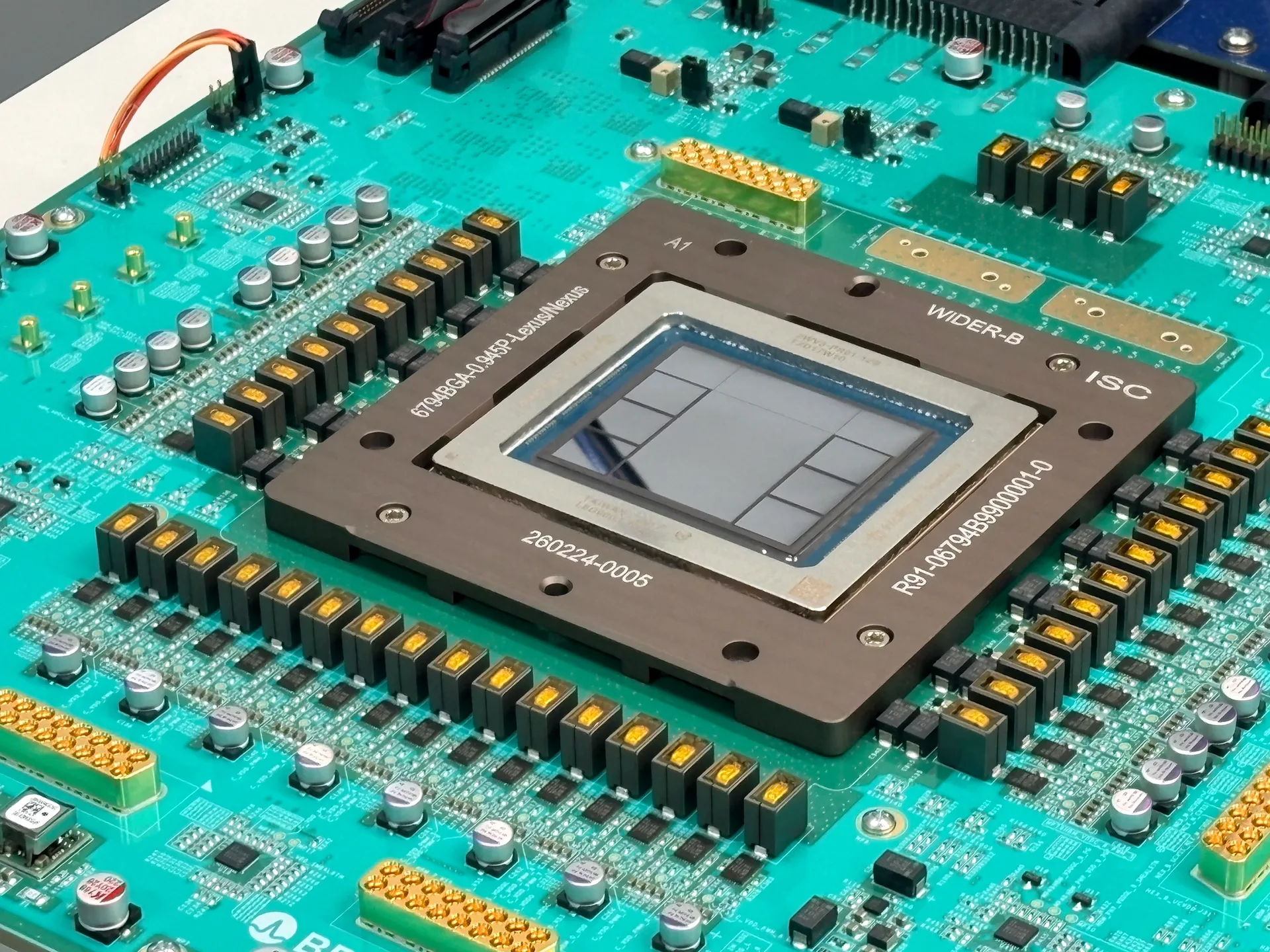
OpenAI has revealed details and published measured data on its first proprietary chip for the first time. Called Jalapeño, it was developed in collaboration with Broadcom and, according to the company's tests, can handle more queries using the same amount of electricity than the best commercially available systems while also responding faster. OpenAI's head of hardware, Richard Ho, told reporters that it represents a major leap over what the best systems available today can achieve
What Jalapeño can and cannot do
Jalapeño is a chip designed to run already-trained models, meaning the stage when a user submits a query and the system constructs a response word by word. This solution has nothing to do with training new models, an area in which Nvidia maintains a very strong position. OpenAI therefore readily acknowledges that it will continue to deploy accelerators from Nvidia and other partners extensively, both for the training phase and for inference itself.
The chip has a power rating of 700 watts, while its actual sustained power draw remained at 550 watts or less during the tested workloads. The Nvidia systems used for comparison consume considerably more power: 1,200 watts for the GB200 platform and 1,400 watts for the GB300. Richard Ho said that the low power consumption should reduce electricity bills in data centers, adding that the chip should make operations significantly cheaper.
How the measurements were conducted
OpenAI subjected the chip to the public InferenceX benchmark from analytics firm SemiAnalysis, which tracks the entire process of handling a single request rather than just one aspect of performance. The tests ran on three publicly available models: OpenAI's own smaller open model GPT-OSS 120B, DeepSeek R1, and the trillion-parameter version of Moonshot AI's Kimi K2.5 model. The company normalized the results by power consumption because it considers performance per watt a more useful metric than processor performance alone.
According to OpenAI, Jalapeño delivered 1.5 to 1.9 times more work per watt at full load across all three models and produced responses with 1.7 to 3.6 times lower latency. For highly interactive workloads where immediate responses matter, the difference increased to between 2.1 and 4.1 times.
The figures show what these differences amount to. With the GPT-OSS 120B model, the complete response took roughly one second, compared with 1.8 seconds for the system used for comparison. A single user received more than 1,400 tokens per second, versus approximately 535 tokens from the competing system. With the DeepSeek R1 model, the difference in total response time was the most pronounced, at 1.65 seconds compared with nearly six seconds. On Kimi, the largest model tested, the Jalapeño chip delivered approximately 1.5 times higher performance per watt and responded 3.4 times faster. According to the company, the gap widened even further in internal testing on its own advanced models, suggesting that the more demanding the workload running on this architecture, the greater its benefits.
A faster and more efficient chip
Running a language model involves phases that place entirely different demands on hardware. Processing an input query is computationally intensive, while generating the response token by token is constrained more by memory bandwidth. There is also the time lost as data moves between cores and chips, leaving some compute units merely waiting. A system that excels in one phase can therefore often lose its advantage while waiting for data.
OpenAI therefore designed the chip, memory, network, software, and entire rack as a single unit and sought to minimize data movement. The model state, including the cache for a response being generated, can be placed in a stable location and kept local. The system then activates precisely the combination of compute capacity, memory, and networking required for each phase. The network is an integral part of the design rather than merely an add-on, and it is large enough for the entire workload to fit within a single interconnected system. The result is intended to be a versatile accelerator capable of handling both phases as well as changes in the balance between them during operation, something that happens constantly with agents.
Because the chip can handle both high-volume operation and latency-sensitive workloads, OpenAI can offer customers the choice of optimizing their configuration for lower cost or faster responses.
AI completed the design in nine months
Nine months elapsed between the initial design and its submission for manufacturing at Taiwan's TSMC, an exceptionally short period for a new chip. OpenAI acknowledges that its own models helped make this possible. They tested various solutions, shortened the cycles between design, measurement, and verification, and also helped fine-tune the arithmetic circuits. As a result, the chip incorporates more computing power than would have been possible using conventional methods within the same timeframe.
The company also designed the chip so that artificial intelligence could program it. An engineer describes the workload using local tensors, explicit communication, and predictable synchronization. The model then determines how the workload should be distributed and scheduled across the entire system. Using the Codex tool and the GPT-Astra model, the team optimized three open models for high performance within two months, even though they had not originally planned to support them at all. For selected blocks of the GPT-OSS model, implementations written by artificial intelligence ran 1.5 to 1.8 times faster than versions created by human experts. However, this applies only to selected components, not the entire model.
When Jalapeño will enter operation
OpenAI plans to begin deploying the chip in its computing infrastructure by the end of the year. Richard Ho clarified, however, that volumes will be very small this year, with more significant deployment not expected until next year. The second generation is already at an advanced stage of development, and a third generation is taking shape. The company is currently completing manufacturing qualification, fine-tuning the software, and validating performance on additional models.
Competition for Nvidia
Nvidia maintains a near-monopoly on the most advanced artificial intelligence chips, but analysts say the wave of proprietary processors from major technology companies is weakening that monopoly. Adrien Sanchez of Yole Group told CNBC that Jalapeño demonstrates the ability of chips designed by data center operators to match or surpass Nvidia's Blackwell-generation cards in energy efficiency when running models. According to him, Nvidia still provides most of the computing power used for artificial intelligence, and its customers are tied to the CUDA software platform. However, OpenAI's new chip is targeting its margins in model inference, the part of the market that is currently growing the fastest.
Analysts also point to one weakness. Jalapeño beat Blackwell-generation systems in performance per watt in nearly all tested scenarios, but a comparison with Nvidia's newer platform would have been fairer. TechCrunch also highlighted this fact, noting that competitors may advance further before the new chip reaches full deployment. Nvidia did not comment on the results.
For OpenAI, cost remains the main argument. When it introduced the chip together with Broadcom, it said initial samples could reduce model operating costs by approximately half compared with conventional graphics processors for artificial intelligence. According to analysts interviewed by CNBC, Jalapeño could put pressure on Nvidia in precisely this area and reduce OpenAI's dependence on its hardware for at least some workloads.