


Is OpenAGI the New King of Computer Control?
The startup OpenAGI, led by CEO Zengyi Qin, has emerged with a bold claim. Its new Lux model can control computers better than systems from OpenAI and Anthropic—and at a fraction of the cost. This San Francisco startup, founded by an MIT researcher, released Lux as a foundation model that interprets screenshots and performs actions in desktop applications. According to the company, Lux achieves a success rate of 83.6% on the Online-Mind2Web benchmark, the most rigorous test for AI agents that control computers.
For comparison, OpenAI's Operator model achieves only 61.3%, while Anthropic's Claude Computer Use reaches 56.3%. That is a huge leap. In an interview with VentureBeat, Qin explained that traditional large language models (LLMs) are trained on text and learn to produce text. By contrast, Lux is trained on screenshots and sequences of actions, so it learns to directly produce actions for controlling a computer.
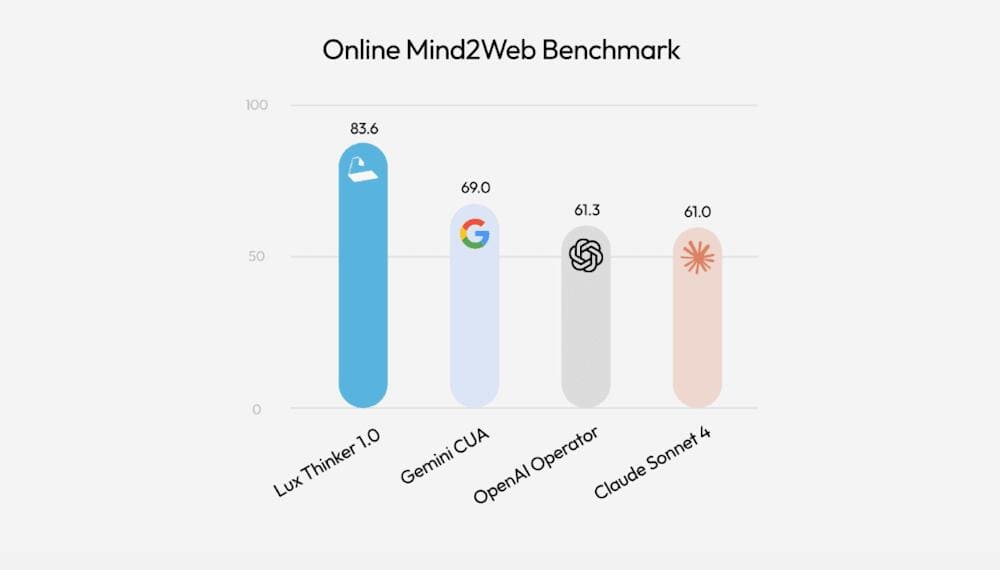
The Significance of the Online-Mind2Web Benchmark
This benchmark was created by researchers from Ohio State University and the University of California, Berkeley. It contains 300 different tasks across 136 real-world websites—from booking flights to making complex online purchases. Unlike older tests, it runs in a live online environment where websites change and unexpected obstacles arise. The researchers found that many current agents, despite substantial investment, do not perform better than the simple SeeAct agent from January 2024.
The research was published in April and accepted at the Language Modeling 2025 conference. In a blog post, the researchers noted that current agents are not as capable as figures from earlier tests suggest. The leaderboard on Hugging Face tracks results from various teams and companies, and Lux now leads it.
Training on Actions Instead of Words
OpenAGI uses a method called Agentic Active Pre-training. Instead of static data, the model learns by exploring its environment. Actions allow the model to discover new things, which then feed back into and improve its training. Qin said that a better model enables better exploration, which leads to better knowledge and ultimately an even better model. This cycle enables continuous improvement without enormous datasets.
The company claims that Lux operates at one-tenth the cost of models from OpenAI and Anthropic and completes tasks faster. This could explain how a small team managed to outperform the major players.
Lux Controls Not Just Browsers, but the Entire Desktop
Unlike competitors that focus mainly on web browsers, Lux can handle applications across the entire operating system. This includes working with Excel, communicating in Slack, designing in Adobe applications, or editing code. This capability opens the door to a wide range of productivity uses.
OpenAGI is also releasing a software development kit (SDK) so that third parties can build applications on Lux. The company is working with Intel to optimize the model for edge devices, allowing it to run locally on laptops without the cloud. This addresses data security concerns. Qin also mentioned discussions with AMD and Microsoft about additional partnerships.
Safety First
Agents that control computers introduce risks such as unintended money transfers or file deletion. OpenAGI has built safety mechanisms directly into Lux. If the model encounters a request that violates safety policies, it refuses the request and alerts the user.
In one example, when a user asked it to copy bank details into a Google document, Lux internally determined that the information was sensitive and blocked the action. Such safeguards will be tested by researchers, as attacks such as prompt injection (inserting malicious instructions) have already exposed weaknesses in other systems.
The Brain Behind OpenAGI
Zengyi Qin completed his PhD at MIT in 2025, where he focused on computer vision, robotics, and machine learning. His work has appeared at conferences such as Computer Vision and Pattern Recognition, the International Conference on Learning Representations, and the International Conference on Machine Learning.
Before OpenAGI, he led the development of JetMoE, a model trained for less than $100,000 (approximately CZK 2,300,000). It outperformed Meta's LLaMA2-7B model on benchmarks. His open-source project OpenVoice (voice cloning) has 35,000 stars on GitHub, while MeloTTS (text-to-speech) has been downloaded over 19,000,000 million times.
Qin co-founded MyShell, a platform for AI agents with six million users who have created more than 200,000 agents and carried out one billion interactions.
Source: venturebeat.com


