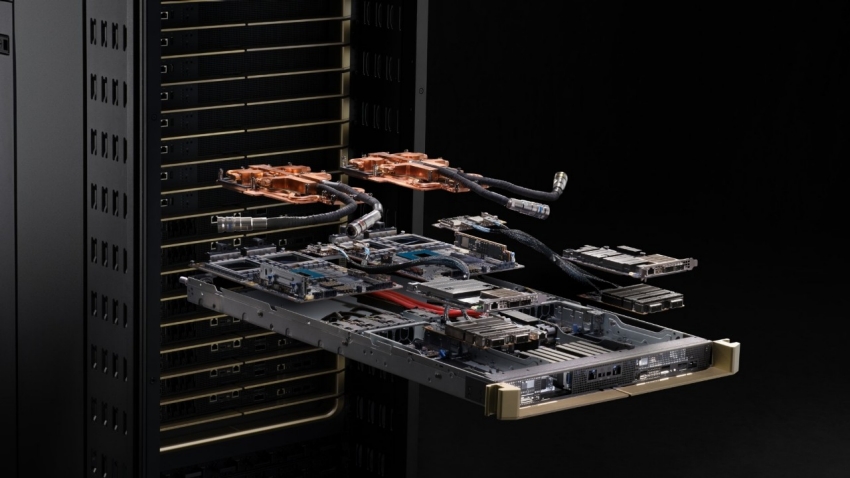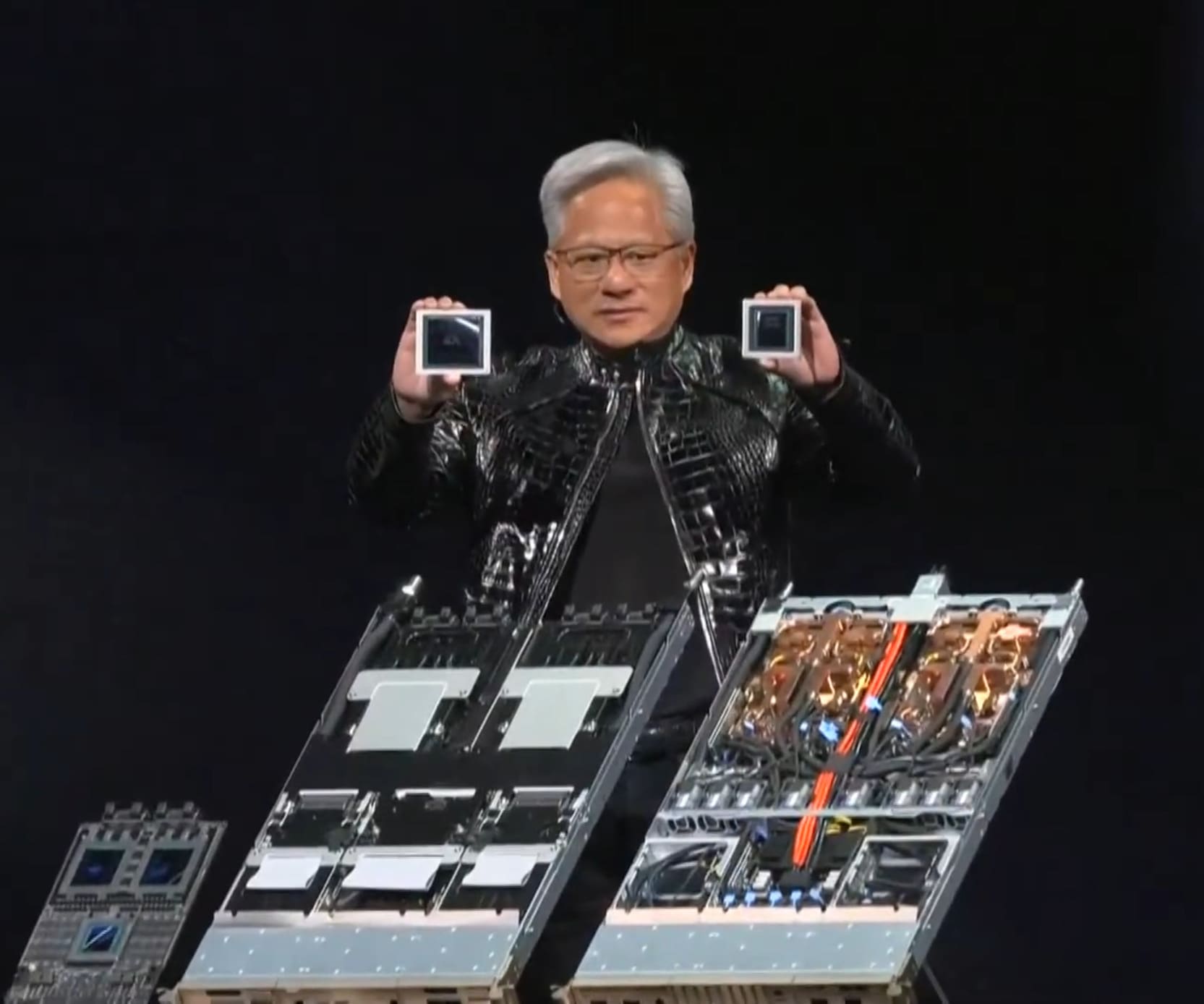
Nvidia has unveiled its latest artificial intelligence (AI) server systems, called Vera Rubin. The system will come to market in the second half of this year, earlier than originally expected. Nvidia CEO Jensen Huang announced this at the Consumer Electronics Show in Las Vegas. According to him, the demand for AI computing power is skyrocketing because models need to process enormous amounts of data. The company tested the new system on the assumption that developers will soon use up to 10 trillion data parameters to train AI models.
Vera Rubin systems are designed to handle enormous computational workloads, enabling the creation of reality simulations for AI training. For example, autonomous vehicles can improve their models faster through simulations of driving scenarios instead of thousands of hours of real-world testing. Nvidia has integrated a range of connectivity and memory storage products into the system, increasing computing speed. In doing so, the company has strengthened its position as the largest manufacturer of networking hardware and computing semiconductors.
Rubin GPU: The Heart of AI Computing
The Rubin GPU (graphics processing unit) is primarily used to accelerate the millions of calculations required to train and run AI models. This chip is part of the Vera Rubin NVL72 platform, which contains 72 such GPUs in a single rack. The Rubin GPU is manufactured using Taiwan Semiconductor Manufacturing Company's 3-nanometer process and uses state-of-the-art HBM4 high-speed memory technology (high-bandwidth memory).
Each Rubin GPU has 288 GB of HBM4 memory with a bandwidth of 22 TB/s (terabytes per second) and an NVLink bandwidth of 3.6 TB/s. These specifications make it possible to train mixture-of-experts (MoE) models using only a quarter of the number of GPUs required by the previous Blackwell generation.
The Rubin GPU is optimized for the next generation of AI, including agentic models that handle complex tasks such as reasoning and decision-making. Nvidia says that it reduces inference costs (responding to user queries) to one-tenth of those of Blackwell, making advanced AI systems more accessible.
Vera CPU: A Processor for Data and Decision-Making
The Vera CPU (central processing unit) is designed specifically for moving data and supporting agentic reasoning in AI, where models simulate thought processes. This processor delivers high-speed, energy-efficient computing with predictable performance. The Vera Rubin NVL72 platform includes 36 such CPUs, each with 88 custom NVIDIA Olympus cores (Arm-compatible).
Vera CPU specifications include: when combined with GPUs, the system provides 3,168 custom NVIDIA Olympus cores, 54 TB of LPDDR5X memory (low-power double data rate memory), and 65 TB/s of NVLink-C2C bandwidth. Overall, the platform contains 1,296 NVIDIA chips plus HBM4. The Vera CPU works with the Rubin GPU to scale intelligence in a rack-scale system, using an NVLink 6 switch for 3.6 TB/s all-to-all communication between GPUs.
This processor accelerates data processing across storage, networking, cybersecurity, and elastic scaling in AI factories. Nvidia emphasizes that the Vera CPU delivers massive efficiency gains; for example, when training models with 10 trillion parameters, results can be achieved in one month with fewer components.
Production and Partners
Nvidia has confirmed that Vera Rubin is in full production and will begin shipping to customers in the second half of the year. The first partners include Microsoft and CoreWeave, which will offer services based on these chips. Microsoft plans to integrate thousands of Rubin chips into its data centers in Georgia and Wisconsin. The company is also working with Red Hat on products for banks, automakers, and airlines.
The Vera Rubin NVL72 platform is built on the third-generation NVIDIA MGX rack design, enabling an easy transition from previous generations. It also includes the ConnectX-9 SuperNIC with 1.6 Tb/s (terabits per second) of bandwidth per GPU for low-latency networking, the BlueField-4 DPU for accelerating data processing, and Spectrum-X Ethernet with integrated silicon photonics for 5x greater energy efficiency and 10x higher network resilience.