Quantum computers could revolutionize the worlds of science and medicine. So why are we still not using them? They are not reliable enough. At least not yet. NVIDIA recently unveiled new AI models that are expected to change that.
Why Aren’t Quantum Computers Fully Operational Yet?
First, a little context. A classical computer works with bits, with each bit being either 0 or 1. A quantum computer works with so-called qubits, which can be both 0 and 1 at the same time. This is precisely what gives quantum computers their enormous computing power. They can solve problems that would take a conventional computer thousands of years.
However, there is a major catch. Qubits are extremely sensitive, and even small changes in temperature or electromagnetic radiation can disrupt a calculation. Quantum computers therefore require constant calibration and rapid real-time error correction. Until recently, this was an insurmountable obstacle.
NVIDIA Ising: An Ecosystem for Quantum Computers
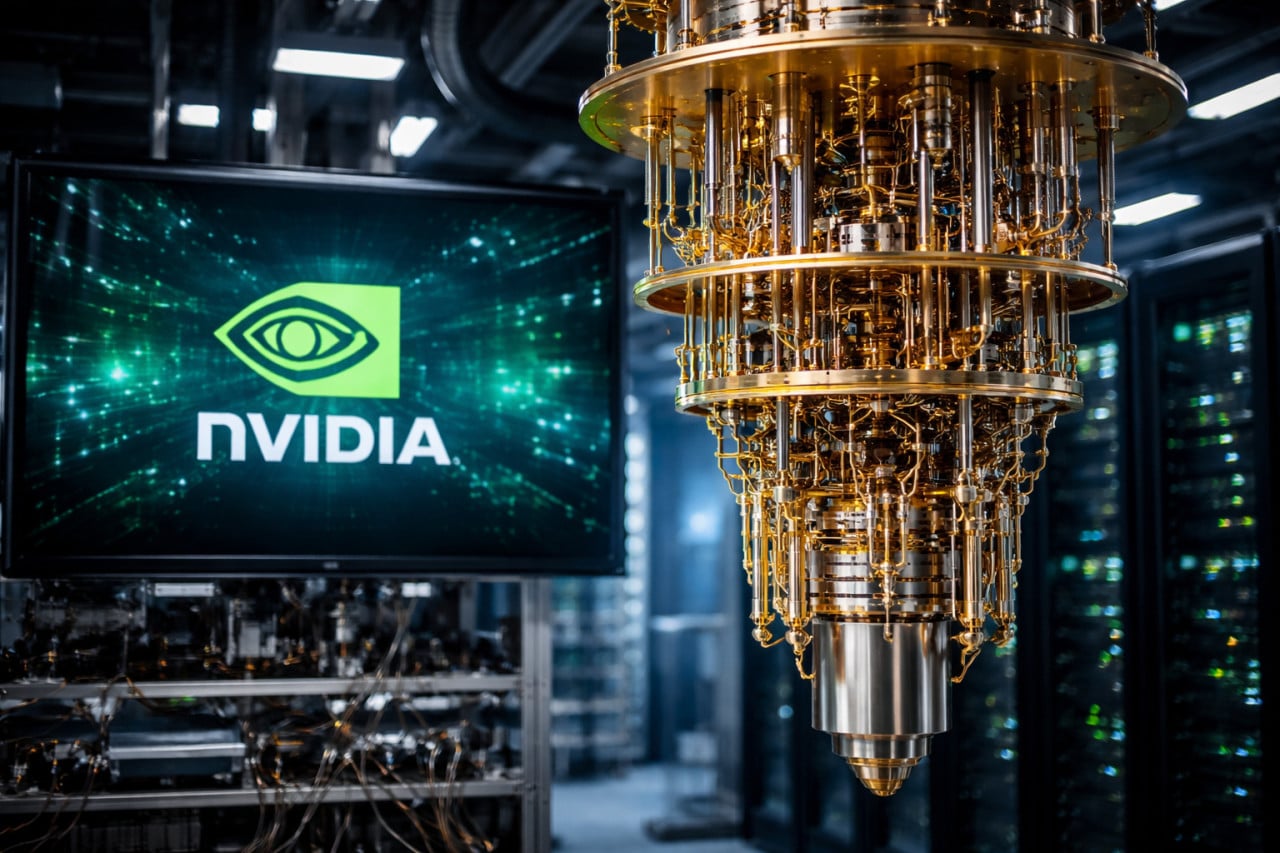
NVIDIA Ising is an open-source family of AI models that improves performance in quantum computing. These are the first AI models of their kind, and NVIDIA is making them available to everyone, from research institutes and laboratories to quantum hardware manufacturers.
The name refers to the Ising mathematical model, which is widely used in quantum research. It encompasses two AI models that are already delivering real-world results.
Ising Calibration and Ising Decoding
Ising Calibration focuses on one of the most sensitive areas of quantum research: calibration. Quantum processors require constant fine-tuning to operate smoothly. Any hardware imperfection or deviation can present an insurmountable problem.
Existing approaches are not fast or autonomous enough. But that is changing with Ising Calibration. This model can automatically evaluate the state of quantum hardware and connect to an agent that performs calibration automatically and without human intervention. It therefore outperforms other approaches.
Ising Decoding, meanwhile, handles error correction. For quantum processors to function at all, qubit errors must be corrected continuously. This requires processing terabytes of data thousands of times per second, which is an enormous workload. Ising Decoding delivers a 2.5x speedup and 3x improvement in accuracy compared with the best existing solution.
From Drug Development to Supply Chains
Until now, calibration and error correction have been the biggest obstacles to progress. However, NVIDIA’s models have great potential to change that, allowing quantum computers to finally be used in real-world applications.
The models are also freely available under an open license, including the data and tools needed to customize them for specific requirements. This makes them accessible to the scientific community and enables the development of new drugs, the breaking of encryption systems, and the optimization of large-scale supply networks.
AI as the Missing Piece of the Puzzle
NVIDIA Ising is more than just a technical innovation. It could accelerate the development of a crucial technology that has so far stalled halfway. And although talk of a quantum revolution is still premature, AI assistants such as Ising are bringing it closer faster than we expected.
Source: NVIDIA Ising, NVIDIA Newsroom, Microsoft Azure, IBM