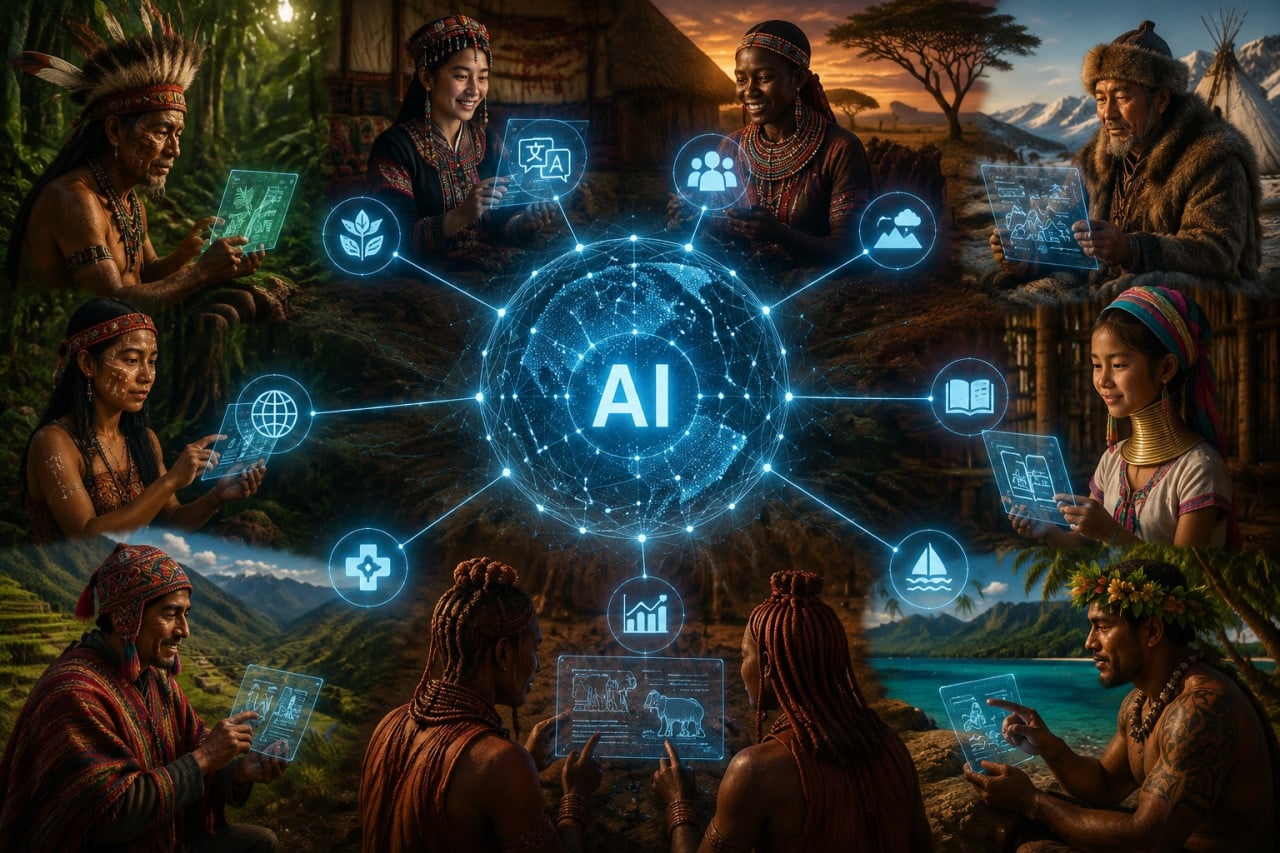
A farmer in the countryside takes a photo of a wilting plant. She wants to find out what is wrong with it, but she does not speak English, and the nearest data connection is who knows where. A project aimed at building artificial intelligence available free of charge to anyone in the world was created precisely for people like her.
The nonprofit organization Current AI wants to create open and public artificial intelligence modeled on the early web—a technology accessible to everyone, regardless of language, income, or internet connection. “When it comes to a technology that is set to transform every aspect of every person's life, there must also be a public alternative,” the organization's head, Ayah Bdeir, told TechCrunch. “Like the World Wide Web, available to anyone, for free.”
It Starts with Languages
The first major task Current AI has undertaken concerns languages. Half of those spoken around the world today are at risk of extinction. And because large language models are powered primarily by English, a huge share of the world's cultures and communities is being left out.
According to Bdeir, multilingual models are built mainly to expand their market, “regardless of consent or context.” The consequences can be very real. For some Indigenous languages, missionary translations of the Bible reportedly become training data before communities have a chance to establish any rules.
Current AI's answer is to build technology together with communities, not just for them, and to keep data local. In India, for example, the organization collaborated with the government's Bhashini language division on a device called Suno Sutra, which means “listening chronicles” in Hindi. It is a pocket-sized device that works without internet access and supports artificial intelligence in 22 Indian languages. “There are hundreds of different languages and dialects in India, and artificial intelligence does not represent them right now,” Bdeir explained. The entire solution is open, allowing other developers to build on it.
A machine's ability to speak a particular language is only part of what it must learn. “Language is how knowledge, tradition, memory, and identity are passed from one generation to the next. When technology does not understand your language, it cannot preserve your culture either,” Bdeir explained.
This is the foundation of the organization's entire vision: an open system modeled on the early internet, where improvements benefit everyone, no one is locked out, and communities retain control over their own data.
Funding Is Starting to Arrive
Spending has begun, although it remains modest for now. Last month, the organization distributed $3.2 million among four projects in Kenya, Lebanon, and the Brazilian Amazon.
Kenya's Masakhane project is creating datasets for more than 50 African languages focused on healthcare, agriculture, and education. Lebanon's Institute for Worldmaking is converting Arab cultural history into machine-readable databases controlled by communities rather than technology companies. Brazil's Portal sem Porteiras is developing offline tools with Indigenous people in the Amazon so that the data remains on their land. And Kenya's African Internet Rights Alliance is building tools to audit artificial intelligence systems and hold them accountable.
Not one of the funded projects has yet resolved the question of who actually owns the data. Bdeir sees that as intentional. Each of them has reportedly built the question directly into its work instead of accepting the usual situation in which complexity serves as an excuse and a government or company makes the decision for everyone.
When asked whether $3.2 million can really make a difference, she rejects the premise itself. “Scale is not always what matters. That is the way big technology companies think,” she said. As an example of the potential impact, she describes a situation in which an older person from the Brazilian Amazon uses a tool developed in Kenya to pass on knowledge about the local natural environment in their own language.
Building the Entire Technology Stack
The greater ambition is to build a complete open technology stack, from chips to finished applications. In early July, the organization unveiled Alpha Chat in Geneva, an open chatbot assembled in seven weeks by a coalition of ten organizations. They include Hugging Face, Mozilla, and the MIT Media Lab, each contributing a piece of the puzzle, whether a language model, safety tools, or computing power.
Current AI has also reached an agreement with Tokyo-based startup Sakana AI, known for its work on so-called sovereign artificial intelligence. Together, the two organizations want to create a shared open ecosystem that will support the Japanese language and culture while also serving communities across the Global South that dominant systems have long overlooked.
Current AI was unveiled at France's AI Action Summit in early 2025 and was founded by Martin Tisne. The French government launched it with $100 million, joined by the Ford Foundation and MacArthur Foundation, along with DeepMind and Salesforce. Total pledged investment now exceeds $400 million, and the organization aims to raise $2.5 billion within five years.
Crucially, the contributors are not seeking profit. “They are not investors; they are donors,” Bdeir emphasized. Before joining the organization, she led Mozilla's artificial intelligence strategy. Prior to that, she founded littleBits, a company that brought technology education to millions of children before it was acquired by Sphero in 2019.
Sources: timesnownews.com, thenextweb.com and beingguru.com