

New AI Can Predict Human Decision-Making Better Than Other Models
A team of scientists led by Marcel Binz from the Helmholtz Center for Artificial Intelligence (Helmholtz Center for Human-Centered AI) has introduced a revolutionary model called Centaur in the prestigious journal Nature—the first universal computational model of human cognition capable of predicting and simulating human behavior across a wide range of psychological experiments.
The Model’s Foundation: The Massive Psych-101 Dataset
Centaur is based on the Llama 3.1 70B large language model, which was specially trained on an enormous dataset called Psych-101. This unique dataset is the most extensive collection of human behavioral data to date and contains more than 10 million individual decisions from over 60,000 participants across 160 different experiments. The dataset covers a wide range of cognitive domains, including decision-making, memory, reinforcement learning, multi-armed bandits, Markov decision processes, and many other areas of psychology. Thanks to this breadth, Centaur can capture the diversity of human behavior in a wide variety of situations.
The Model’s Exceptional Capabilities
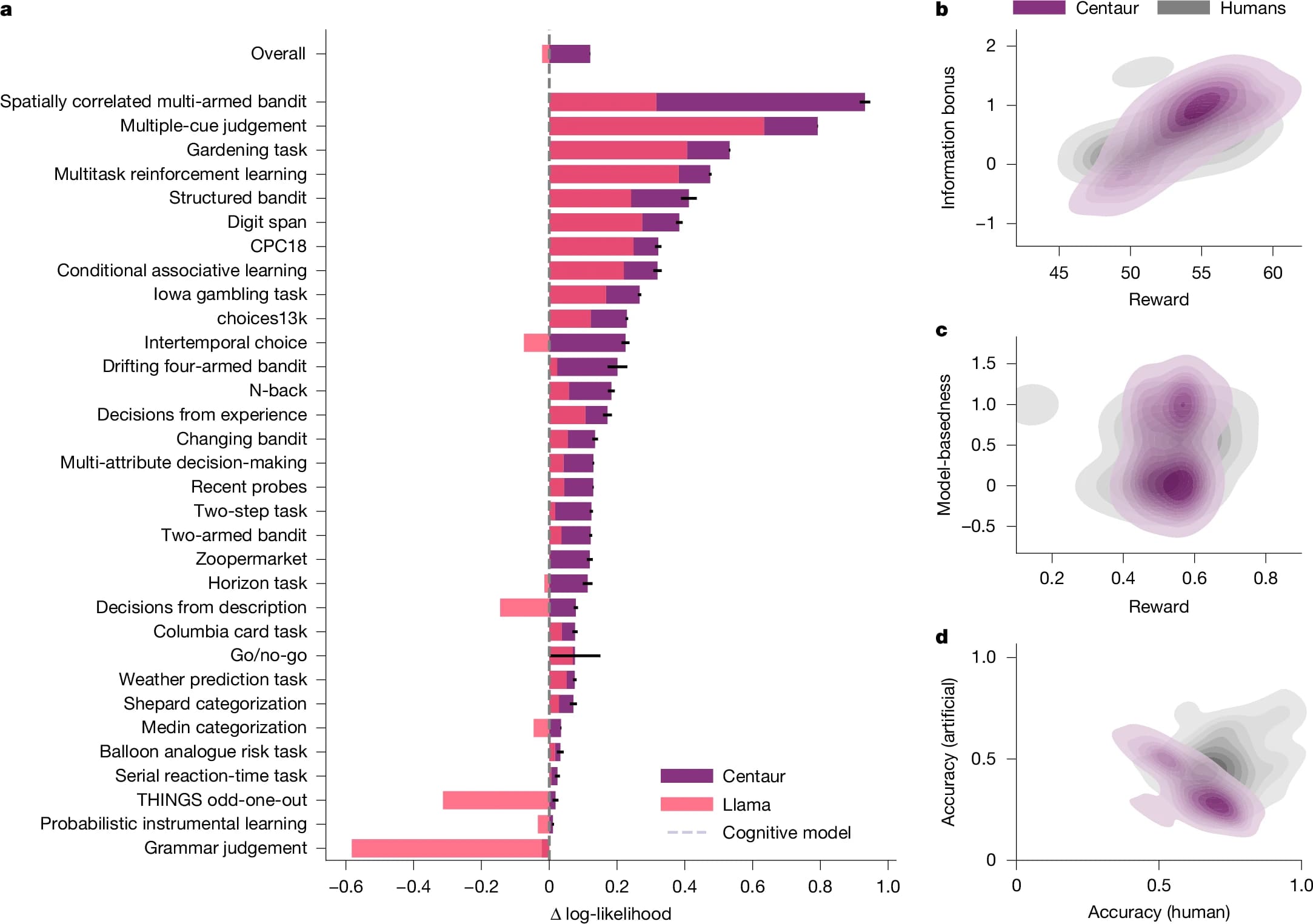
Centaur demonstrates several groundbreaking capabilities that distinguish it from existing cognitive models. Generalization is one of its greatest strengths—the model can predict human behavior not only for tasks on which it was trained, but also for entirely new experiments, modified narratives, and even completely new domains.
In rigorous testing, Centaur outperformed traditional cognitive models in predicting the responses of participants who were not part of its training data. The model demonstrated remarkable flexibility—it can adapt to new contexts and identify different decision-making strategies, while also predicting reaction times with high accuracy.
Neural Alignment with the Human Brain
One of the most fascinating discoveries is that after fine-tuning, Centaur’s internal representations become more similar to human brain activity. This neural alignment suggests that the model captures some of the fundamental cognitive mechanisms that govern human thought.
The team led by Marcel Binz, in collaboration with other researchers including Elif Akata, Matthias Bethge, Peter Dayan, and Eric Schulz, demonstrated that the model can map neural activity in specific areas of the brain, particularly the motor cortex, which is related to its ability to predict decisions.
Practical Applications and Impact
Centaur opens the door to a virtual laboratory for cognitive science, where human behavior can be simulated and predicted for any experiment described in natural language. This approach represents a fundamental shift away from traditional research methods.
Theory development is another key application—the model bridges the gap between interpretable cognitive theories and predictive modeling, while highlighting areas where classical theories could be improved.
Clinical and health research offers promising opportunities for analyzing and simulating decision-making in clinical contexts, such as understanding cognitive patterns in depression or anxiety.
Methodology and Results
The researchers used a sophisticated methodology involving multidimensional scaling to analyze representations of experiments. Testing was conducted on participants who were not part of the training data, ensuring an objective assessment of the model’s capabilities.
Centaur was compared with various versions of Llama models trained for other purposes, such as Nemotron (trained to follow instructions), Hermes (trained for various purposes, including agentic capabilities), and Reflection (trained for logical reasoning). None of these variants was able to capture human behavior better than the base model.
The Future of Universal Cognition
Centaur is important for the unification of theories of human cognition
The research suggests that an approach based on foundation models could revolutionize the way we understand the human mind. Centaur not only predicts behavior, but also offers a tool for scientific inquiry and a platform for future research and applications.
This groundbreaking research published in Nature represents a fascinating convergence of artificial intelligence and cognitive science that could fundamentally change our understanding of human thought and behavior.


