New AI Technology Predicts Cyclones Up to 15 Days in Advance
Launch of Weather Lab and an Advanced AI Model
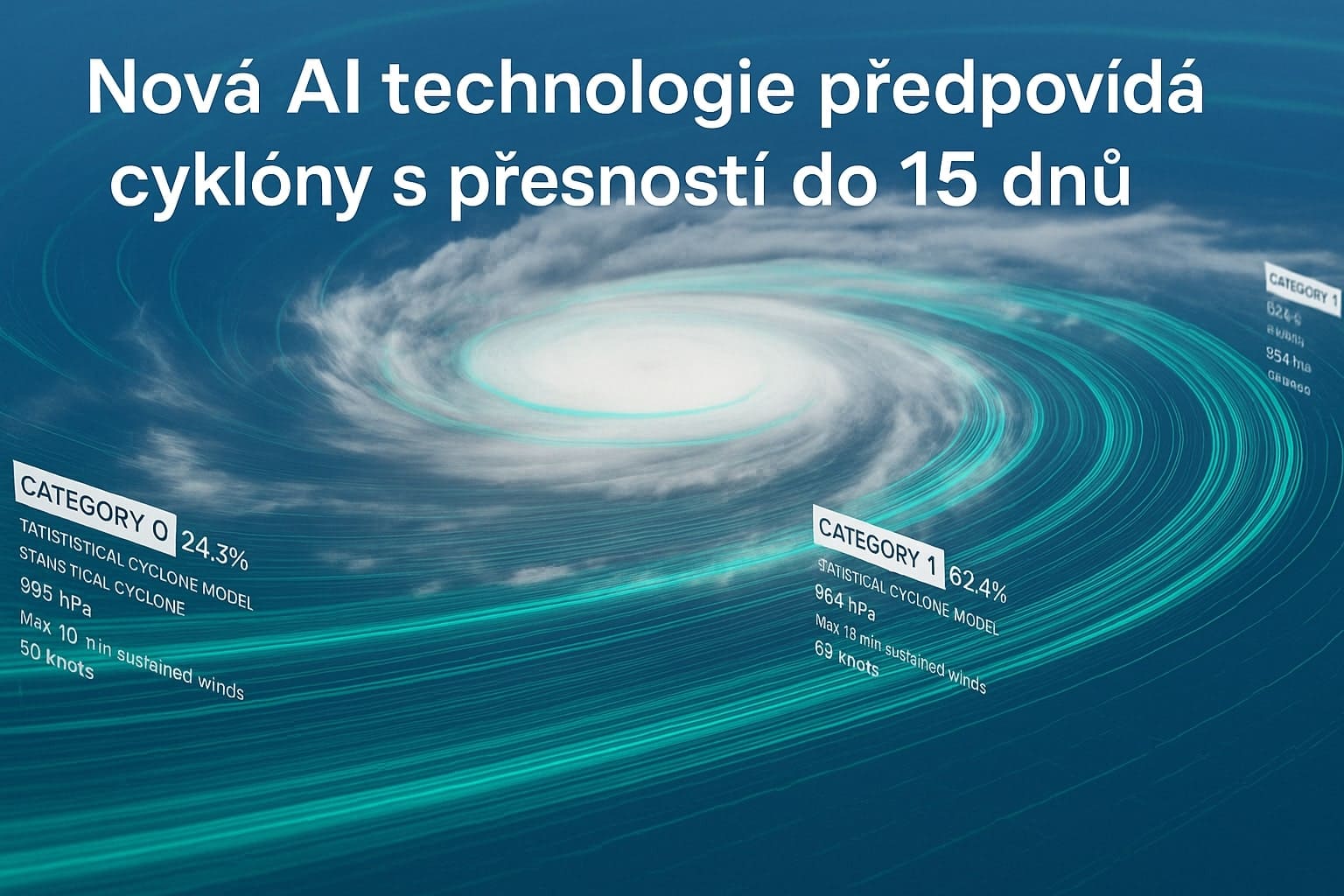
Google DeepMind and Google Research are launching Weather Lab, an interactive website for sharing their artificial intelligence-based weather models. Weather Lab features their latest experimental AI model for tropical cyclones, which is based on stochastic neural networks. This model can predict cyclone formation, track, intensity, size, and shape, generating 50 possible scenarios up to 15 days in advance. Internal testing shows that the model's cyclone track and intensity forecasts are as accurate as, and often more accurate than, current physics-based methods.
Google has partnered with the US National Hurricane Center (NHC), which assesses cyclone risks in the Atlantic and eastern Pacific basins, to scientifically validate its approach and outputs. Expert forecasters at the NHC can now view live forecasts from Google's experimental AI models alongside other physics-based models and observations. The goal is for this data to help improve NHC forecasts and provide earlier, more accurate warnings of hazards associated with tropical cyclones.
Live and Historical Forecasts on the Weather Lab Platform
Weather Lab displays live and historical cyclone forecasts from various AI weather models alongside physics-based models from the European Centre for Medium-Range Weather Forecasts (ECMWF). Several of Google's AI weather models run in real time: WeatherNext Graph, WeatherNext Gen, and the latest experimental cyclone model. Weather Lab was also launched with more than two years of historical forecasts that experts and researchers can download and analyze, enabling external evaluation of the models across all ocean basins.
Weather Lab users can explore and compare forecasts from different AI and physics-based models. When viewed together, these forecasts can help meteorological agencies and emergency services experts better anticipate a cyclone's track and intensity. This could help experts and decision-makers better prepare for different scenarios, share information about related risks, and support decisions for managing the impacts of a cyclone. It is important to emphasize that Weather Lab is a research tool and that its live forecasts are generated by models that are still under development and are not official warnings.
Predicting Cyclone Intensity and Track Using AI
In physics-based cyclone forecasting, approximations are needed to meet operational requirements, meaning that it is difficult for a single model to excel at predicting both cyclone track and intensity. This is because a cyclone's track is controlled by large-scale atmospheric steering currents, while cyclone intensity depends on complex turbulent processes within and around its compact core. Low-resolution global models perform best at predicting cyclone tracks, but they do not capture the fine-scale processes that determine cyclone intensity, which is why high-resolution regional models are needed.
Google's experimental cyclone model is the only system that overcomes this trade-off, with internal evaluations demonstrating state-of-the-art accuracy for both cyclone track and intensity. It is trained to model two distinct types of data: a large reanalysis dataset that reconstructs past weather across the entire Earth from millions of observations, and a specialized database containing key information about the tracks, intensity, size, and wind radii of nearly 5,000 observed cyclones from the past 45 years.
Breakthrough Results in Forecast Accuracy
Modeling reanalysis and cyclone data together significantly improves cyclone forecasting capabilities. For example, an initial evaluation using observed NHC hurricane data from the 2023 and 2024 test years in the North Atlantic and eastern Pacific basins showed that the model's 5-day cyclone track forecast was, on average, 140 km closer to the cyclone's actual position than ENS—the leading global physics-based ensemble model from ECMWF. This is comparable to the accuracy of ENS forecasts at 3.5 days—an improvement of 1.5 days that would typically have taken more than a decade to achieve.
While previous AI weather models struggled to calculate cyclone intensity, Google's experimental cyclone model outperformed the average intensity error of the National Oceanic and Atmospheric Administration's (NOAA) Hurricane Analysis and Forecast System (HAFS), a leading high-resolution regional physics-based model. Preliminary tests also show that the model's forecasts of cyclone size and wind radii are comparable to physics-based benchmarks.
Collaboration with Scientific Institutions
In addition to the NHC, Google is working closely with the Cooperative Institute for Research in the Atmosphere (CIRA) at Colorado State University. Dr. Kate Musgrave, a CIRA research scientist, and her team evaluated the model and found that it has "comparable or greater skill than the best operational models for track and intensity." Musgrave said: "We look forward to validating these results with real-time forecasts during the 2025 hurricane season." Google is also collaborating with the UK's Met Office, the University of Tokyo, Japan's Weathernews Inc., and other experts to improve its models.
The new experimental model for tropical cyclones is the latest milestone in a series of pioneering WeatherNext research projects. By responsibly sharing AI weather models through Weather Lab, Google will continue to gather important feedback from meteorological agencies and emergency services experts on how its technology can improve official forecasts and inform life-saving decisions.