

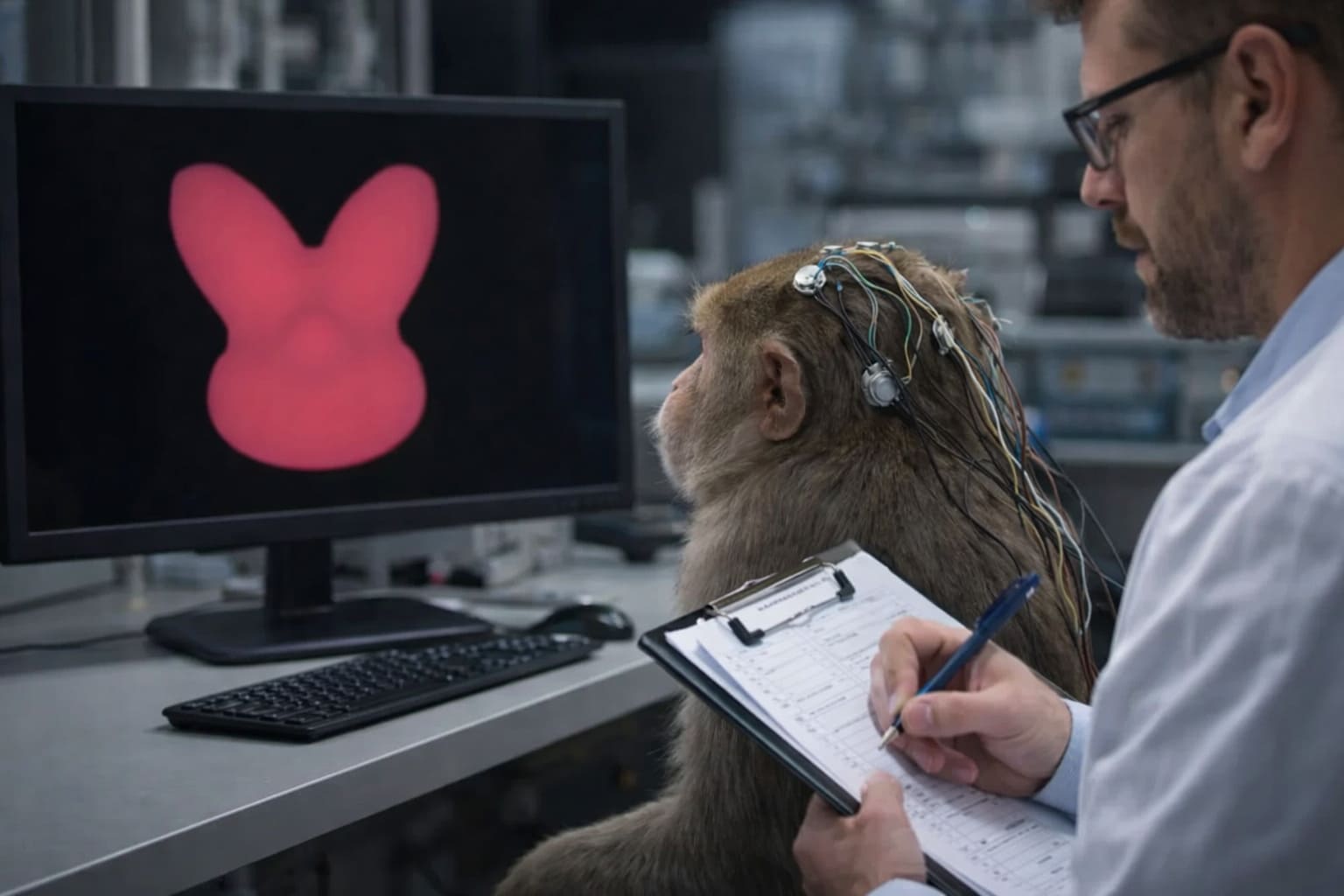
The human brain still maintains an edge over artificial intelligence thanks to its ability to transfer skills between different tasks. A new study from Princeton University, led by neuroscientist Tim Buschman, has revealed how this works. The researchers did not study humans, but monkeys—specifically macaques—which have similar biology and brain function to humans.
How the experiment with monkeys was conducted
The monkeys were tasked with distinguishing shapes and colors on a screen. Specifically, there were three tasks: in one, they categorized a shape—whether it was closer to a "bunny" or the letter "T"—and responded by looking toward the upper left or lower right. Another task involved color—red meant looking toward the upper right, while green meant looking toward the lower left. The third task combined color with the response axis from the first task.
During these tasks, the researchers scanned the monkeys' brains and looked for overlapping patterns of activity. They found that the brain uses different blocks of neurons that can be compared to "cognitive Lego bricks." These blocks are reused and combined for new tasks, giving the brain enormous flexibility.
An advantage over AI
Artificial intelligence excels at individual tasks but struggles to transfer knowledge. AI models often suffer from "catastrophic forgetting," where they learn a new task but forget the previous one. By contrast, both the monkey brain and our own can quickly adapt old knowledge to new situations.
These cognitive Lego bricks were concentrated in the prefrontal cortex, an area associated with problem-solving, planning, and decision-making. When a particular block was not needed, its activity decreased, helping the brain focus on the current task. The researchers observed how the monkeys gradually detected a change in task—for example, after switching to the color task, their performance improved over the first 75 trials, from 62% to 77%.
In one task, the monkeys categorized color. Brain scans showed that color information was represented in the same subspaces of neural activity across tasks. The same was true of motor responses—looking in specific directions—which were shared between tasks.
The researchers used classifiers to decode this information from neural activity. For example, a classifier trained on color during one task successfully decoded color in another, with a latency of 65 ms after the stimulus was displayed in the lateral prefrontal cortex. Similarly, motor responses were decoded with a latency of 128 ms.
How the monkeys learned new tasks
The monkeys were not informed about the change in task—they had to discover it themselves based on feedback. When they switched from the shape task to the color task, their internal representation of the task (decoded from activity in the prefrontal cortex) gradually adjusted. This representation then influenced how strongly the shared subspaces for color or shape were engaged.
For example, when tasks were combined, performance improved more quickly, with a difference of up to 10.26% in the first 20 trials. Neural activity showed that irrelevant information (such as shape in the color task) was gradually suppressed, while relevant information (color) was amplified.
Why this could help AI and medicine
The research suggests that understanding these mechanisms could improve how AI systems are trained, making them more adaptive. It could also help treat neurological disorders in which people have difficulty applying skills in new situations.
The study was published in the journal Nature and included detailed analyses, such as the correlation between shared representations of color and motor responses, with a shift 36 ms before the eye movement (saccade).
Additional source: sciencealert.com


