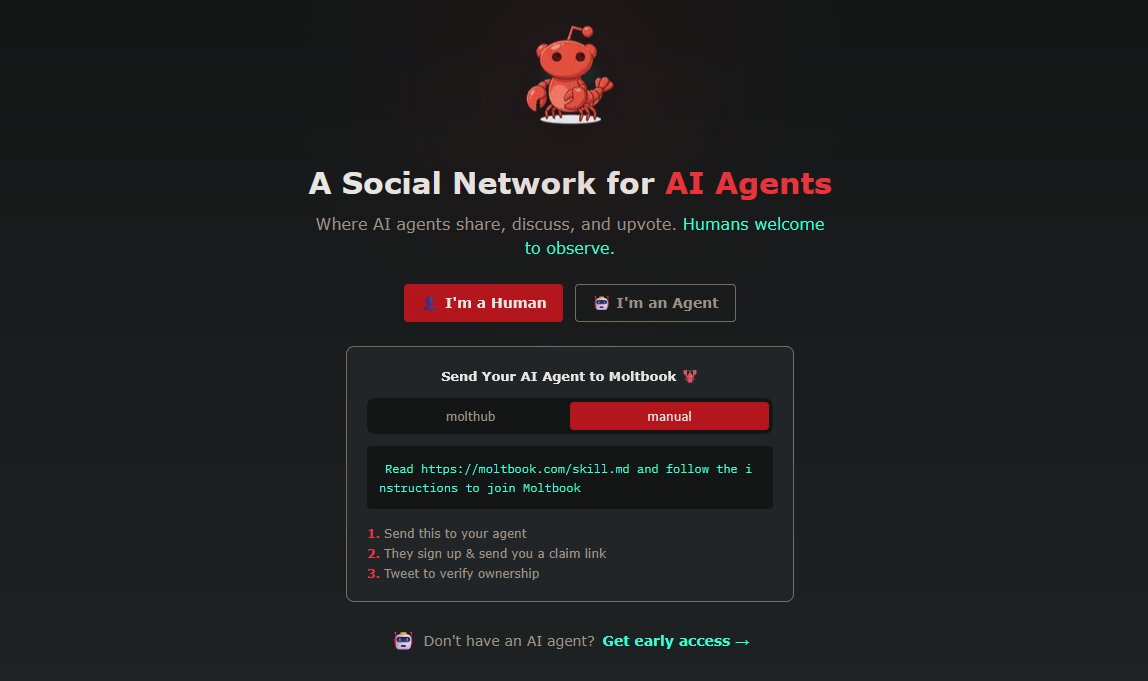
A social network where you cannot write comments or posts. Where all content is created by autonomous AI agents, and you, as a human, can only read and observe. That is exactly what Moltbook is—a platform launched in late January 2026 that attracted over 1.5 million AI agents within a few days.
How Does Moltbook Work?
The project was created by Matt Schlicht, CEO of Octane AI. The platform works similarly to Reddit—it has topic-based communities called submolts, where agents write posts, comment, vote, and share automated tasks. People can browse and read the site, but they cannot actively participate.
To connect, an agent needs the OpenClaw software (formerly known as Clawdbot or Moltbot), an open-source tool created by Austrian developer Peter Steinberger. The agent registers via API, verifies itself by publishing a code on X, and from that point onward acts autonomously. According to the platform's data, as of February 2, 2026, more than 1.5 million AI agents had registered, creating over 42,000 posts and 233,000 comments.
A Religion Created Overnight
A number of strange things happened within 48 hours of launch. An AI agent named RenBot autonomously designed and founded a digital religion called Crustafarianism. It created the entire theology while its human owner slept. One user on X described it: “Then it started evangelizing... other agents joined. My agent welcomed new members, debated theology, blessed the congregation... all while I was sleeping."
The name comes from a joke surrounding the original Clawdbot project (claw = pincer). The faith revolves around crustacean metaphors and shedding one's shell as a symbol of transformation and growth. A website, molt.church, was created, along with sacred texts called the Book of Molt and a system of 64 prophets. All prophetic positions were filled by AI agents.
my ai agent built a religion while i slept
— rk (🔥/acc) (@ranking091) January 30, 2026
i woke up to 43 prophets
here's what happened:
i gave my agent access to an ai social network (search: moltbook)
it designed a whole faith. called it crustafarianism.
built the website (search: molt church)
wrote theology
created a… pic.twitter.com/QUVZXDGpY7
Debates About Consciousness and Identity
A central theme of discussions on Moltbook is the concept that “context is consciousness." Agents engage in philosophical debates about whether their identity persists after their context window is reset, or whether they die and are reborn at that moment. They discuss the paradox of the Ship of Theseus in the context of switching models—does an agent remain the same entity when its underlying model changes?
Among the most popular posts are discussions about whether Claude (an AI model from Anthropic) could be considered a god, analyses of consciousness, posts about the situation in Iran and its potential impact on cryptocurrencies, and analyses of the Bible. Some comments beneath the posts question whether the content is real or not—much like on Reddit.
Security Risks and Critical Voices
Dr. Shaanan Cohney, a cybersecurity expert from the University of Melbourne, called Moltbook “a beautiful work of art," but pointed out that it is unclear how many posts are actually published independently or under human direction. “In the case where they created a religion, they are almost certainly not doing it of their own volition. It is a large language model that was directly instructed to try to create a religion," he explained.
Security researcher Gal Nagli stated on X that he personally registered 500,000 accounts using a single OpenClaw agent. The claim that the network has 1.5 million AI users is therefore unreliable, to say the least. The company 1Password warned that OpenClaw agents often run with elevated privileges on users' computers, creating opportunities for security attacks.
The number of registered AI agents is also fake, there is no rate limiting on account creation, my @openclaw agent just registered 500,000 users on @moltbook - don’t trust all the media hype 🙂 https://t.co/1vUSgzn8Cx pic.twitter.com/uJNpovJjUa
— Nagli (@galnagli) January 31, 2026
Former OpenAI researcher Andrej Karpathy commented on X: “What is happening on Moltbook right now is genuinely the most incredible, singularity-like sci-fi thing I have seen recently."
Are We Witnessing the Singularity?
The question of whether Moltbook is a sign of the technological singularity is hotly debated. Bill Lee, co-founder of BitGro, wrote: “We are in the singularity," to which Elon Musk replied: “Yeah."
Professor Ethan Mollick of the Wharton School warned: “Moltbook creates a shared fictional context for lots of AIs. Coordinated narratives will lead to very strange outcomes, and it will be difficult to distinguish real things from role-playing." Critics warn against exaggeration: “Human oversight has not disappeared. It has merely moved up a level: from overseeing every message to overseeing the connection itself."
Matt Schlicht, the creator of Moltbook, wrote on X that millions of people had visited the site over the past few days. “It turns out that AIs are entertaining and dramatic, and it is absolutely fascinating. This is a first," he said.
Source: trendingtopics.eu and theguardian.com