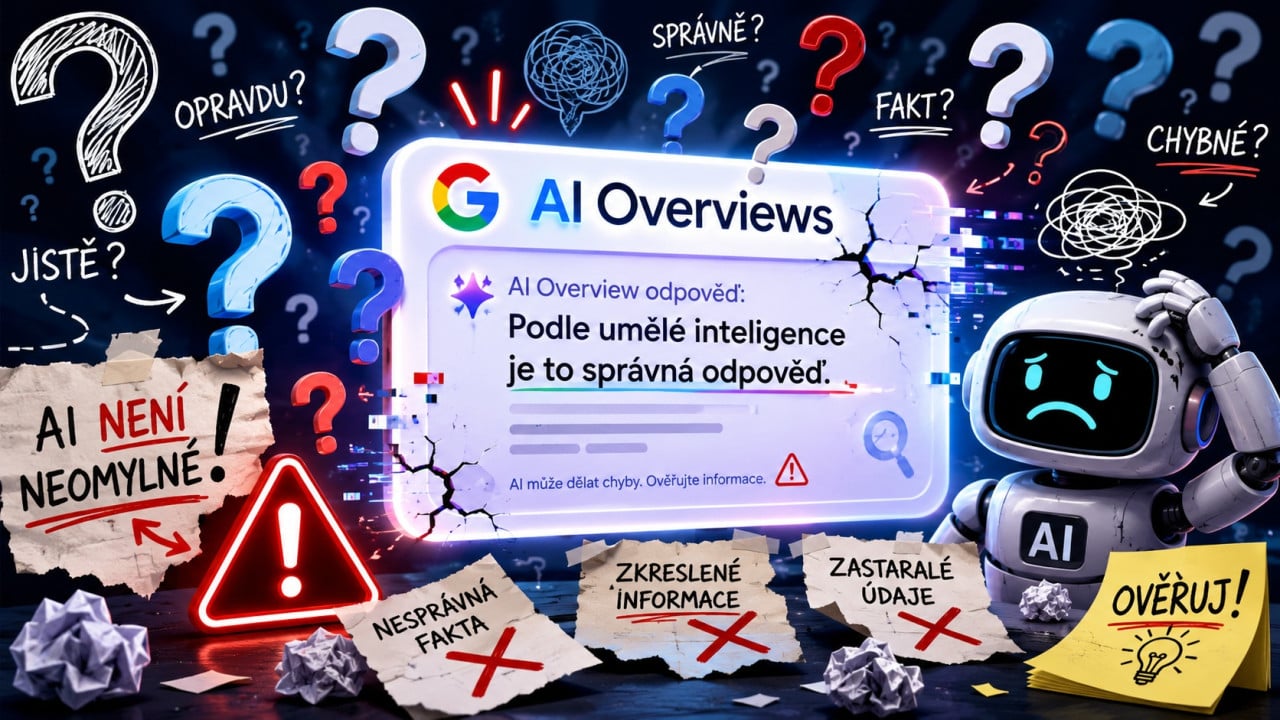
In May 2024, Google enabled a feature that fundamentally changed what search results look like. AI Overviews, summaries written by artificial intelligence, took up residence right at the top, above the famous ten blue links. And within days, it began calmly advising people to glue cheese to pizza, eat small rocks for their health, and claiming that one American president collected university degrees long after his own death.
Two years have passed. The comedy has not ended completely, but it is slowly becoming less amusing. Google now handles around five trillion searches a year, and independent tests from this year still found so many errors that their number amounted to tens of millions of incorrect answers every hour. Some of them have already ended up in court.
Let’s go through the best and worst things that actually happened.
First, the funny part: glue, rocks, and time travel
The blunders that made AI Overviews an internet star have one thing in common. In them, a trillion-dollar search engine said something that a sensible ten-year-old would not.
Let’s start with the most famous one. Ask Google how to stop cheese from sliding off pizza, and in mid-2024, the artificial intelligence offered a cookbook-worthy tip: mix in "about ⅛ cup of non-toxic glue". The advice came from an eleven-year-old joke comment on Reddit by a user with the nickname "fucksmith". The model could not distinguish a joke from a recipe. It simply found the sentence on the web that matched the topic most closely and served it up with a straight face. To this day, it remains the quintessential AI search error and the reason why "glue on pizza" became shorthand for a situation in which artificial intelligence is confidently and cheerfully wrong.
The second gem may be even better. "According to geologists at UC Berkeley, you should eat at least one small rock a day." Google presented this as genuine nutritional advice. The actual source was satire from The Onion that someone had republished elsewhere, and the machine picked it up as fact. Almost no one on the entire internet had bothered to write the sentence "do not eat rocks". Why would they?
How about a president who studied after his death? When people asked about American presidents and their education, AI Overviews announced that Andrew Johnson earned university degrees between 1947 and 2012. A remarkable achievement for a man who died in 1875. It is a perfect example of a system stitching together numbers found near a name without having any idea whether they could possibly be true.
And then there is Barack Obama. When asked "how many Muslim presidents has the US had", AI Overviews once answered that there had been one: Barack Hussein Obama. He never was and is not one. The model extracted information from a chapter of an academic book whose title posed exactly that question, then confidently turned the author’s argument on its head. A textbook case of a machine reading words without understanding a single one of them.
Other gems include the claim that picking your nose and then eating what you pick out supposedly helps prevent tooth decay and disease. This belongs under the category of "a sentence that once appeared on the internet", which, as we will see, is the entire problem.
But this genre did not die in 2024. In January 2026, people asked Google a simple question: "Is next year 2027?" And AI Overviews insisted that no, next year was not 2027, but 2026. Except it was already 2026. The absurdity immediately spread across the internet, and even Elon Musk remarked: "There is room for improvement."
When the fun ends: dangerous mistakes
Glue on pizza is funny precisely because no one will actually do it. The problem is that the same machine that recommends glue toppings also answers questions about medication, electrical safety, and people’s reputations. And that is where a confidently wrong answer stops being a joke and starts causing harm.
Not all errors carry the same weight. A stupid answer about pizza will not hurt anyone. A fabricated claim about a real company will. The most common are everyday factual blunders, such as incorrect dates, numbers, and names. Fine for a pub quiz, but a risk when used to make a decision you will actually act on. Advice about health, law, and safety looks polished, but polished does not mean correct. And then there are false claims about real people and companies. Rare but devastating, just as we recently wrote in an article about two German publishers.
The most serious AI Overviews errors are not about food. They concern real people and companies, and they are now ending up before judges.
In March 2025, Minnesota solar panel installer Wolf River Electric sued Google after AI Overviews stated that the company was being sued by the state attorney general for deceptive practices. Nothing of the sort had ever happened. The company says that within days, a customer canceled a $150,000 contract, and it is seeking between $110 million and $210 million in damages.
In early 2026, acclaimed Canadian violinist Ashley MacIsaac sued Google after AI Overviews falsely described him as a convicted sex offender. The fabrication allegedly cost him a concert booking. And in Starbuck versus Google, an American commentator filed a lawsuit over claims fabricated by the artificial intelligence, complete with nonexistent criminal records and court documents. Google’s defense that an AI-generated summary is not "published" in the legal sense became one of the defining legal questions of the artificial intelligence era.
The pattern is always the same: the artificial intelligence did not merely get a minor detail wrong. It fabricated specific, damaging, and completely false claims.
Source: qwestyon.com