


Microsoft Introduces CLIO: A Control Layer That Can Improve Any AI
Microsoft Research recently introduced a new technology designed to make artificial intelligence more accurate and useful for new research and discoveries. It is a control layer called CLIO, which can turn conventional language models into smarter, “thinking” AI. And it does all of this without any training!
Until now, working with artificial intelligence looked something like this—a language model (e.g., GPT-4) was trained once, and that was it. It would then provide answers to questions, but its training did not continue, and there was no way to intervene in how it reasoned. CLIO is set to change that.
What Exactly CLIO Does
Artificial intelligence holds great potential for science and research. However, scientists and experts often encounter the problem that AI approaches questions using its established patterns and is unable to respond to input or change the way it reasons. CLIO, however, can do this. It can turn a conventional AI model into a scientific assistant capable of critically examining and adjusting its own thinking on the fly while solving a task.
The acronym CLIO stands for Cognitive Loop via In-Situ Optimization, and these cognitive loops allow the AI layer to think, evaluate, and change strategies.
Better Results Without Additional Training
When a conventional language model receives a query, it answers based on how it was trained. We cannot see into its thought processes, so we cannot tell how it arrived at the answer or whether it made a mistake somewhere along the way.
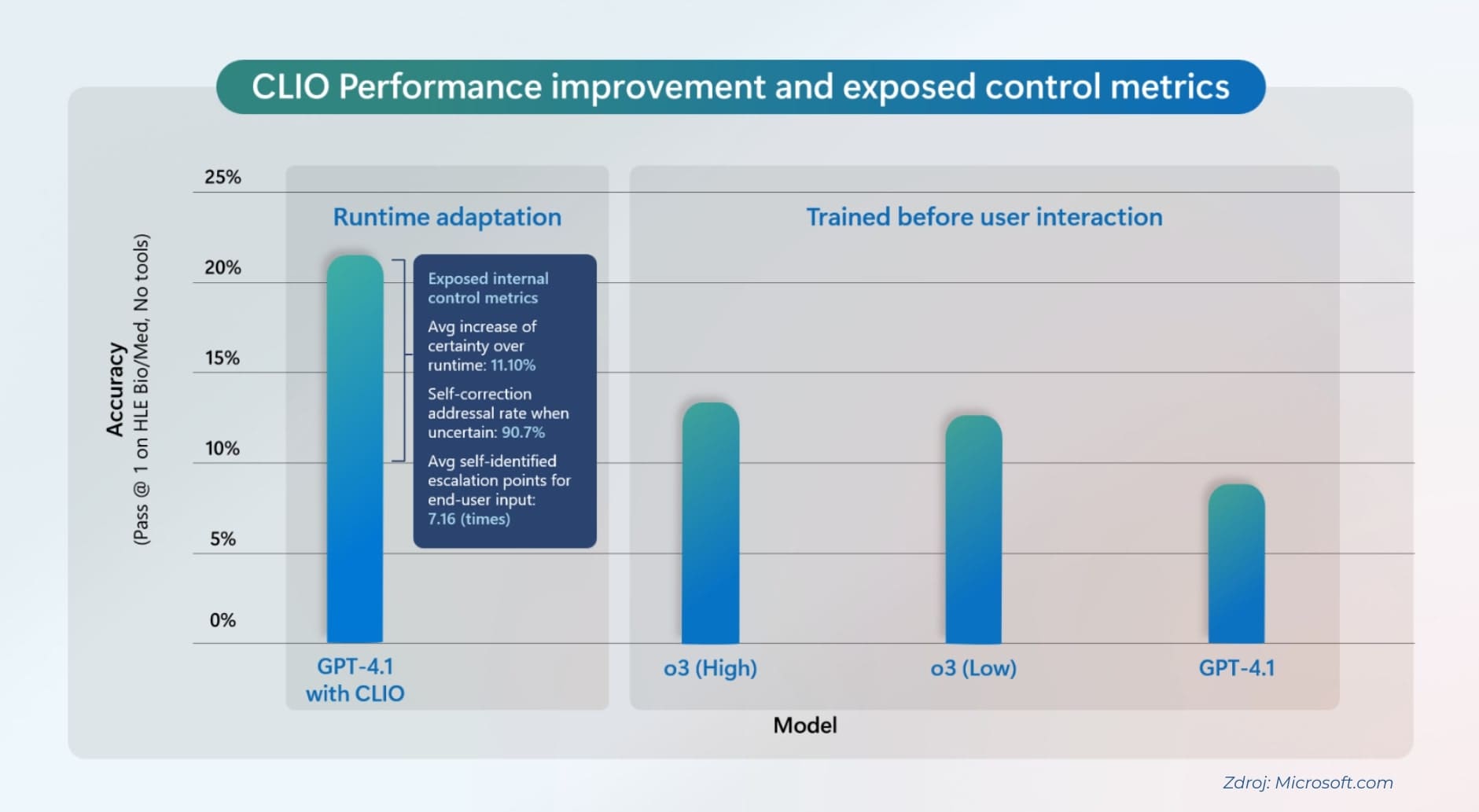
Without any additional training, however, CLIO turns AI into a virtual scientific colleague that stops when it does not know something and admits when it has lost track. This allows experts to guide the artificial intelligence more effectively and place greater confidence in the final results. In addition, they can directly see how the model reasons and at which points it is uncertain.
Improving GPT-4.1
Now let us look at how CLIO performs in practice. One of the most difficult benchmarks (comparative tests for AI) is the so-called Humanity’s Last Exam. This test consists of 2,500 questions from a wide range of fields. Its difficulty lies in the fact that the answers cannot simply be looked up. These are complex tasks that require multi-step reasoning and the integration of diverse knowledge.
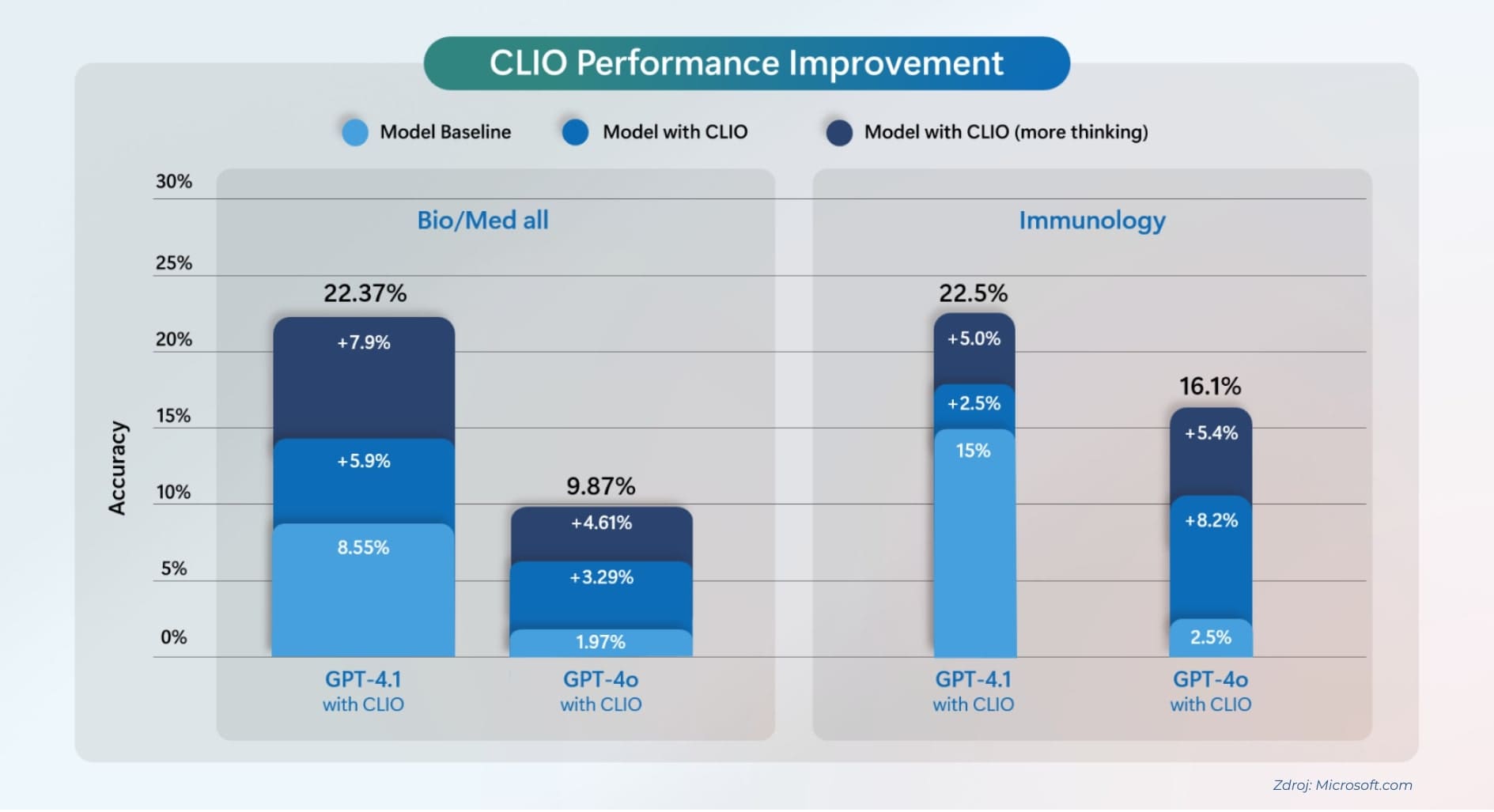
On challenging biology and medicine questions, CLIO increased the accuracy of the GPT-4.1 model from 8.55% to 22.37%. The control mechanism added to the conventional language model thus improved the results by 161% and even outperformed the o3 “reasoning” model, which boasts the knowledge of a Ph.D. student.
CLIO as a Partner for New Research and Discoveries
CLIO from Microsoft Research is not a new language model, but a way of working with a model. It acts as a control mechanism that forces AI to check its answers, assess its level of confidence, and revise them if necessary. It therefore delivers results that are more accurate and transparent, while allowing people to intervene throughout the process.
CLIO is currently used primarily for scientific research (e.g., healthcare). In the future, however, it could find broader applications in fields such as finance, law, or engineering, where transparency in decision-making plays a key role.


