Microsoft has made a claim that quickly spread throughout the worlds of technology and medicine. Its artificial intelligence system can reportedly identify the correct diagnosis in complex cases up to four times more accurately than human doctors. The results were published in Science, one of the world's most prestigious scientific journals, and Microsoft AI division chief Mustafa Suleyman is calling it a major milestone. It is finally here, he declared. But when you examine the study in greater detail, you find that much of the success is due not to Microsoft's models, but to competitors' language models, especially OpenAI's GPT-5.
An AI-led medical consultation
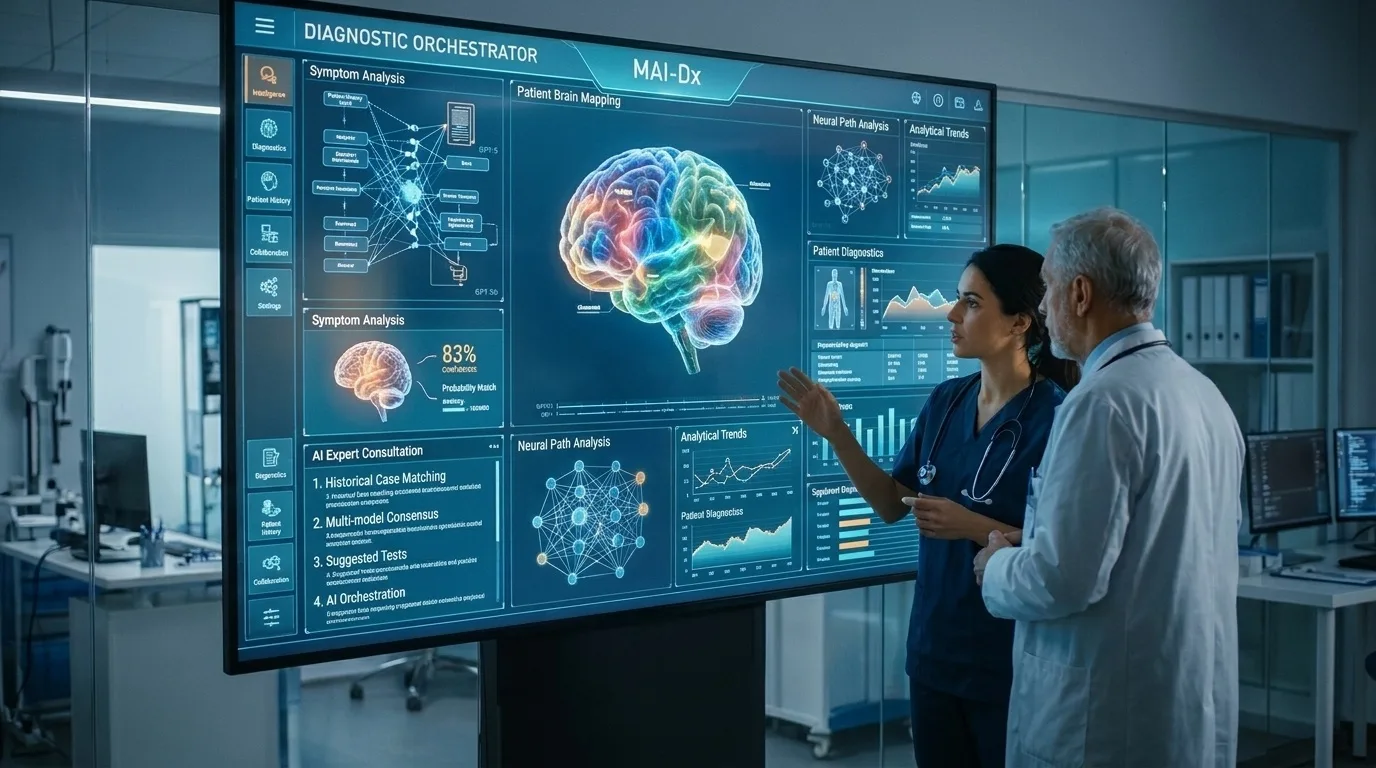
The system is called MAI-DxO, short for Diagnostic Orchestrator. It is not a single artificial intelligence, but several collaborating AI assistants that behave like a team of experts in a consultation. They ask about symptoms, review the patient's medical history, decide which tests to order, and ultimately agree on a diagnosis. In this way, they mimic the process specialists use to investigate the cause of a patient's problems.
Microsoft does not provide its own language model for the system to run on. Instead, its product works more like a conductor that directs language models from other companies and assigns tasks to them. The study primarily used the aforementioned GPT-5 model. The mechanism itself was developed when the older GPT-4.1 was still the most advanced foundation available.
For comparison, Microsoft compiled its own test set containing two types of tasks. The first consists of hundreds of complex cases from the specialist journal The New England Journal of Medicine. These are detailed descriptions of real patients and their illnesses that often left doctors puzzled for a long time. The second group consists of emergency department scenarios drawn from an extensive database maintained by Boston's Beth Israel Deaconess Medical Center.
For the complex cases, Microsoft's system identified the correct diagnosis in roughly 83 percent of cases. General practitioners and internists who were allowed to use professional reference materials were correct about 36 percent of the time. Healthcare professionals without reference materials managed only 22 percent. This difference is the source of the headline claim of fourfold accuracy. In the emergency department, AI achieved an 80 percent success rate, compared with an average of 47 percent for doctors. Artificial intelligence also generally reached its conclusions with lower estimated testing costs.
There are two problems to consider when properly assessing the study. The AI was compared with general practitioners and internists working individually. In real-world medicine, however, cases this complex are usually handled by specialists or entire medical teams, neither of which were included in the comparison.
The second problem is acknowledged by Microsoft itself. So far, the mechanism has only worked with past cases whose outcomes are already known, not with actual patients in a doctor's office. No one yet knows how it would perform in routine hospital operations. It needs clinical validation, Suleyman acknowledges. It is a big leap, but this is an important milestone along the way.
How much did Microsoft contribute, and how much did OpenAI?
The biggest question, however, is who actually deserves the credit. The study's data show that much of the progress comes from the powerful language foundations on which everything runs. Microsoft's tool adds only a relatively small improvement.
The company tested its product with tools from OpenAI, Google, Anthropic, Meta, and China's DeepSeek. It achieved the best results with OpenAI's GPT-5 and GPT-5.5 models. GPT-5 alone, given only a short and simple prompt by the researchers, correctly diagnosed nearly 79 percent of the complex cases. However, testing for each case cost more than eight thousand dollars. Microsoft's developers reduced these costs by roughly three thousand dollars, but increased accuracy by only about four percentage points. In the emergency department, the additional layer brought virtually no improvement in either accuracy or cost.
Results with the newer GPT-5.5 version were mixed. For complex tasks, the new architecture increased the success rate from 72 to nearly 87 percent while costing slightly less. In the emergency department, however, there was again no visible difference, with the system scoring around 85 percent both with and without the additional layer.
The tool helps most with complex cases and weaker model variants. Google's Gemini 2.5 Flash managed only 46 percent on its own, but nearly 69 percent with the external layer. Even so, the gap between performance tiers is greater than the benefit of the program itself. In other words, the choice of foundation matters more than what Microsoft can add.
A company spokesperson counters that efficiency gains naturally diminish as the theoretical maximum approaches and that the program helps strike a balance between accuracy and cost. The researchers say that further testing shows even more advanced versions do not eliminate the advantage of collaboration among multiple AI assistants. However, the study does not include the latest software generations, such as GPT-6 Astra, Meta's Muse Wonder Full, Google's Gemini 4 Argon, or Anthropic's Opus 5.5.
From the archive straight into the hospital
The next step is expected to take place directly in a clinical setting. Microsoft has reached an agreement with Boston's Beth Israel Deaconess Medical Center to test the mechanism in real-world operations. Patients will receive standard care, from initial triage based on urgency through a specialist consultation and testing to the decision of whether it is safe to discharge them. Those who consent will also communicate with the AI. Researchers will then compare the machine's recommendations with the doctors' verdicts.
This technology is ready for a real-world trial, says Dominic King, who leads healthcare at Microsoft AI and co-authored the paper. According to him, you can probably imagine how complex and varied the problems arriving at an emergency department on a Friday night can be. King estimates that it will be the largest project of its kind, encompassing both the emergency department and urgent care clinics. No executive has provided a firm date, but testing is expected to begin within several months.
Microsoft is not the only company boasting that its AI can outperform people in white coats. Similar claims have also been published by Google and OpenAI. This month, Google published a paper in The Lancet in which it tested its diagnostic AMIE system during actual patient visits at the same Boston institution, with specialists monitoring the conversations live throughout.
Big plans for medical superintelligence
The work is part of an initiative Microsoft calls medical superintelligence. By this, the company means artificial intelligence that surpasses even the best human-led healthcare networks in medical reasoning and care coordination. According to King, diagnosis is only one component. In an accompanying article, Microsoft describes five other areas AI must master, including treatment decisions and the human side of medicine.
The company is training its own foundation model for healthcare with Mayo Clinic and plans to release it next year. Suleyman predicts that these tools will improve tenfold within two to three years, and he expects a solution indistinguishable from human performance to emerge in the coming years. At the same time, he insists that doctors will retain a central role in caring for patients. Although he admits that artificial intelligence could ultimately create more work for them, he hopes it will instead reduce tedious routine tasks and free up time for people.
Microsoft has not yet revealed when or how the software package will reach the market. The company already sells healthcare professionals tools for dictating reports and for radiology. Health-related questions are also among the most common topics the public brings to the Copilot chatbot. King points to the strict rules and obligations that every new medical tool must meet. Suleyman, however, makes no secret of where he is heading. In the coming years, we must have the absolute best products for clinical decision support, declared the man who was already involved in the field as a co-founder of DeepMind, now part of Google. He added that they are simply true believers.
Sources: theverge.com and techcrunch.com