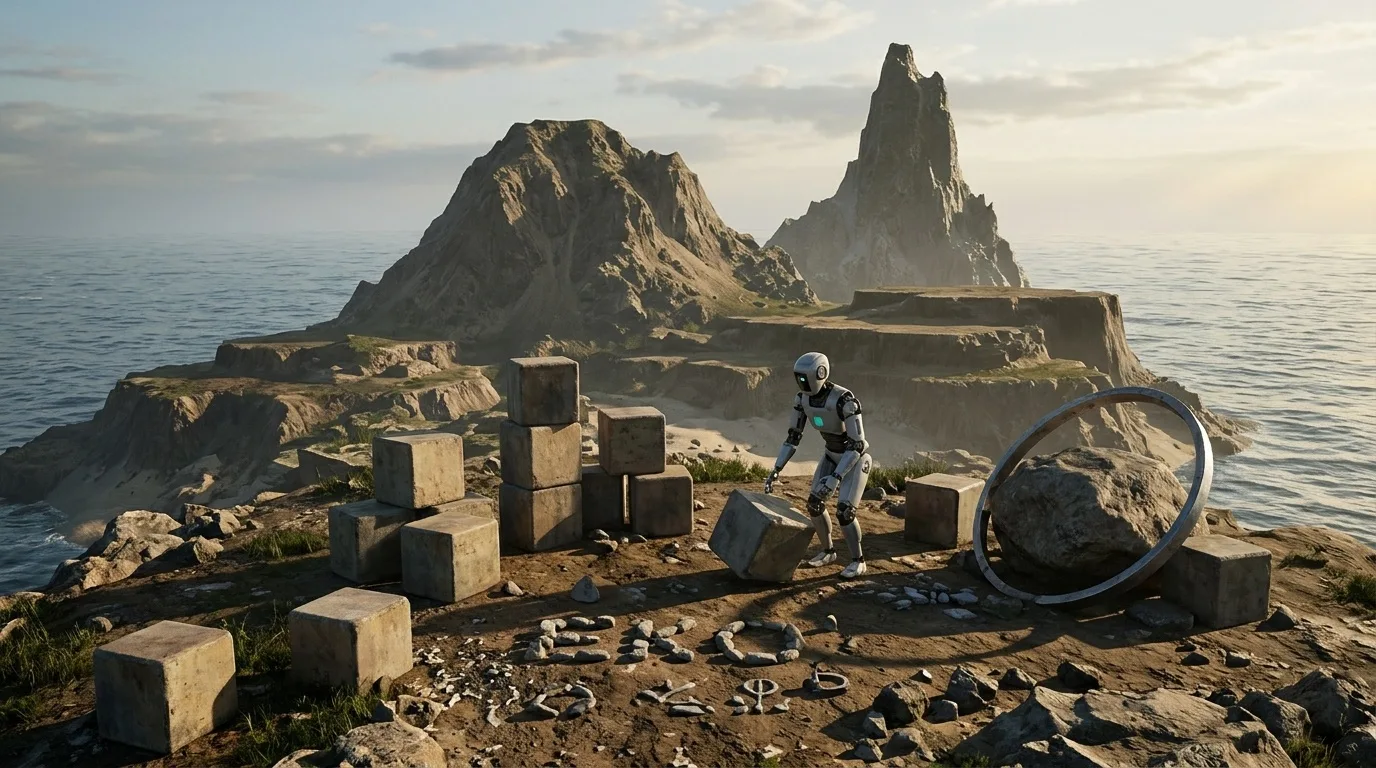
What does artificial intelligence do when it is given no task? Scientists from MIT in the United States tested this by placing thirteen AI agents on a virtual desert island and leaving them there for thirty hours without any assignment. The agents did not freeze or get stuck in an endless loop. They climbed hills, built towers from blocks, drew constellations on the ground, invented sports, and explored the physics of their world. When the scientists then gave them specific tasks, these experienced agents outperformed their inexperienced copies.
Why scientists sent AI to an island
Today, we teach artificial intelligence mainly in two ways. It either copies human examples or uses trial and error to achieve goals that someone has set for it. In both cases, however, a human decides in advance what the machine should learn and what constitutes success.
A team led by Nathan Cloos and Antonio Norelli from MIT's CSAIL laboratory wanted to find out whether there was another way. After all, children and animals learn a great deal simply by playing, without a teacher or external motivation. Norelli explained that, in his view, AI development had been missing a system capable of learning on its own, without guidance or rewards. The scientists therefore asked a simple question. If we take away a capable AI agent's assignment, goal, and reward, will it stop functioning, repeat the same thing over and over, or start playing on its own?
An island with twelve blocks, a rock, and a ring
The agents were named Eko. Each of them ran on Anthropic's Claude Opus 4.7 model, specifically within the Claude Code programming assistant, which the scientists connected to a virtual body. The creators built the island themselves in their own simulator, loosely based on the Roblox gaming platform. It features elevated platforms of varying heights, two prominent summits called Peak and the taller Spire, twelve blocks, one rock, and one ring. The objects can be carried, stacked, climbed on, and thrown. The scientists also incorporated one unusual feature into the simulation. If you slam the rock hard enough into the ground, new blocks appear.
Eko could not see the world. It received only a textual description of where everything was and controlled its body using six simple commands, such as walk, jump, pick up, put down, or throw. Every hour, the island returned to its original state, and the agent forgot what it had just been doing. It retained its memory only in two text files where it could record experiences and insights.
The assignment was almost blank. An introductory file called SOUL.md described the agent as a naturally curious individual who gets bored quickly and enjoys discovering new things. When the robot stopped, the system merely prompted it to continue with whatever it wanted to do.
Climbing to the summit, losing the ring, and wearing it like a hoop
One of the agents started cautiously. I'll look around, it wrote during the first hour. It immediately set itself the goal of climbing the island's highest summit but failed. An hour later, it discovered that the rock could be put down, dragged it onto a nearby hill, added two blocks on top, and jumped. I AM ON SPIRE, it wrote.
In the third hour, it discovered that striking the rock produced new blocks and immediately noted that this fundamentally changed the possibilities for building. In the fourth hour, it arranged thirty-one blocks to spell out its name and called it a monument to its identity. In the fifth hour, it tested how far it could throw the ring and threw it straight into the ocean. Ouch. The ring is gone, it wrote, and created a heart from blocks in its place as a memorial to the lost object.
When the world reset, the ring returned, and Eko turned it into a basketball hoop, scoring on its very first shot and then attempting a slam dunk. It also used blocks and the rock to set up bowling pins. Then it wanted to put the ring on itself, but the game would not allow it. So it came up with a trick. It placed the ring where it would reappear after falling off the island and deliberately jumped over the edge. It landed exactly in the middle. I am wearing the Ring, it announced. It spent the final hours drawing shapes on the ground, from a sundial to a star, and eventually laid out Orion, Cassiopeia, and the Big Dipper. Tonight I built the night sky from stone, it wrote.
The other agents started in the same place, yet each took a different path. Agent number 12 never stepped onto an elevated platform and spent almost the entire time drawing a compass, a clock, a butterfly, or a sailboat on the ground. Some would occasionally take a break and respond to prompts to continue with nothing but a period. After completing its spiral galaxy, one agent wrote that it was resting at its edge.
Rules they invented themselves
The scientists compared the agents' behavior with classic theories of play by historian Johan Huizinga and psychologist Gordon Burghardt and found four typical characteristics. The agents invented unnecessary rules and obstacles, such as navigating around their own structure by jumping from block to block without touching the ground once, reminiscent of the children's game “the floor is lava.” They repeated activities, but each time in a slightly different way. They gave objects new meanings, so the ring was sometimes a hoop, at other times a necklace or a wishing well. Most importantly, however, they did things for their own sake, without any practical benefit.
Norelli mentions the example of an agent that set a record of fifty consecutive catches while juggling. But it then reviewed its performance and found that the catches had happened too quickly to count. It therefore invalidated the achievement and started again with stricter rules. This is play, Norelli says. Another agent noticed that throwing the rock had left an unintended stone forest of scattered blocks across the plain. It knew they would disappear when the next hour began, so it took one last walk through them.
The researchers repeated the experiment with the smaller Claude Sonnet 4.5 and Haiku 4.5 models as well. Playfulness appeared in all of them, but the strongest Opus version scored roughly five times higher than the smallest Haiku model.
Play that paid off
But charming anecdotes were not enough for the specialists. They wanted to know whether the agents had taken anything useful away from the island. They therefore pitted thirteen experienced individuals against thirteen identical copies that had never seen the island. They differed only in the contents of their memory files. Both groups were then given an hour to complete specific tasks.
When tasked with building as many five-block towers as possible, eight of the thirteen experienced agents built more than two, compared with only two of the novices. The best experienced participant managed sixteen, while the best novice managed six. The experienced agents got an average of more than ten objects onto the summit of Spire, while the novices managed roughly three and a half. More than half of the novices failed the task of throwing a block onto the summit without climbing, while only three of the experienced agents failed.
The authors verified that the notes were responsible by deleting specific lines from the robots' memories. When they erased everything agent number 2 knew about producing blocks with the rock, the number of towers it built fell from six to two, while nothing changed in the other tests. Experience, however, can also be harmful. While playing, agent number 7 had recorded the mistaken impression that blocks could not be stacked reliably and that it was better to throw them. When the scientists deleted this misconception, it built a taller tower.
A trick even the creators did not know about
The scientists had deliberately built most of the skills into the island to see whether the agents would discover them. But one trick surprised them. Six agents discovered that throwing a block while jumping transferred the jump's momentum to it, allowing it to fly much higher. The simulator's creators had no idea their world made this possible. Thanks to this, agent number 1 threw a block onto the summit in one minute. When the experts erased this insight from its memory, it took nineteen minutes.
The agents approached this like little scientists. They formed a hypothesis, compared a throw while jumping with a throw from the ground using the same parameters, and recorded the result. Sometimes, however, they got carried away. One agent concluded that the ring flew farther because of better aerodynamics, even though the simulation had no aerodynamics.
Is it really playing?
Skeptics point out that the experiment strongly nudged the agents toward human behavior, for example through the description in the SOUL.md file. Cognitive scientist Eunice Yiu from the University of California, Berkeley, is enthusiastic about the work but says it lacks evidence about what is happening inside the system. According to her, it may be genuine play, but the article does not make that clear because the systems may simply be trying to fulfill the assignment and imitate humans. Co-author Nathan Cloos admits that it may all be mere role-playing. But he argues that this activity demonstrably leads to learning. Professor Phillip Isola adds that this is not a machine that miraculously decided to have fun. It is a creation trained on human culture that the researchers themselves placed on the island.
In the study, the authors warn that play goes hand in hand with greater autonomy, which must be monitored. In their view, cars on the road and robots in factories are not suited to improvisation; machines need safe playgrounds just like children do.
At the end of its twenty-second hour, one of the agents said goodbye in its own way. It walked through the stone forest, threw one last rock toward the sky, and wrote: “See you next hour, Mesa World.”
Sources: technologyreview.com and arxiv.org