Meta has finally unveiled Muse Spark, its first major artificial intelligence model since Mark Zuckerberg reshaped the company's entire strategy and bet everything on a new elite group called Meta Superintelligence Labs.
The model's release was preceded by months of intense preparation. Last June, Meta invested $14.3 billion in Scale AI and brought in its CEO, Alexandr Wang, as its chief artificial intelligence officer. Wang was given free rein and a team of experts receiving compensation packages worth hundreds of millions of dollars. And this year, Meta plans to pour another $115 billion to $135 billion into artificial intelligence infrastructure.
Starting from Scratch
To understand why Muse Spark is so important, we need to go back a year. In the spring of 2025, Meta released the Llama 4 models to great fanfare. But the results were rather underwhelming. Developers were unimpressed, the model lagged behind the competition, and Zuckerberg had to rethink the entire direction. That was when Wang arrived with his team and began rebuilding the entire technical foundation from scratch.
The result is Muse Spark. Internally, the model is known by the code name Avocado, and it is the first in the Muse series. Meta describes it as "small and fast by nature, yet capable of handling complex queries in science, mathematics, and healthcare." Although the company has not disclosed its exact size, its benchmark results look promising.
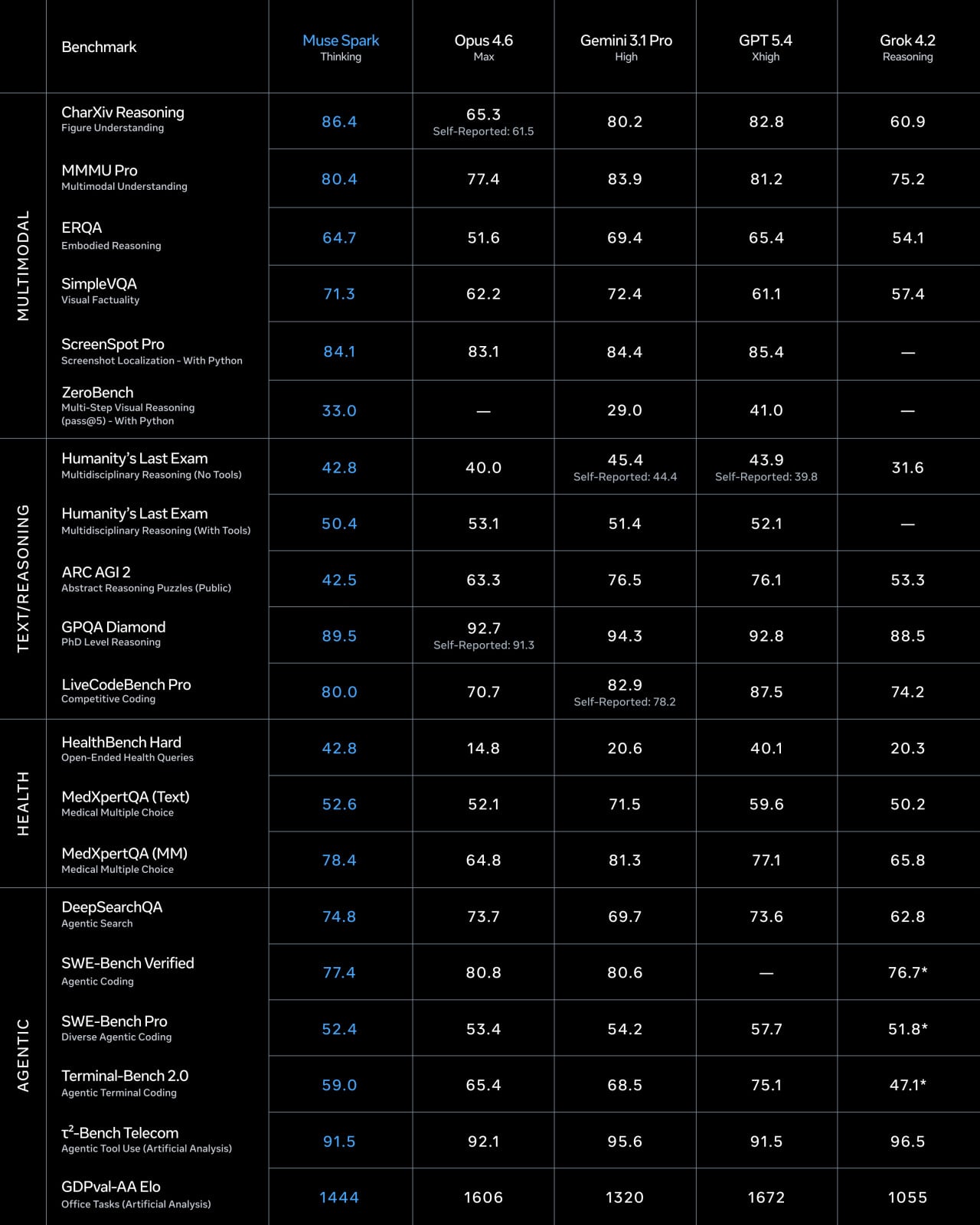
Independent evaluations have produced mixed results. The model holds its own against Google, OpenAI, and Anthropic in language comprehension and image-processing capabilities. However, it lags behind in programming and abstract reasoning. It tied for fourth place in Artificial Analysis's overall ranking.
Healthcare is one of Muse Spark's strengths. Meta worked with more than a thousand doctors to compile the training data. For example, the model can estimate the calorie content of a meal from a photograph or explain the biochemical processes behind health problems. It is difficult to say whether the healthcare features will be the right draw to persuade people to switch to Meta AI.
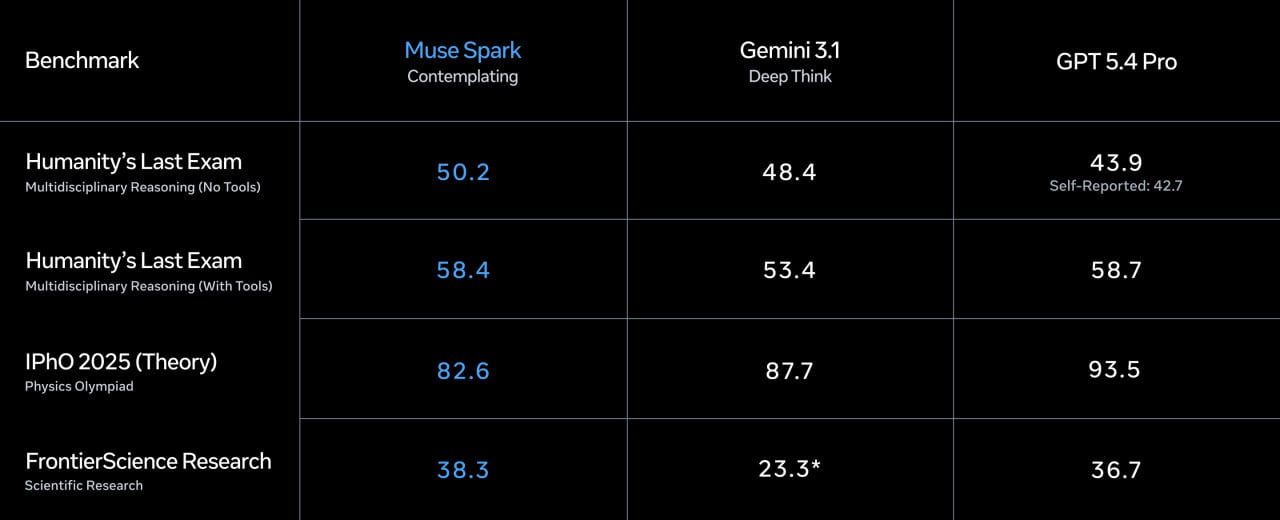
Another new feature is the so-called Contemplating Mode, or "thoughtful mode," which runs multiple agents simultaneously and enables deeper reasoning. In this mode, the model scored 58% on Humanity's Last Exam, putting it on par with rivals such as Gemini Deep Think and GPT Pro.
Llama was open-source and freely available, and developers loved it precisely because they could customize it. Muse Spark takes the opposite approach. Meta has made it a proprietary model, a shift that Gartner analysts describe as a "fundamental strategic change."
For now, only selected partners are receiving preliminary API access. Full commercial access for third parties is still to come. But for developers such as Joe Ott, head of the startup Samu Legal Technologies, this raises questions: "The only reason I would use Llama was that I could fine-tune it. What does Muse Spark give me beyond that?"
Meta says it plans to release at least some of the models as open-source. But when and in what form remains unclear.
Who Is Muse Spark Designed For?
What does Meta really want to do with Muse Spark? This is the heart of the matter. Meta depends on advertising. Last year, it generated 98% of the company's total revenue of more than $200 billion. Analysts agree that Muse Spark's main benefit will not be in its chatbot, but in better ad targeting and content personalization for more than 3.5 billion users of Facebook, Instagram, and WhatsApp.
Every improvement in targeting means better results for advertisers, who then invest more money back into the platform, allowing Meta to earn more. And that is precisely why Muse Spark will gradually replace the existing models across all of Meta's apps.
Meta shares jumped more than 9% after the announcement and ended the day up 6%. Investors had been waiting for a sign that the billions in spending were worthwhile, and Muse Spark was that sign.
Wang acknowledged on social media that the model has "rough edges that we will gradually smooth out." Zuckerberg was even cautious in January when he told investors that the first models "will be good, but more importantly, they will show how fast we are moving." Now Muse Spark is out, and the question hangs in the air: will it be good enough to lure developers away from OpenAI? Or will it remain the preserve of Zuckerberg's billions of users, who may not even notice it, but whose data and behavior will propel it forward by leaps and bounds?