

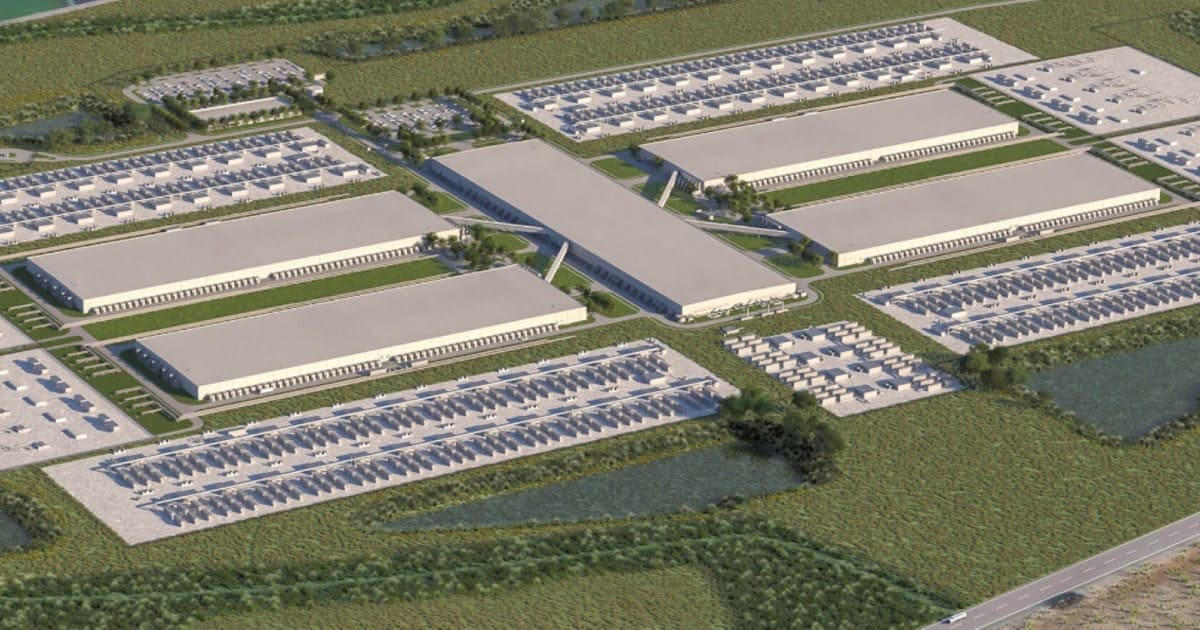
Get ready for the story of how Meta Platforms, the company behind Facebook and Instagram, is raising a vast amount of money to build a data center in Louisiana. This project, called Hyperion, promises to be one of the largest of its kind and is focused on supporting artificial intelligence. According to reports from Bloomberg, Reuters and The Information, Meta is working with investment firm Blue Owl Capital on financing totaling nearly $30 billion (approximately CZK 697.5 billion). It is the largest private capital deal in history, all driven by the need for massive computing power for AI.
How is this colossal project being financed?
An entity associated with Meta Platforms sold more than $27 billion (about CZK 627.75 billion) in debt at an interest rate of approximately 2.25 percentage points above the yield on U.S. Treasury bonds. This debt, due in 2049, is being used to finance a special purpose vehicle (SPV) worth roughly $30 billion (CZK 697.5 billion), which is responsible for constructing the Hyperion data center. According to Bloomberg and Reuters, the package includes more than $27 billion in debt and about $2.5 billion (CZK 58.125 billion) in equity. PIMCO, a bond market giant, is leading the offering and selling it to a broader group of investors with the assistance of investment bank Morgan Stanley, which is acting as the sole bookrunner and financial adviser.
Lenders to this SPV will receive an interest rate of around 6.8%, based on the current yield on 30-year U.S. Treasury bonds. By comparison, Meta Platforms' publicly traded bonds due in 2054 yield about 5.4%. Meta Platforms shares ownership of this SPV with Blue Owl Capital, with Meta retaining only a 20% stake while Blue Owl holds the majority. This arrangement helps Meta Platforms move construction costs off its own balance sheet, according to Bloomberg. A Meta Platforms spokesperson did not respond to a request for comment on the bond pricing, which was first reported by Bloomberg.
Details of the Hyperion data center
The Hyperion data center is being built in Richland Parish, Louisiana, and is expected to be completed by 2029. According to reports from Bloomberg and Reuters, it could eventually consume up to five gigawatts of power, an enormous amount—enough to power millions of homes. It covers more than four million square feet (approximately 371,612 square meters), and the entire project is a key part of Meta Platforms' efforts to build infrastructure for advanced AI workloads. Meta Platforms will be the developer, operator and tenant of the center, ensuring that it remains under the company's control even though ownership is shared with Blue Owl Capital.
This deal is rated A+ by S&P, indicating investment-grade quality, and the bonds are fully amortizing with maturity in 2049. According to Reuters, Meta Platforms is not raising the capital directly; instead, it is being financed by an entity under the SPV structure, an increasingly common approach for large projects. PIMCO is acting as the lead lender, and several other investors will receive portions of the debt in a 144A format.
Hyperion's location
Louisiana is becoming an attractive location for tech giants thanks to its energy resources and available space. Hyperion is not Meta Platforms' only project—the company recently announced a $1.5 billion (about CZK 34.875 billion) investment in a data center in El Paso, Texas, its 29th facility globally. In August, Reuters reported that Meta Platforms had approached PIMCO and Blue Owl Capital to raise $29 billion (approximately CZK 674.25 billion) for the data center expansion, a deal that is now nearing completion. This transaction underscores how hyperscalers such as Meta Platforms are accelerating the construction of AI infrastructure to keep pace with growing demand for computing power.
The entire bond pricing process took place on October 16, 2025, according to Bloomberg, marking the final stage of this record-breaking deal. Meta Platforms, Blue Owl Capital and Morgan Stanley did not respond to requests for comment, but details from these sources paint a picture of an ambitious plan that could transform the U.S. data center landscape.
Sources: reuters.com, bloomberg.com and theinformation.com


