

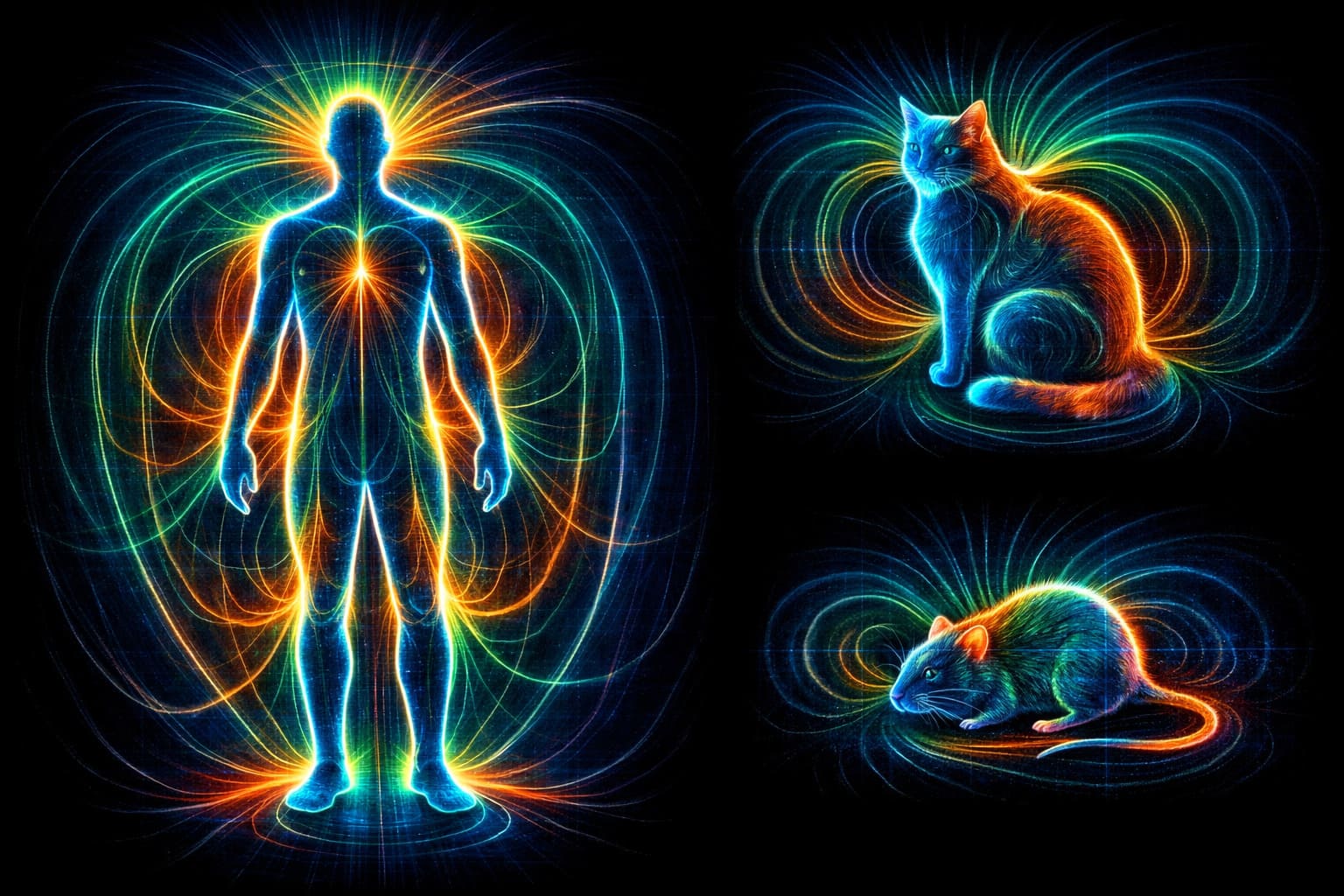
Have you ever wondered why birds or sea turtles can navigate thousands of kilometers without a map? The answer lies in magnetoreception—the ability to sense the Earth's magnetic field. This trait has evolved in many organisms and helps them survive. Magnetotactic bacteria have chains of magnetite that act like built-in compass needles. Honeybees use magnetite in their abdomens for orientation. The American cockroach responds to specific radio frequencies, suggesting a magnetic sense. Fruit flies have a cryptochrome-dependent magnetic compass under blue light. Monarch butterflies use a time-compensated magnetic compass for migration. Loggerhead sea turtle hatchlings orient themselves in artificially modified magnetic fields. Carp spontaneously align themselves north-south in ponds. And so on. What about humans? A 2019 study showed that alpha waves in EEG respond to rotations of the Earth's magnetic field.
Biomagnetism produced by living organisms
Biomagnetism refers to magnetic fields generated by living organisms. Weakly electric fish generate pulsed currents with magnetic fields on the nanotesla scale, recorded directly near the fish. Earthworms produce biomagnetic fields from action potentials in giant axons, detectable by magnetic resonance spectroscopy. Gulls have action currents in giant axons that generate fields with strengths ranging from 10⁻¹⁰ to 10⁻⁹ T, measured using toroidal coils. Frogs have action potentials in the sciatic nerve that produce fields ranging from picotesla to 10⁻¹⁰ T, recorded by SQUIDs and optical magnetometers. Humans routinely have biomagnetic signals measured: cardiac fields (magnetocardiography), brain fields (magnetoencephalography), skeletal muscle fields (magnetomyography), and peripheral nerve fields (magnetoneurography).
Meta AI and decoding thoughts
Magnetoencephalography (MEG) maps brain activity by recording magnetic fields from natural electrical currents in the brain using sensitive magnetometers. Researchers at Meta trained models on public MEG data and decoded the thoughts of study participants. They were able to convert brain activity from the magnetic field into images and words with millisecond precision. This means that the brain's magnetic field represents a highly faithful analog record of the current state of the mind that can be decoded across different brains.
The question is: Why wouldn't the brain read its own magnetic field? Evolution often makes use of available signals. Magnetite biomineralization is an ancient process that organisms use to create perfect ferrimagnetic crystals. The human brain produces ferrimagnetic crystals within a narrow size range that could resonate with neural oscillations (brain waves). This stochastic resonance would make it possible to overcome the Earth's magnetic field, which is 50 to 500 million times stronger than the brain's. The crystals could thus read and potentially modulate the brain's own field.
Locus coeruleus
The locus coeruleus (blue spot) is a small part of the brain near its center that synthesizes norepinephrine. This chemical affects alertness, focus, and brain plasticity. Its projections extend into the spinal cord, brainstem, cerebellum, hypothalamus, hippocampus, thalamic relay nuclei, amygdala, basal telencephalon, and cortex. Norepinephrine has an excitatory effect on most of the brain, priming neurons for stimuli. It influences wakefulness and the sleep cycle, attention and memory, behavior and cognitive flexibility, creativity, personality, behavioral inhibition, stress, cognitive control, decision-making, emotions, neuroplasticity, posture and balance, as well as responses to major violations of assumptions about the world.
Alongside natural magnetic crystals in the brain, pollution particles enter through the nose and olfactory nerve. These particles from urban dust have various shapes and sizes. Above a certain size, they would disrupt resonance with the brain's field. This could lead to problems with learning and memory and reduced locus coeruleus activity. Air pollution is associated with Alzheimer's disease, with evidence of causality. The earliest signs of Alzheimer's disease pathology appear specifically in the locus coeruleus.
AI is the key to understanding the brain
Researchers at Meta have shown how the brain's magnetic field can be decoded into specific images and words. They trained these models on public magnetoencephalography (MEG) data, which recorded magnetic signals from electrical currents in the brain. With millisecond precision, they were able to convert these signals into visual or verbal representations of the study participants' thoughts—for example, images people were imagining or words they were hearing. This suggests that the brain's magnetic field is not merely a by-product but contains rich, readable information about our thoughts. If AI can interpret this field and extract meaningful data from it across different people, why wouldn't the brain itself use this signal for its own "reading" and optimization? This discovery by Meta opens the door to the question of whether our consciousness arises from precisely this kind of internal communication, in which the brain reads its own global state—all thanks to artificial intelligence, which has demonstrated this to us in practice for the first time.


