Liquid AI has released two open-weight models that evaluate predefined options instead of writing an answer. d1-3B accepts text and images, while the experimental d1-omni-600M accepts text paired with either images or audio. For classification tasks, they return structured probabilities directly, removing the need for applications to process a generated text response.
Three ways to ask a decision question
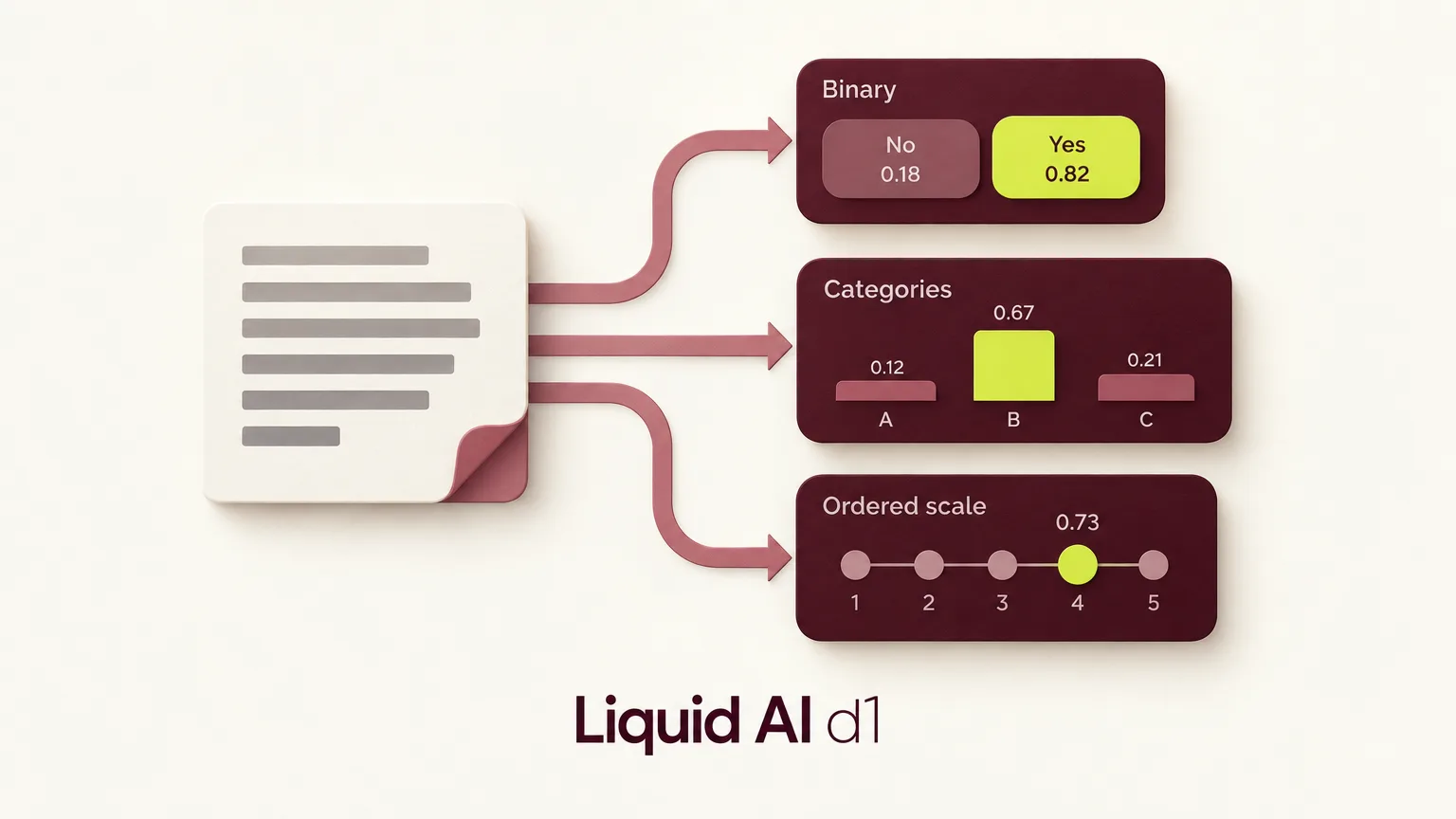
At the heart of d1 is a single model pass that evaluates the options supplied in a request and returns calibrated probabilities. It generates no tokens in the process. The interface provides three question types, depending on whether an application needs a binary decision, a category selection, or a rating on an ordered scale.
Noul handles yes-or-no questions, returning a probability from 0 to 1. Possible uses include detecting spam and approving tool calls. Choice instead assigns probabilities to named options: a customer support request could be assigned to billing, technical support, or account management.
Score evaluates input against an ordered rating scale and returns a probability-weighted position. It can be used to estimate severity, urgency, or response quality. Several questions can also share an input and inference request—for example, identifying a customer's intent, choosing the appropriate team, and assessing urgency together.
The options defined by the caller determine the scope of use. d1 does not produce free-form text and is not intended for multi-turn conversations, summarization, code generation, or open-ended questions and answers.
Two architectures for different inputs
d1-3B is based on LFM2.5-VL-3B and uses a decoder-only architecture for text and image processing. The experimental d1-omni-600M has 600 million parameters and is based on LFM2.5-Encoder-350M. It uses a bidirectional encoder with image and audio components, accepting text combined with either images or audio.
Latency on GeForce and Jetson hardware
Liquid AI reports single-question latency for d1-3B of 8 ms on NVIDIA GeForce RTX 4090 and 9 ms on AMD MI325X. For MI325X, the company also reports throughput of 1,106 packed input states per second. That throughput figure applies to batching, whereas the latency measurements apply to one question.
On NVIDIA Jetson AGX Thor, Liquid AI reports 16 ms for one question and 20 ms for three questions in a shared request. The company's single-question figures are 26 ms on NVIDIA Jetson AGX Orin and 50 ms on NVIDIA Jetson Orin Nano.
Text tests and comparisons with Decider models
According to Liquid AI, d1-3B scores 48.57 on the public split of Decision Index v0.2.1, a composite benchmark for decision models. The company says it leads among models with fewer than 10 billion parameters. It also describes the performance as comparable to Decider 35B-A3B, which it calls 12 times larger.
Across seven public text benchmarks, Liquid AI reports an average score of 82.9 for d1-3B, compared with 81.1 for Decider 4B. The tested areas include reading comprehension and intent classification, as well as toxicity detection, medical question answering, and cross-lingual understanding.
For the experimental d1-omni-600M, Liquid AI reports a Decision Index v0.2.1 score of 15.95. In specialized text tasks, the company reports 95.8 for toxicity detection on Civil Comments and 79.5 for paraphrase identification on PAWS-X.
The hosted API returns a selection and confidence
The hosted model is accessible through the system_one endpoint. A call supplies an input state, typed questions, and optional images; the response provides a probability distribution, the selected answer, and a confidence value. Applications can set explicit thresholds to process high-confidence cases automatically and pass ambiguous inputs to another model or a human.
A request can include up to eight images and 10,000 image patches measuring 32 × 32 pixels. The hosted API offers a paid d1 tier with image support and a text-only d1:free tier, with Liquid AI billing image processing at 1.5 tokens per patch.
Open weights, llama.cpp, and a camera demo
Both models are available on Hugging Face under open-weight licenses. The release includes llama.cpp support for hardware from Apple, AMD, Qualcomm, and NVIDIA, including the NVIDIA NVFP4 format. Jetson AI Lab has published model cards for edge deployment.
Liquid AI also provides a live demo featuring ten camera-based examples. These include gesture-controlled games and content moderation in which the model runs one forward pass for each frame.