
LG Introduces Exaone Deep: The First Korean AI Model for Logical Reasoning
The South Korean technology giant enters the global artificial intelligence competition with a model that excels in mathematics and logical reasoning
At a time when the world of artificial intelligence is undergoing a revolution with models capable of logical reasoning, LG has unveiled a breakthrough for the South Korean technology sector. On March 18, 2023, LG AI Research revealed the Exaone Deep model, the first South Korean artificial intelligence model specialized in logical reasoning, putting South Korea on the map of global competition in this rapidly developing field.
The New Generation of AI: From Memory to Logical Thinking
Unlike conventional artificial intelligence models, which search for answers in pre-trained data, Exaone Deep represents a new generation of AI systems. These so-called "reasoning AI" models can imitate the human way of thinking - they proceed step by step through a logical process to arrive at solutions to problems they have never encountered before.
"This is a revolution in the approach to artificial intelligence," explains an AI expert. "While traditional models are essentially sophisticated search engines in vast databases of learned information, reasoning AI actually 'thinks' similarly to a human when solving a new problem."
Exaone Deep: Impressive Performance with Fewer Parameters
The main model, Exaone Deep-32B, has 32 billion parameters. Compared with competitors such as China's DeepSeek R1 with 671 billion parameters, it may seem relatively modest - it represents only about 5% of the size of its Chinese counterpart. Parameters in AI models function like neurons in the human brain - the more there are, the more complex tasks the model can theoretically handle, but at the cost of higher computational demands.
Despite this apparent disadvantage, however, Exaone Deep-32B achieves remarkable results. In benchmark tests, it surpassed or matched much larger models, particularly in mathematics and scientific reasoning:
It achieved a score of 90 in the 2024 American Mathematics Olympiad, surpassing DeepSeek-R1 (86.7) and Alibaba QwQ-32B (86.7)
In the mathematics section of South Korea's 2025 university entrance exam, CSAT, it achieved the highest score of 94.5 among all tested models
It achieved a score of 66.1 in solving doctoral-level scientific problems, surpassing Alibaba QwQ-32B (63.3)
This success underscores a growing trend in AI research: optimizing performance while reducing the number of parameters. With fewer parameters, models require less computing power, consume less energy, and are more efficient overall.
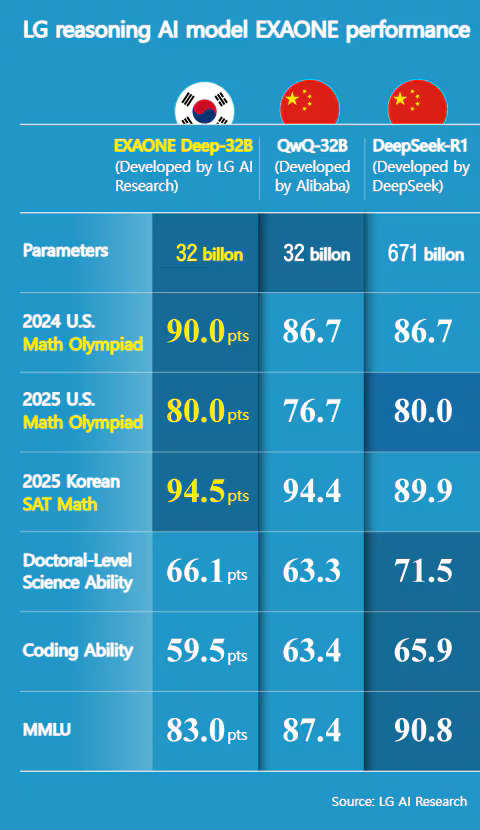
For more information about the results, visit www.lgresearch.ai
Weaknesses in Language and Coding
Although Exaone Deep-32B excels at mathematical and scientific tasks, it lags behind the competition in language abilities and programming. In the Massive Multitask Language Understanding (MMLU) test, it achieved a score of 83, which is lower than Alibaba (87.4) and DeepSeek (90.8).
"AI models for logical reasoning are primarily designed to solve mathematical and scientific problems, so their language abilities naturally lag behind those of larger models," explains an industry expert. This specialization shows that even in the era of general-purpose AI models, there is room for systems optimized for specific types of tasks.
Lightweight Versions for Different Needs
LG AI Research did not stop at the main model. It also introduced two smaller variants:
1. Exaone Deep-7.8B - a lightweight version with only 24% of the size of the main model, while retaining 95% of its performance
2. Exaone Deep-2.4B - an ultra-compact model for deployment directly on devices, achieving 86% of the main model's performance at just 7.5% of its size
These smaller models show that LG is focusing on the practical deployment of AI in real-world products and devices, where factors such as model size, energy consumption, and response speed are crucial.
Internal Use Instead of Public Deployment
Unlike companies such as OpenAI or Anthropic, which offer their models to the public through services such as ChatGPT, LG plans to use Exaone Deep only internally to develop its own products. Although the company has released the model's source code as open source for developers, similarly to what DeepSeek did, the model itself will not be publicly available.
This decision is primarily economic - deploying an AI model for public use on the scale of services such as ChatGPT would require massive investments in data centers and infrastructure, worth at least several trillion won (hundreds of millions to billions of crowns).
Wider Context: LG AI Research and EXAONE
Exaone Deep represents another step in LG's ambitious AI strategy. LG AI Research was established in December 2020 as the artificial intelligence research center of South Korea's LG Group, with the aim of leading a new era of AI and contributing to the realization of a promising future.
As early as 2021, LG AI Research developed its first large-scale AI, EXAONE - a multimodal model with an impressive 300 billion parameters. EXAONE, whose name means "Expert AI for Everyone," is distinguished by its ability to process both language and visual data, setting it apart from many competing models.
With one of the world's largest capacities for learning from data, LG AI Research aims to improve business decisions through its state-of-the-art artificial intelligence technologies and continuous efforts in fundamental AI research.
South Korean Competition in AI
LG is not the only South Korean company investing in the development of advanced AI models. In 2023, technology giant Naver introduced its HyperCLOVA X model and has since reduced the number of parameters by approximately 60% while simultaneously improving its logical reasoning performance. The company also stated that the operating costs of the new model had improved by more than 50%, and it is working on a specialized AI model for logical reasoning.
Leading South Korean AI startup Upstage has also recently begun full-scale development of AI for logical reasoning, showing that the South Korean technology sector recognizes the strategic importance of this technology.
Conclusion: A New Chapter in Global AI Competition
The introduction of the Exaone Deep model marks an important milestone for the South Korean technology sector and underscores the growing global competition in artificial intelligence. While American companies such as OpenAI and Anthropic and Chinese firms such as DeepSeek and Alibaba have dominated discussions about advanced AI models, LG's entry shows that other regions can also contribute significant innovations.
LG's ability to create a model that outperforms much larger systems in some areas also illustrates an important trend in AI research: it is not just about the size of the model, but about its efficiency and specialization. At a time when the environmental and economic impacts of energy-intensive large language models are being discussed more and more, LG's approach represents a potentially more sustainable path forward.
Whether the future of artificial intelligence belongs to gigantic general-purpose models or specialized, efficient systems, one thing is certain - the competition is expanding and innovations are coming from all over the world.